
Lieferung heute & morgen

Qualitätsgarantie

Willkommens-Angebote freischalten: KOSTENLOSE Lieferung | Bis zu 80 % RABATT | Kostenlose 30-Tage-JoyPlus-Testphase
App herunterladen
An Ohuhu Dual Tip Art Marker Set 40 Colours may initially seem like a versatile basic kit for creative projects. In practice, however, it is not simply the number of colours or eye-catching packaging that determines whether a marker set is genuinely practical for everyday drawing. For drawings, bullet journals, scrapbooking and hand lettering, the key factors are the tip design, ink base, paper compatibility and storage.
A large number of colours does not automatically mean a well-balanced palette. Some sets contain numerous similar shades, while lacking light pastels or high-contrast neon colours. If you want to colour illustrations or structure a journal, it is therefore important to look at the actual colour selection.
The Ohuhu set includes 40 numbered colours and, according to the product description, also contains pastel and neon colours. The numbering makes it easier to find colour combinations again. An enclosed DIY colour chart can be completed on your own paper before use. This is important because the on-screen display may differ from the colour that later appears on paper.
The term dual-tip marker initially only tells you that two tips are included. For versatile use, the tips should perform different functions:
The Ohuhu Dual Tip Art Marker Set 40 Colours is specified as having a 0.4-mm fine tip and a 1–5-mm brush tip. This means each pen can handle both fine lines and larger areas. For highly technical drawings or extremely consistent lines, separate fineliner pens with several fixed line widths may still be useful.
Even quick-drying ink can show through thin paper or bleed at the edges. Choosing the right paper is therefore an important factor:
According to the product description, the 40-piece set uses low-odour, water-based and quick-drying ink. The properties acid-free and non-toxic, as well as certification to ASTM D-4236, are also stated. This information comes from the product details. The ink may still stain surfaces and textiles, and should not come into contact with the eyes or be swallowed.
If you want to combine brush pens, fineliners and lettering pens in one product, you should check the tip sizes. A flexible brush tip allows different line widths depending on the pressure applied. A fine tip, on the other hand, supports controlled details, small lettering and outlines.
For beginners, a combination of brush and fine tips is usually easier to understand than a set with several almost identical tips. For manga, technical sketches or very small illustrations, an additional fineliner set ranging from 0.05 to 1.0 mm may be useful.
Water-based ink is practical for many journalling and craft projects, as it is typically less odorous than solvent-based alternatives. However, drying time, colour coverage and show-through remain important considerations. Descriptions such as “quick-drying” or “bleed-resistant” should not be taken as a guarantee for every type of paper.
With watercolour markers, it is also important to make a distinction: not every water-based marker is automatically designed for pronounced watercolour techniques. If you want a soft colour gradient, test the marker first on suitable paper with a water brush or damp brush.
A marker set can quickly become disorganised in everyday use if there is no colour chart or the pens cannot be stored securely. The Ohuhu set includes a DIY colour chart and a portable PP storage box with handle. According to the care instructions, the pens should be stored horizontally, in a dry place and away from direct sunlight. Both caps must be replaced firmly after every use to prevent the tips from drying out.
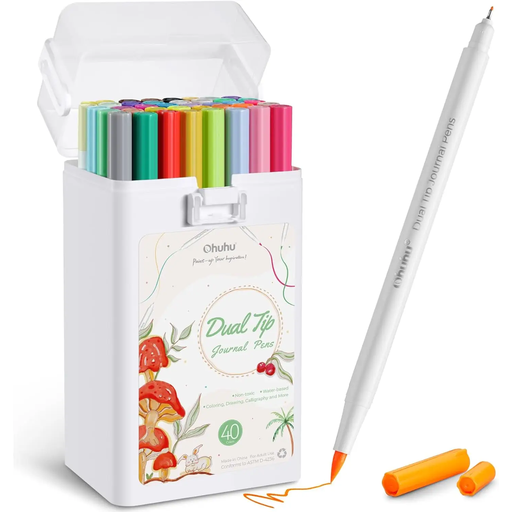
Why this product suits the profile: The set combines 40 colours with a brush tip and fine tip in each pen, making it suitable for first drawings, journalling, hand lettering and craft projects.
The different tips reduce the need for several separate types of pen. Numbered colours and the colour chart help distinguish between similar shades.
40 colours, 0.4-mm fineliner and 1–5-mm brush tip; PP box with handle for storage and transport.
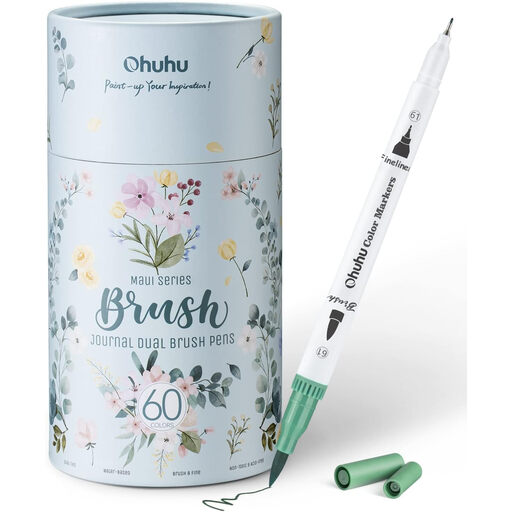
Why this product suits the profile: For users who want a larger colour palette and additional replacement tips, this set offers more choice for illustrations and colour gradients.
The 60 numbered colours and colour chart make selection easier. According to the product description, five replacement tips are included; paper compatibility should nevertheless be checked in advance.
0.4-mm fineliner and 1–6-mm brush tip; 60 water-based colours plus three brush and two fineliner replacement tips.
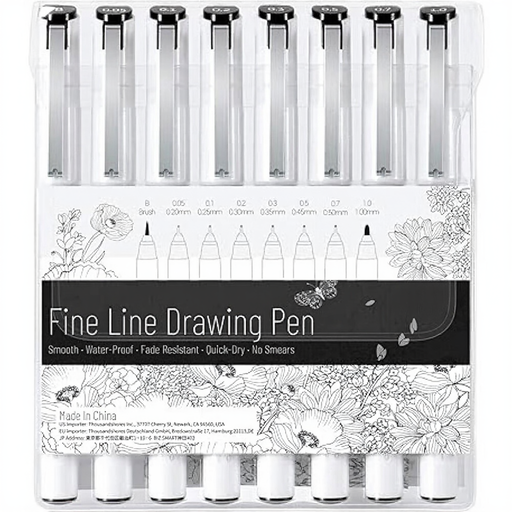
Why this product suits the profile: For detailed drawings, manga, sketches and users who need additional black lines in different widths alongside the 40-colour set.
The different tips, ranging from 0.05 to 1.0 mm, eliminate the need to use a single fine marker tip for every detail.
Seven different fineliner tips plus one brush tip; according to the product description, quick-drying, water-resistant black ink.
A marker’s lifespan depends greatly on how it is used and stored. To ensure the most consistent performance possible:
Children under three years of age face a risk of swallowing caps or other small parts. Children should only use the markers under supervision, in accordance with the product warnings. Ink may stain surfaces and clothing.
We have put together a complete, regularly updated list of products that fully meet these strict selection criteria and the safety regulations applicable in the EU.
The combination of a 0.4-mm fineliner and brush tip is generally suitable for headings, colour coding, small illustrations and hand lettering. As the ink may show through, the paper should be tested beforehand.
Replace both caps fully after every use and store the pens horizontally in a dry place protected from light. Do not leave the caps off for extended periods.
Water-based ink can be partially worked with water on suitable, heavier paper. The result depends on the paper, ink coverage and drying time. Testing before using the markers on a finished project is recommended.