If you need a little extra warmth at your bedroom desk from time to time, first check that you have a safe, clear place to position a heater. Then choose a power output and controls to suit your needs. According to the manufacturer, the De’Longhi TRNS0505M has a 500 W output, while the De’Longhi TRRS0920 offers up to 2,000 W. At the same running time, a higher output can mean higher electricity costs. If you need to heat your room regularly for many hours, a portable oil-filled radiator won’t necessarily be a budget-friendly option: your actual usage time and electricity tariff are what matter.
Who is an oil-filled radiator suitable for?
People with limited space at their desk
If there’s little room left beside your desk and bed, or around textiles, the dimensions and positioning instructions for the specific appliance matter. A compact design doesn’t replace the need for safety clearances; VdS Schadenverhütung warns of the fire risk posed by electric heaters that aren’t positioned correctly.
People who want gentle warmth while they work
An oil-filled radiator could be an option if you want extra warmth during longer periods of work without the airflow from a fan heater. Compare the thermostat and heat settings, but don’t assume they guarantee a particular room temperature.
Occasional users keeping an eye on running costs
If you only want extra heat during occasional work sessions, you can estimate the cost based on the power consumption, actual running time and your electricity tariff. The ADAC identifies running time and your household electricity tariff as key cost factors.
What should you look for when buying?
First check that you have a safe place for the radiator. Then compare its controls, running costs and heat output with how you plan to use it.
| What matters |
What to check when buying |
Who will find this important? |
| A safe place to position it |
Positioning instructions, required clearances and stability; a tip-over switch may be an additional feature. |
If my space is limited by a desk, bedding or paper, I want to know whether the appliance can be positioned safely. Around 29% of consumers would check space and safety first. |
| Gentle, adjustable heat |
Check whether the specific model has a room thermostat and how many heat settings it offers. Treat claims that it is “quiet” as manufacturer statements, not independent noise measurements. |
During longer work sessions, I want to adjust the heat to suit my needs without the airflow from a fan heater. Around 29% of consumers rank adjustable heat as their top priority. |
| Running costs |
Check the power consumption, expected running time and your electricity tariff. For a rough estimate, multiply the power in kW by the number of hours and the unit rate per kWh. |
If I only use extra heating occasionally, I want to estimate the cost using my tariff and a realistic running time. Around 24% of consumers weigh up running costs first. |
| The right heat output |
Compare the room volume and existing heating with the details for the specific model. The manufacturer’s information doesn’t guarantee that it will suit your room. |
For my bedroom, I want to avoid choosing a heater whose extra heat isn’t enough for my specific needs. Around 18% of consumers say the right heat output is their top priority. |
Common misconceptions
-
Assuming heat retention means lower electricity use
The oil continues to give off heat after the radiator is switched off, but it doesn’t generate any extra energy. That stored heat doesn’t automatically make the radiator an economical way to heat a room continuously.
Compare the power consumption and a realistic usage time, and calculate the cost using your own electricity tariff rather than relying on broad promises of savings.
-
Looking only at the width of the appliance
Desk legs, paper, bedding and cables can all limit where you can position a heater safely. A narrow design alone doesn’t tell you whether there’s enough space to leave the required clearances.
Measure the space you plan to use and check the positioning instructions for the specific model before you buy. Don’t assume that clearances for other types of heater also apply to oil-filled radiators.
-
Taking conflicting thermostat information at face value
For the ECG OR 2090, the main product text describes continuously adjustable thermostat control, while the technical specifications say “Thermostat: No”.
If a thermostat is important to your decision, check the feature for the exact version on offer before you buy.
Brands and models at a glance
De’Longhi
The specifications for the Nano TRNS0505M and Radia S TRRS0920 let you compare lower and higher rated power outputs.
- De’Longhi lists an output of 500 W for the TRNS0505M and up to 2,000 W for the TRRS0920, along with three heat settings and a room thermostat.
- The stated room volumes of 15 and 60 m³ are manufacturer specifications, not a guarantee of performance in a particular room. These features don’t automatically apply to other models from the brand.
Clatronic
The RA 3735 has three heat settings and is designed for occasional use as an additional source of warmth.
- For this model, Clatronic lists settings of 600, 900 and 1,500 W, a thermostat control, castors, overheat protection and a tip-over switch.
- Clatronic says the model is suitable for well-insulated rooms or occasional use; this isn’t an independent assessment of its heating performance.
ECG
The OR 2090 adds a nine-fin model with three heat settings to the comparison.
- ECG lists settings of 750, 1,500 and 2,000 W for the OR 2090, as well as wheels. The product page describes the model as quiet; this is a manufacturer statement, not an independent noise measurement.
- The product page gives conflicting information about the thermostat. If this feature matters to you, check it before choosing the specific model.
Oil-filled radiators at Joybuy
This selection features oil-filled radiators with a range of heat settings for occasional extra warmth at your desk. The models vary in rated power, design and stated features.
 No image available
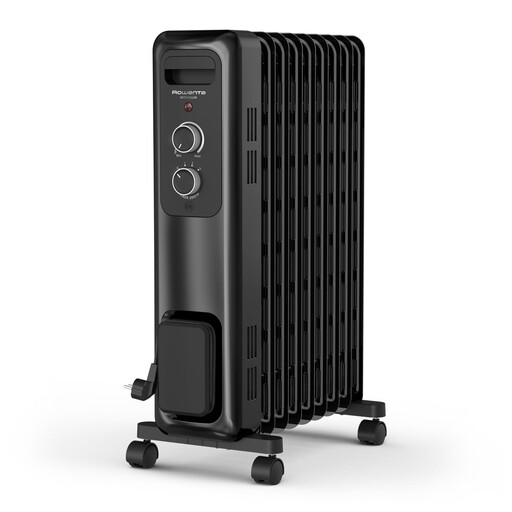
Rowenta Intensium Ultra BU2420
An option if you’re looking for a higher heat output and have enough space to position it.
The product description lists 2,000 W, three heat settings, an adjustable thermostat, eight columns, castors, and tip-over and overheat protection. It specifies a minimum distance of 1 m from flammable materials such as furniture and bedding.
View at Joybuy
 No image available
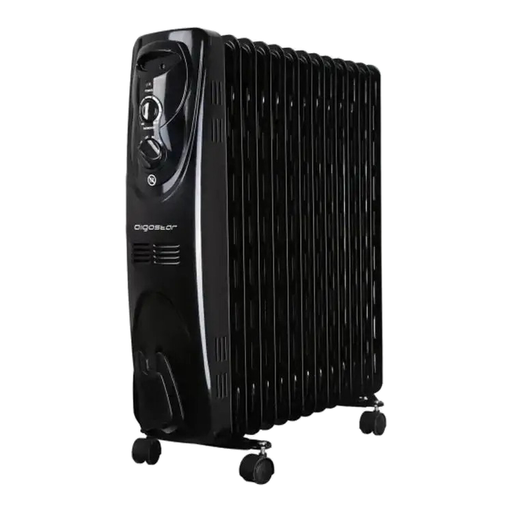
Aigostar oil-filled radiator with 13 fins
A possible option if you want to use different heat settings and move the appliance around.
The product description lists settings of 1,000, 1,500 and 2,500 W, an adjustable thermostat, castors and a carry handle. Tip-over and overheat protection are also specified.
View at Joybuy
 No image available
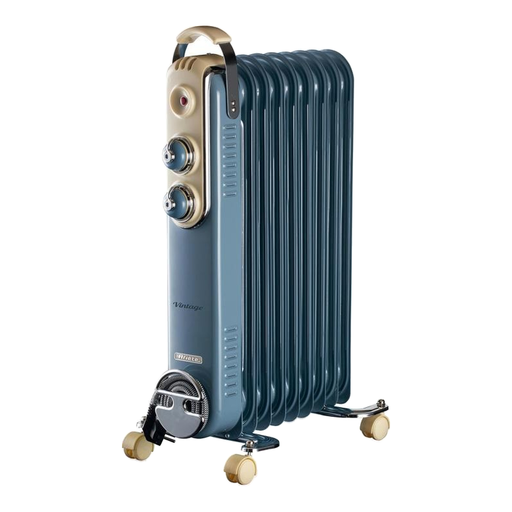
Ariete oil-filled radiator with 9 elements, blue
An option if its stated dimensions fit your available space and you want to choose between different heat settings.
The description lists 2,000 W, three adjustable heat settings, overheat protection and automatic shut-off. The stated dimensions are 40 × 12 × 67 cm.
View at Joybuy
 No image available
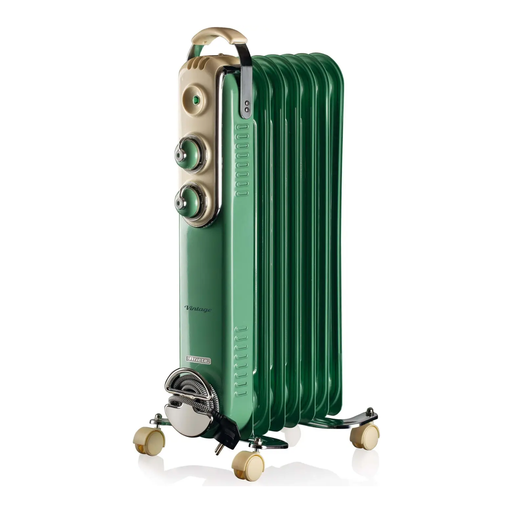
Ariete Vintage oil-filled radiator, 1,500 W, 7 fins, green
An option for occasional extra warmth if you want to move the appliance between rooms.
The product title lists 1,500 W and three settings. The description specifies a handle and four castors.
View at Joybuy
 No image available
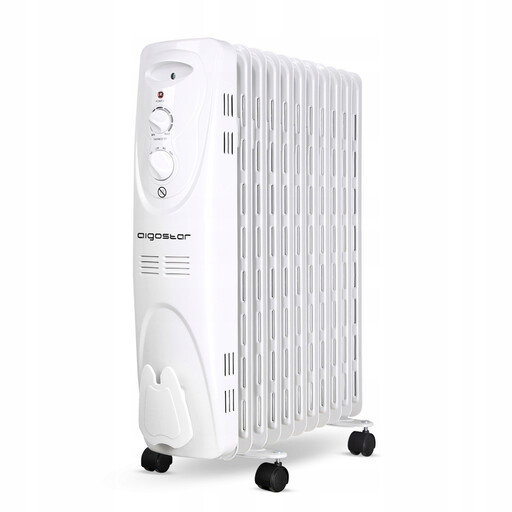
Aigostar oil-filled radiator with 11 fins, 2,300 W
Could be an option for occasional extra warmth if the room is well insulated and your intended use matches the product information.
The product description lists settings of 1,000, 1,300 and 2,300 W, an adjustable thermostat, castors, and tip-over and overheat protection. It states that the appliance is intended only for well-insulated indoor spaces or occasional, short-term heating.
View at Joybuy
Frequently asked questions
Can I put an oil-filled radiator directly under my desk or next to my bed?
Only if you follow the instructions for the specific appliance and keep airways and clearances around furniture, paper and bedding unobstructed. VdS Schadenverhütung warns generally about electric heaters that aren’t positioned correctly. The minimum clearances it gives for fan heaters and radiant heaters aren’t blanket recommendations for oil-filled radiators.
Is a small oil-filled radiator enough for my bedroom?
Compare your room size, existing heating and need for extra warmth with the information for the specific model. De’Longhi lists an output of 500 W and a room volume of 15 m³ for the TRNS0505M; this doesn’t guarantee that it will be suitable for every room of that size.
How can I estimate the electricity costs before buying?
Multiply the actual power consumption in kW by the number of hours it will run and your unit rate in euros per kWh. At full power throughout, a 2,000 W heater uses 2 kWh in one hour; thermostat breaks and other heat settings will affect actual consumption. The ADAC identifies running time and your own electricity tariff as cost factors.
What should I bear in mind when plugging it into an extension lead?
Don’t overload extension leads or plug them into one another. VdS Schadenverhütung warns that powerful electric heaters can cause an overload. Check the power requirements and follow the instructions for your chosen radiator; an extension lead isn’t a substitute for a suitable electrical connection.
Which EU rules apply to electric oil-filled radiators in Germany?
Since 1 July 2025, electric local space heaters within its scope have been subject to Regulation (EU) 2024/1103 on ecodesign requirements; the previous Regulation (EU) 2015/1188 applied until 30 June 2025. The European Commission doesn’t list electric local space heaters among the products covered by its energy labelling rules for certain other local space heaters. This doesn’t establish whether an individual product complies with the rules.


