For a single cool room that only needs extra warmth now and then, an oil-filled radiator could be a good fit, provided its output, footprint and safe positioning are right for the space. Don’t choose based on the highest wattage alone. If you plan to use it for several hours every day, weigh up the electricity costs based on how long it will run and your tariff. If you need warm air straight away, a fan heater may be a better option.
Who is an oil-filled radiator suitable for?
Occasional room heaters
If you want to give a single cool room a little extra warmth from time to time, compare the heat settings with the room’s heating needs and how long you plan to use the radiator. ADAC notes that an oil-filled radiator continues to give off heat for a while after it has been switched off.
Cost-conscious supplementary heaters
If the appliance will be running for several hours, electricity costs depend on its power consumption, actual running time and your electricity tariff. ADAC highlights operating time as an important factor in energy consumption.
People with limited space
If you have little spare floor space or want to move the radiator between rooms, check its dimensions and features such as castors or a carry handle before buying. Follow the instructions for the specific model when positioning it.
What should you look for when buying?
First, consider how much warmth the room needs for occasional use and where the appliance can be positioned safely. Then compare its heat settings, controls and expected running time with your electricity tariff.
| Buying consideration |
What to check before buying |
Who is it important to? |
| Suitable heat output |
Compare the room size, insulation and existing heating with the heat settings and thermostat of the specific model. |
If I only want to give a cool room extra warmth now and then, it matters to me that the output and controls suit my needs. Around 33% of consumers are likely to prioritise a suitable heat output. |
| A safe place to position it |
Follow the instructions on suitable rooms and clearances; check the cable condition and the safety features specified for the particular model. |
In a small flat, I want to know in advance where I can position the radiator safely and whether the cable and plug are undamaged. Around 27% of consumers are likely to put safe positioning first. |
| Electricity costs |
Use the power rating in kilowatts, planned hours of use and your electricity tariff to make a rough estimate. |
If I plan to use the appliance for several hours, I want to be able to estimate the running costs on my tariff. Around 20% of consumers are likely to focus above all on predictable running costs. |
| Quiet operation and portability |
Consider whether instant warm air or fan-free operation matters more; compare dimensions, weight, castors and handle. |
If I move between rooms or want to avoid fan noise, the design and portability are key. Around 20% of consumers are likely to place particular importance on quiet operation or being able to move the appliance. |
Avoid common buying mistakes
-
Assuming residual heat means free or inherently more economical heating
The heat an oil-filled radiator gives off after being switched off was generated using electricity. On its own, this does not give it a consumption advantage over another heater meeting the same heating needs.
Compare how long you plan to use it, the actual heating needed and your electricity tariff, rather than focusing only on how long the appliance stays warm. ADAC identifies operating time as an important factor in energy consumption.
-
Choosing the largest appliance based only on its maximum wattage
Wattage alone does not show what output your particular room needs. The models listed differ in various respects, including rated output and controls.
First consider the room, insulation, planned heating time and available floor space. Then compare the heat settings and thermostat controls of each model.
-
Planning to use occasional supplementary heat as your main heating
Clatronic describes the RA 3735 and RA 3737 models as suitable for well-insulated rooms or occasional use. ADAC categorises portable electric heaters as supplementary heating.
If a room is consistently too cold, check the existing heating and estimate the electricity needed for longer periods of use based on your tariff.
Brands to consider
De’Longhi
The Radia-S range includes oil-filled radiators with mechanical controls. The TRRS0920 is one model to consider if you want to compare heat settings and castors.
- De’Longhi lists a maximum output of 2000 W, three heat settings, a room thermostat and castors for the TRRS0920.
- These details apply to the TRRS0920 model and are not an independent measurement of heating performance or a claim about the brand as a whole.
Clatronic
The RA 3735 and RA 3737 models have different stated maximum outputs, offering a basis for comparing options for different heating needs.
- Clatronic lists three heat settings up to 1500 W for the RA 3735 and three up to 2300 W for the RA 3737; both have a thermostat.
- The manufacturer describes both appliances as suitable for well-insulated rooms or occasional use. Wattage alone cannot tell you whether a model is right for your room.
DREO
The OH310S is worth considering if you want to compare adjustable temperature settings and a timer.
- DREO lists 2000 W, a temperature range of 5 to 35 °C and a 24-hour timer for this model.
- The energy savings promoted by the manufacturer are not an independently verified comparison or a guaranteed reduction in electricity costs.
Ariete
The Vintage oil-filled radiator 0837 is a design-led alternative with castors.
- Ariete lists three heat settings and says the radiator can be moved using its handle and castors.
- The model and colour code may vary by version, so check them against the specific listing.
Oil-filled radiators at Joybuy
The following Joybuy products are oil-filled radiators designed to provide extra warmth in a cool room. Compare their heat settings and controls with your actual heating needs, and check the available floor space and safe-use instructions.
 No image available
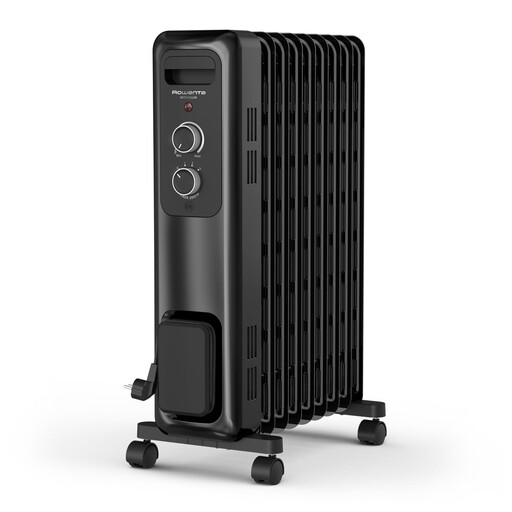
Rowenta Intensium Ultra BU2420 oil-filled radiator
Three heat settings and an adjustable thermostat give you options for occasional extra warmth; castors are listed for moving the radiator.
The description lists eight fins and quiet operation. According to the product description, keep it at least 1 m away from flammable materials, do not cover it, and do not use it in a bathroom, near water or outdoors.
View at Joybuy
 No image available
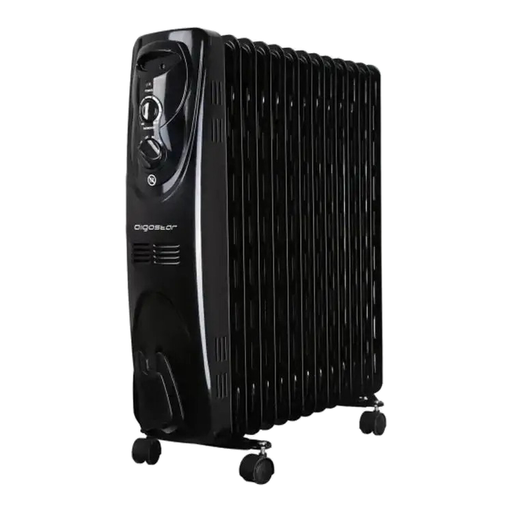
Aigostar 13-fin oil-filled radiator, black
Three heat settings and a thermostat let you adjust the output to suit your needs; castors and a carry handle are listed for moving it around.
The listed settings are 1000 W, 1500 W and 2500 W. According to the product description, it is for indoor use only. Do not cover it or use it near a bath, shower or swimming pool.
View at Joybuy
 No image available
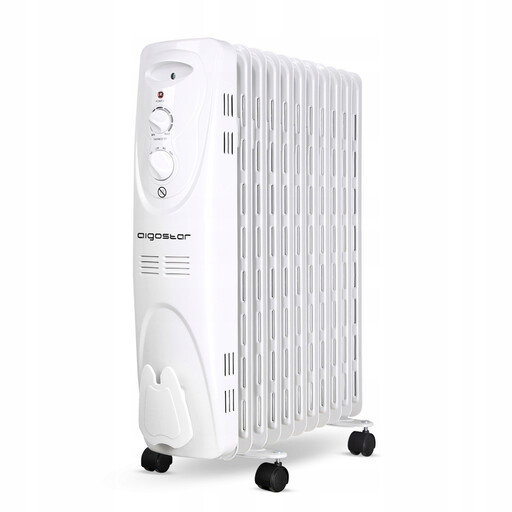
Aigostar 11-fin oil-filled radiator, 2300 W, white
Three heat settings, an adjustable thermostat and four swivel castors are listed, giving you the option to adjust the heat and move the appliance around.
According to the description, it is intended for well-insulated rooms or occasional use. Fit the castors before use, position the radiator upright on a stable surface and do not cover it.
View at Joybuy
 No image available
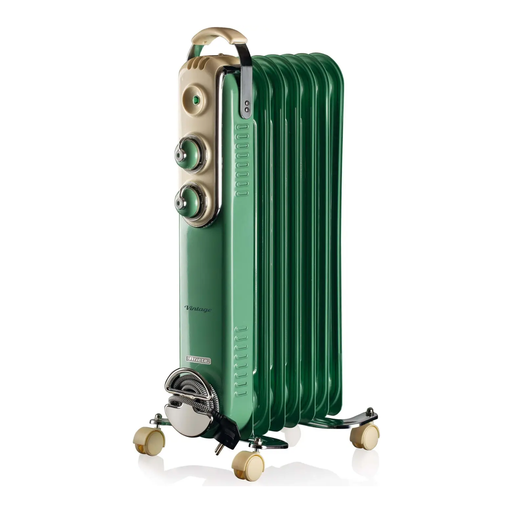
Ariete Vintage oil-filled radiator, 1500 W, 7 fins, green
Three heat settings, a carry handle and four swivel castors are listed if you want to move the radiator between rooms.
According to the product description, place the appliance on a stable, level surface. Do not cover it while it is in use or position it near flammable materials.
View at Joybuy
 No image available
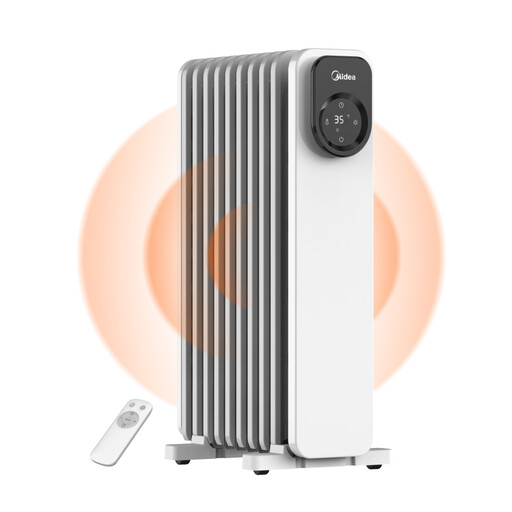
Midea NY2009-24UR oil-filled radiator, 2000 W, 9 fins
A thermostat, four modes, a remote control and an LED touchscreen are listed if you value having several ways to operate the appliance.
The product description lists 2000 W and says it is suitable for well-insulated rooms or occasional use. Keep it at least 1 m away from flammable materials, do not cover it, and do not use it in damp areas or outdoors.
View at Joybuy
Questions about oil-filled radiators
How can I estimate the electricity costs?
Multiply the power actually used in kilowatts by the hours of operation and your unit rate per kilowatt-hour. At full power, a 2000 W setting uses 2 kWh in an hour. Thermostat breaks can affect actual consumption. ADAC notes that operating time is relevant to energy consumption.
Can I use an oil-filled radiator as soon as I unpack it?
First, check the instructions for the specific model and fit the castors if needed. Choose a permitted location and do not use an appliance with a damaged cable or visible scorch marks. The German Fire Service Association warns against using damaged electrical appliances.
Do I need to top up the oil in an oil-filled radiator?
An oil-filled radiator heats its oil electrically and does not need fuel in the way a fuel-burning appliance does. Follow the instructions for the specific model if it needs maintenance or develops a fault, and do not open it to try to top up the oil.
Does an electric oil-filled radiator need an EU energy label?
The European Commission describes the energy labelling rules under Regulation (EU) 2015/1186 as excluding electric local space heaters from their scope. This does not indicate how much energy a particular model uses, nor does it exempt it from other applicable product requirements.
What does the CE marking mean on a new oil-filled radiator?
Electrical products covered by Germany’s low-voltage regulations must meet safety and conformity requirements. The Federal Institute for Occupational Safety and Health explains the voltage range covered by the Low Voltage Directive. A CE marking does not replace checking the specific product listing yourself. Check the marking and product documents on the actual appliance.


