What should you look for when choosing one?
First check the space available and how you plan to use the radiator. Then compare the controls and power rating, and work out the likely cost based on how long you expect to run it.
| What matters |
What to check when buying |
Who is this important to? |
| Extra warmth at your desk |
Compare the space available, model dimensions, rated power, heat settings and thermostat with your intended use. |
If I mainly want to warm up my workstation when it gets chilly, suitable heat output in a limited space matters. Around 32% of consumers prioritise this. |
| Safe positioning in a shared room |
Follow the instructions and warnings on where to place the appliance; don’t treat safety features as a substitute for suitable positioning. |
If other people share the room, I want to find a spot where the appliance can be used in accordance with its instructions. Around 31% of consumers prioritise safe shared use. |
| Electricity costs with regular use |
Multiply the power rating in kilowatts by the actual hours of use, then calculate the cost using your own price per kilowatt-hour. |
If I switch the radiator on regularly, I want to estimate its potential energy use in advance and factor it into my running costs. Around 25% of consumers prioritise running costs. |
| Moving and storage |
Check the specific model’s dimensions, weight, handle or castors, and cable storage; follow the instructions when moving it. |
If I want to keep the desk area clear after use, it matters how easy the appliance is to move and store. Around 12% of consumers mainly look for flexibility when moving it. |
Oil-filled radiators at Joybuy
The Joybuy options below are oil-filled radiators with higher rated power and adjustable settings. Check whether this type of appliance suits your heating needs at your desk and the shared space it will be used in.
 No image available
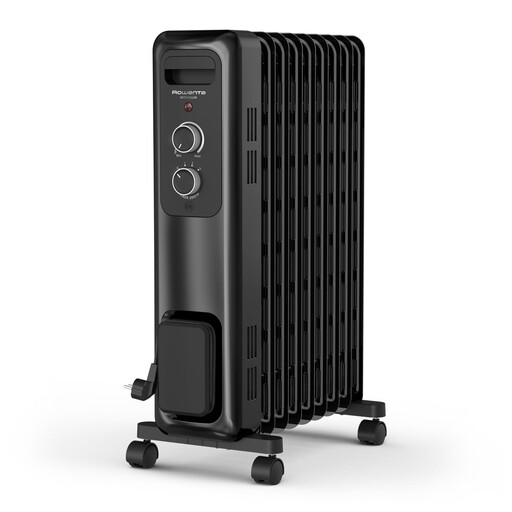
Rowenta Intensium Ultra BU2420 oil-filled radiator
Three heat settings and an adjustable thermostat let you tailor the settings to your heating needs.
The product description lists 2000 W, eight columns and castors. The instructions say to place it on a stable, level, heat-resistant surface, not to cover it and to keep it at least one metre away from combustible materials.
View at Joybuy
 No image available
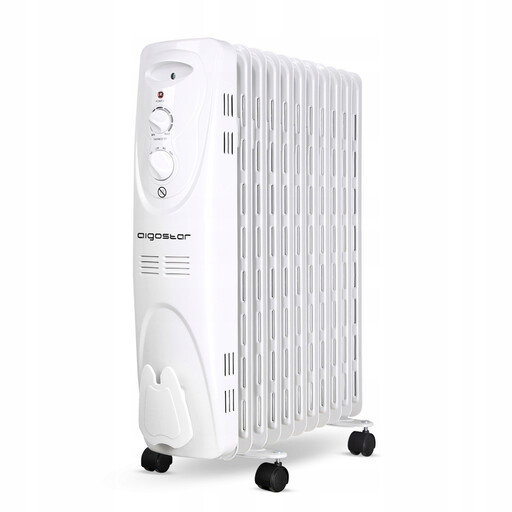
Aigostar 11-fin oil-filled radiator, 2300 W
Three heat settings and an adjustable thermostat give you options for changing supplementary heating needs.
The listed settings are 1000, 1300 and 2300 W, and it has four swivel castors. The instructions state that the appliance is intended for well-insulated, enclosed rooms or occasional short-term heating; the castors must be fitted before use.
View at Joybuy
 No image available
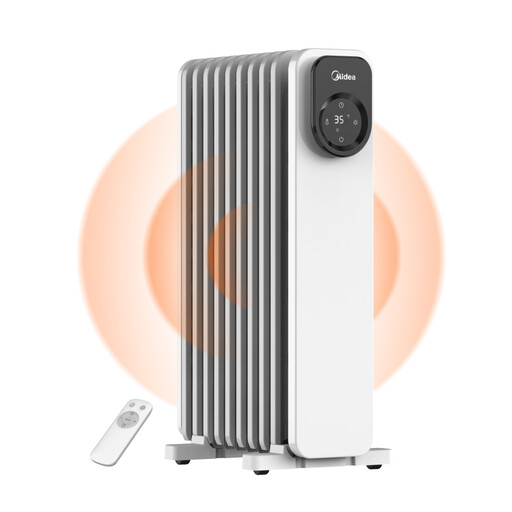
Midea NY2009-24UR oil-filled radiator, 2000 W
The thermostat and four modes let you tailor the settings to how you want to use the appliance.
The title lists nine fins, a remote control and an LED touchscreen; the description specifies 220–240 V and 50 Hz. The description states that the appliance is intended for household use, not commercial use. The instructions require at least one metre of clearance from combustible materials; before moving it, switch it off, unplug it and let it cool completely.
View at Joybuy
Frequently asked questions
How do I work out the electricity cost of using a radiator at my desk?
Multiply the power rating in kilowatts by the actual hours of use and your electricity price per kilowatt-hour. A 2000 W appliance running continuously for an assumed hour would use 2 kWh; thermostat cut-outs will affect the actual figure. This is an example calculation, not a measured consumption figure or a general price estimate.
What should I bear in mind when positioning it and moving it later?
Read the instructions for the exact model, including guidance on where to position it, how to connect it, warnings and transport. The Federal Institute for Occupational Safety and Health (BAuA) lists using appliances as intended and checking their condition as basic precautions. This does not establish a single minimum distance that applies to every model mentioned here.
Do I need to top up the oil regularly?
For the Tristar KA-5103, the manufacturer says its sealed oil system does not need an oil change. Don’t assume this applies to every model; if the appliance is damaged, follow the instructions and customer service guidance for that specific version.
What labels and documents should I check when buying?
Look for the CE marking, identifiable product and manufacturer details, and instructions in German with the necessary usage and warning information. The German Federal Network Agency explains that CE is a declaration made by the manufacturer under its own responsibility, not an independent product test. For electric room heaters, the European Commission lists Regulation (EU) 2024/1103; according to the Commission’s guidance, the revised ecodesign requirements have generally applied since 1 July 2025.
How should I dispose of an oil-filled radiator that has reached the end of its life?
In Germany, waste electrical appliances must not be put in household waste. The Federal Environment Agency lists local collection points and, subject to the relevant take-back conditions, retailers as return options.


