Who is an oil-filled radiator suitable for?

People living with a cold external wall

If a wall feels damp or you notice mould, you should investigate the cause as well as heating the room. The Verbraucherzentrale recommends finding and eliminating the cause of mould, while the Umweltbundesamt highlights the importance of the surface temperature of walls and windows.

Occasional users keeping an eye on costs

If you only need extra warmth now and again, you can estimate the potential running cost using the rated power and your electricity tariff. The ADAC notes that the actual cost depends on the price of electricity you pay.

People with limited space

In a small room, the appliance’s dimensions, the space you need to move around and the safety clearances specified in the instructions all need to fit. Measure the space you have in mind before choosing a model.

What should you look for when buying?

Concern What to check when buying Who is this important to?
Cold walls and damp Look for damp patches or mould and check whether your existing heating is working properly. If I notice damp or marks, I don’t want to assume that raising the room temperature will solve the problem. Around 36% of consumers focus on finding the cause of cold or damp walls.
Electricity costs during longer use Calculate rated power in kW × hours of use × your price per kWh; don’t assume that thermostat breaks will definitely save you money. If the radiator will be running for several hours, I want to estimate the potential cost using my electricity tariff. Around 29% of consumers prioritise ongoing electricity costs.
Enough extra warmth Take the room’s dimensions, existing heating and heat loss into account; only rely on stated room-size guidance when it applies to the conditions specified. If my existing heating does not warm the room enough, I want to choose an appliance suited to my actual heating needs. Around 21% of consumers pay particular attention to getting enough extra warmth.
Space and a safe position Check the appliance’s dimensions, the cable route and the clearances stated in the instructions; do not cover the appliance with textiles. In a small room, I want to position the appliance without blocking walkways and while keeping to the required clearances. Around 14% of consumers prioritise a compact supplementary heater that can be positioned safely.

Oil-filled radiator buying pitfalls

  • Thinking more watts will solve cold walls

    An oil-filled radiator can add warmth to a room, but it will not fix damp or an underlying structural issue with the wall. If the cause remains, you could use more electricity without resolving the problem.

    Keep an eye on the wall and investigate any damp or mould before choosing a heater based on how cold the room feels alone.

  • Mistaking the oil’s residual warmth for electricity savings

    The oil continues to release stored heat after the radiator is switched off, but it does not generate extra energy. Electricity costs depend, among other things, on power consumption and how long the appliance runs.

    Compare the likely running time with your price per kilowatt-hour, and don’t rely on claims about energy-saving modes without comparable consumption data.

  • Choosing a compact 500 W model just because of its size

    The manufacturer describes the Tristar KA-5103 as suitable for targeted heating in well-insulated rooms or for occasional use. This does not prove that it can adequately heat an entire room with high heat loss as the main source of heating.

    Check the intended use of the specific model, and don’t assume that a room-size recommendation for another appliance applies.

Brands to consider

De’Longhi

The Radia-S range includes oil-filled radiators. For the TRRS0920, De’Longhi specifies up to 2,000 W, three heat settings, a room thermostat and a safety thermostat.

  • For the TRRS0920, the manufacturer specifies a room capacity of 60 m³.
  • The manufacturer’s figure does not guarantee that a room with high heat loss will be adequately warm.

Tristar

According to the manufacturer, the KA-5103 is a compact 500 W oil-filled radiator with five fins for targeted or occasional heating.

  • The manufacturer lists a thermostat, overheat protection and dimensions of 24 × 14 × 38 cm for this model.
  • The manufacturer describes it as suitable for well-insulated rooms or occasional use, not as a proven main heater for a room with high heat loss.

Taurus

According to Taurus, the New Dakar 2000 is a 2,000 W oil-filled radiator with nine heating elements, three heat settings, a thermostat and wheels.

  • The manufacturer lists overheat protection for this model.
  • The manufacturer’s claim of “up to 20 m²” does not prove that it will adequately warm a particular room with cold walls.

ECG

The OR 2090 is available with three heat settings of 750, 1,500 and 2,000 W.

  • The product page lists wheels.
  • The ECG product page describes continuously adjustable thermostat control, but its specifications table says “Thermostat: No”. Check how the controls work in the instructions before buying.

Oil-filled radiators at Joybuy

These models are oil-filled radiators for occasional extra warmth. Before choosing one, check that its power, dimensions and intended use are suitable for your room.
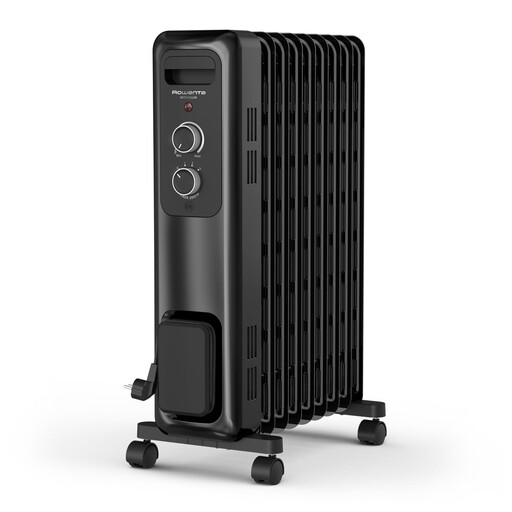
Rowenta Intensium Ultra BU2420 oil-filled radiator

Rowenta Intensium Ultra BU2420

For occasional extra warmth, the product description lists 2,000 W, three heat settings and an adjustable thermostat.

It is listed as having eight heating columns and wheels. According to the description, place it on a stable, level, non-flammable surface and at least 1 m away from flammable materials. Do not cover it or use it in a bathroom or outdoors.

View at Joybuy
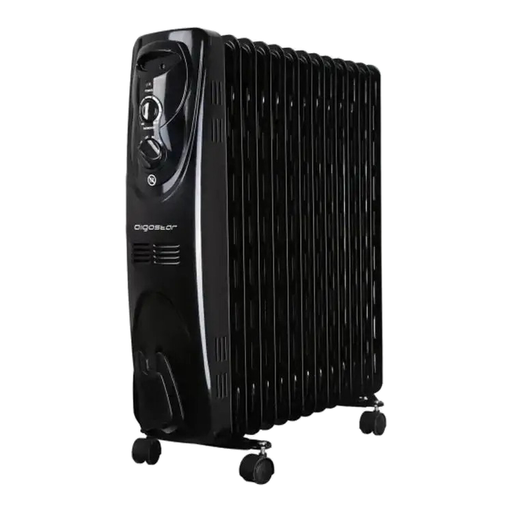
Aigostar 13-fin oil-filled radiator

Aigostar 13 Fins Oil Filled Radiator

For adjustable extra warmth, the product description lists three heat settings and thermostatic control.

The stated power is 2,500 W; it is also listed as having 13 heating fins, wheels and a carry handle. The dimensions are given as 61 × 28 × 64 cm. Do not cover it while in use, and do not use it outdoors or near a bath, shower or swimming pool.

View at Joybuy
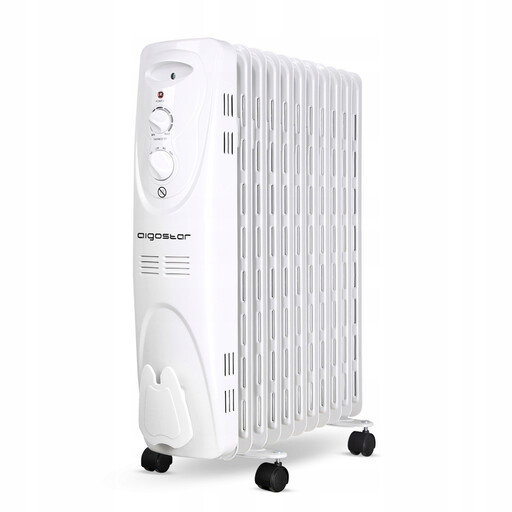
Aigostar 11-fin oil-filled radiator, 2,300 W

Aigostar 11-Fin Oil-Filled Radiator Heater, 2300 W

For occasional extra warmth, the product description lists three heat settings up to 2,300 W and an adjustable thermostat.

According to the description, the model has 11 heating fins, four swivel castors and measures 530 × 280 × 640 mm. It is intended for well-insulated rooms or occasional, short-term use. Do not cover it, and only operate it in an upright position.

View at Joybuy
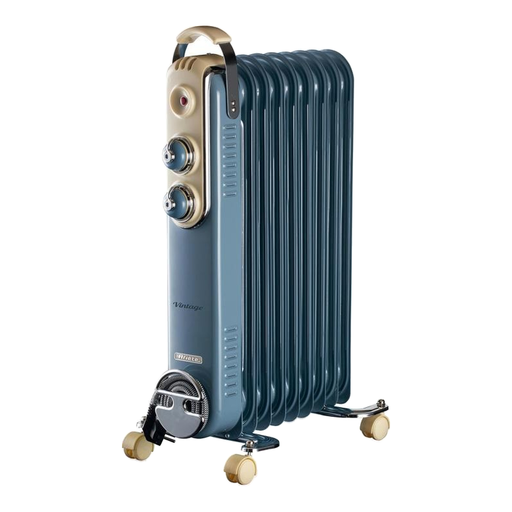
Ariete 9-element oil-filled radiator for indoor use

Ariete 9-element oil-filled radiator

For occasional extra warmth, the product description lists 2,000 W and three heat settings.

This model is described as a 9-element oil-filled radiator for indoor use, with dimensions of 40 × 12 × 67 cm and a weight of 6,6 kg. According to the description, place it on a level, stable surface and away from flammable materials. Do not cover it while in use.

View at Joybuy
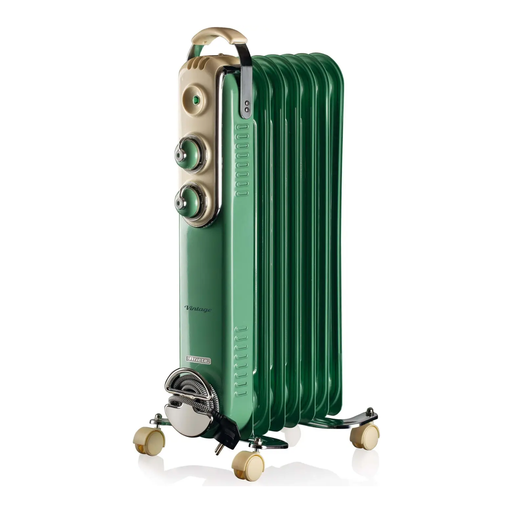
Ariete Vintage oil-filled radiator, 1,500 W, 7 fins

Ariete Vintage Oil Radiator, 1500W, 7 Fins

For occasional extra warmth, the product title lists 1,500 W and three heat settings.

According to the title, the model has seven fins; the description lists a carry handle and four swivel castors. Place it on a stable, level surface and away from flammable materials. Do not cover it while in use.

View at Joybuy

Frequently asked questions

Will an oil-filled radiator prevent mould on a cold external wall?

No, you shouldn’t rely on it to do that. Heating and ventilating appropriately can help control damp, but if you find damp or mould, you need to investigate the cause and, where necessary, deal with it. The Verbraucherzentrale and Umweltbundesamt point out that extra warmth in the room will not fix a building defect.

Does the oil in the Tristar KA-5103 need topping up regularly?

No. According to Tristar, the KA-5103 is a sealed system and its oil does not need changing. Follow the manufacturer’s instructions for other models, and never try to open a damaged appliance yourself.

How can I work out the potential electricity cost?

Multiply the power in kilowatts by the number of hours the appliance is running and your price per kilowatt-hour. At 2 kW for one hour, the calculation would be 0,80 € at 0,40 €/kWh. The ADAC published this example price on 27 January 2026; it is not a tariff for your household.

What labelling and documents should a new appliance for Germany have?

Electrical products covered by the Low Voltage Directive, including appliances with a rated voltage between 50 and 1.000 V AC, must meet the relevant safety requirements. Check the specific appliance for CE marking and the required instructions and safety information in German. The Bundesanstalt für Arbeitsschutz und Arbeitsmedizin and the Bundesnetzagentur explain these requirements; CE marking alone is not an independent safety test.