Guests comparing calories
You want to stick with salted pretzels and find a lower-calorie option among similar products. To do that, compare the kcal per 100 g rather than looking only at the bag size.


If you want to choose pretzel snacks with fewer calories for Oktoberfest, compare the nutrition information per 100 g for similar products and decide how much you’ll have. The product information from REWE, Lorenz and EDEKA puts the classic salted wheat pretzels considered here at 384 to 408 kcal per 100 g. A lower calorie count doesn’t necessarily mean less salt.
You want to stick with salted pretzels and find a lower-calorie option among similar products. To do that, compare the kcal per 100 g rather than looking only at the bag size.
You’re planning a savoury snack but also want to consider its salt content. The figures from Lorenz and EDEKA show that the salt levels vary between the products considered here.
You want to decide on a snack portion in advance, or need to check the ingredients and allergen information. A single pack can help you plan quantities; check the label on the specific pack to see whether a product meets your dietary requirements.
First, compare calories and salt on the same per-100-g basis. Then decide how much you want to serve and whether the ingredients suit your needs.
| Criterion | What to check | Who is it important to? |
|---|---|---|
| Calories | Compare kcal per 100 g and the planned portion in grams. | If I want the classic pretzel shape, I’ll look for a lower-calorie option among similar snacks. Around 32% of consumers would consider calorie content their most important buying criterion. |
| Salt | Consider the salt per 100 g and the portion you plan to serve. | If there are other salty dishes on the table for the celebrations, the salt content of my snack matters more to me than the lowest calorie count. Around 31% of consumers would put salt comparison first. |
| Portion | Check the grams per individual pack and the number of portions in a multipack. | When snacking with a group, I want to decide how much to serve beforehand rather than eating straight from the bag. Portion planning would be the main priority for around 25% of consumers. |
| Ingredients | Read the ingredients list, highlighted allergens and trace warnings on the pack. | If I need to avoid certain ingredients, my first priority is whether the specific pretzel variety suits my needs. Around 12% of consumers would prioritise this check. |
REWE lists Schär Salinis gluten-free pretzels at 482 kcal per 100 g. The gluten-free label alone doesn’t mean a product has fewer calories.
If you’re choosing a gluten-free option, also check the nutrition information and ingredients on the specific pack.
REWE lists Mayka Brezel at 384 kcal and 4.3 g of salt per 100 g; Lorenz gives 395 kcal and 3.5 g of salt per 100 g for Saltletts Brezel. Choosing by calories alone overlooks this difference.
Compare both figures per 100 g and factor in the portion you plan to have.
Lorenz also offers mini pretzels in a 40-g pack. The pack size determines the quantity, but doesn’t change the calories per 100 g.
Use the pack size to plan portions and the per-100-g figures to compare products.
Lorenz notes that packs with both older and newer recipe labels may be available in shops; EDEKA says the information on its product page may differ from the packaging.
Before buying, check the nutrition and ingredient information on the pack actually being sold.
The Saltletts range includes classic salted pretzels, other pretzel-shaped snacks and wholegrain sticks.
REWE’s ja! own-brand range includes mini pretzels in a 250-g bag.
GUT&GÜNSTIG salted pretzels are described as a 250-g product made with sea salt.
SUNSNACKS salted pretzels are listed as a 250-g variety made with sea salt.
Mayka Brezel is a classic pretzel snack in a 200-g bag.
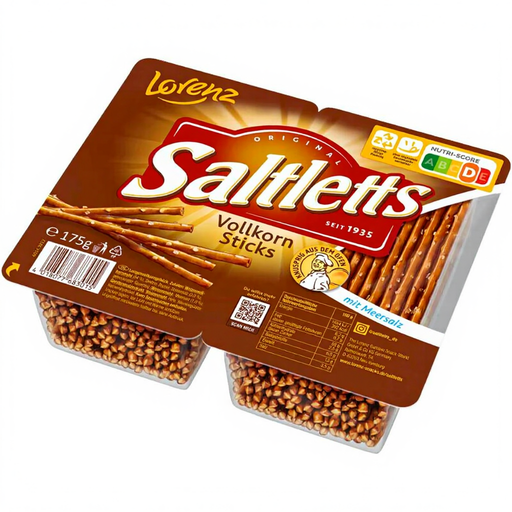
If you’d rather serve wholegrain pretzel sticks than pretzels at Oktoberfest, this 175-g pack is one option. To help you decide, compare the calorie and salt information on the pack with that of other snacks.
 No image available
An option if wholegrain pretzel sticks would suit your Oktoberfest spread and you’re happy to move beyond the classic pretzel shape.
Pack size: 175 g. For a calorie and salt comparison, check the nutrition information on the specific pack.
First compare calories and salt per 100 g, then consider how much you actually plan to serve. Lebensmittelverband Deutschland explains nutrition information per 100 g, which provides a common basis for comparing packs of different sizes.
No. REWE lists Schär Salinis gluten-free pretzels at 482 kcal per 100 g. Check the gluten-free label separately to see whether it meets your dietary requirements, and look at the calorie content too.
Read the ingredients list, highlighted allergens and any trace warnings on the specific pack. The varieties considered here have different recipes, so you can’t assume the information for one product applies to other pretzels.
Follow the storage instructions on the pack and reseal an opened bag. The best-before date applies to an unopened pack stored as directed; Lebensmittelverband Deutschland points out that it isn’t an automatic throw-away date.