
Lieferung heute & morgen

Qualitätsgarantie

Willkommens-Angebote freischalten: KOSTENLOSE Lieferung | Bis zu 80 % RABATT | Kostenlose 30-Tage-JoyPlus-Testphase
App herunterladen
A quality one-handed clamp is an indispensable tool for woodworking and DIY projects. It allows you to quickly and securely clamp workpieces with just one hand, leaving your other hand free for alignment. However, the market is flooded with models whose quality differences are hard to spot at first glance. Many buyers invest in tools that quickly prove to be unreliable.
This guide highlights the most common pitfalls to avoid when purchasing and explains which technical specifications truly matter. This will enable you to make an informed decision and find a tool that will reliably support your projects.
Before choosing a model, you should be aware of the typical weak points that often only become apparent during use and lead to frustration.
To avoid a bad purchase, you should check three core features. These are the primary determinants of the functionality and durability of a quick-grip clamp.
Clamping force, often specified in pounds (lbs) or kilograms (kg), describes the maximum pressure the clamp can generate. A value of approx. 150 lbs (68 kg) is sufficient for most woodworking applications, such as gluing up panels or securing components. However, more important than an extremely high nominal value is the stability of the guide bar. Look for models with bars made of hardened steel. These prevent bending and ensure that pressure is transferred evenly and consistently to the workpiece. A stable bar is the foundation of any reliable screw clamp or bar clamp.
The clamping capacity indicates the maximum size of the workpiece you can clamp. Before buying, measure the typical dimensions of your projects. Do you need a clamp for small crafts or for assembling cabinet bodies? Many modern one-handed clamps also offer a clamp with a spreading function. By easily reconfiguring the fixed jaw, the clamp can be used to push components apart, for example, to disassemble an already assembled frame or to align it perfectly. This dual functionality significantly increases the tool's versatility.
The clamping jaws should be equipped with removable protective pads made from a robust yet soft material like nylon. These prevent scratches and pressure marks on sensitive surfaces while providing a secure grip. The handle and release lever should be ergonomically designed to allow for comfortable and effortless one-handed operation, even with repeated use. A smooth quick-release button is crucial for efficient work.
Based on these objective criteria, we have identified several models suitable for different requirements and projects.
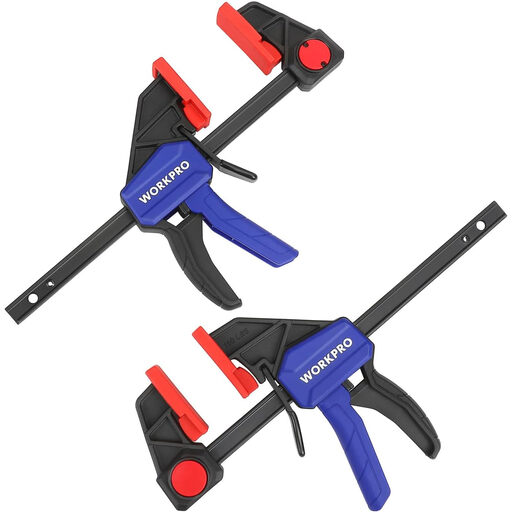
Why This Fits Their Persona: Perfect for smaller projects, crafts, and model making, where precise, easy-to-handle clamping is more important than extreme force. The one-handed clamp set provides an ideal starting point for any workshop.
The heat-treated steel bar prevents bending under load. The nylon jaw pads reliably protect delicate surfaces without slipping or leaving marks.
Convertible design with both clamping and spreading functions. The quick-release button enables true one-handed operation for rapid adjustments.
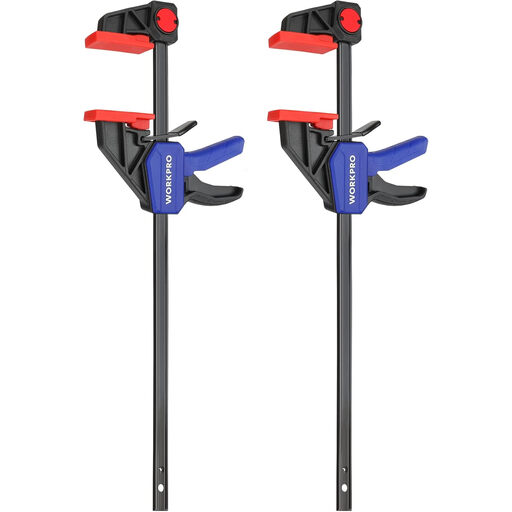
Why This Fits Their Persona: With a large 12-inch (305 mm) capacity, this set is ideal for assembling cabinets, shelves, and other large furniture pieces where standard clamps reach their limits.
The hardened steel bar maintains its stability even at the large capacity of 305 mm and delivers a consistent clamping force of 150 lbs (68 kg) without bending—a common weakness in long clamps.
Large capacity for demanding projects: clamps up to 305 mm and spreads up to 440 mm. The soft, non-marring jaw pads protect workpieces even under high pressure.
Why This Fits Their Persona: This user needs a reliable and versatile woodworking tool that is ready to use out of the box. A set of two clamps is essential for clamping panels and frames symmetrically—a prerequisite for precise results.
Instead of relying on a single, potentially unreliable clamp, this set provides two matched tools. This prevents the uneven pressure that can ruin a glue-up.
The set enables symmetrical pressure distribution, which is essential for square and flat glue-ups. Their compact size makes them universally applicable.
We have compiled a complete, up-to-date list of products that fully meet these rigorous selection criteria and safety standards.
For most DIY and woodworking projects, such as gluing boards or securing workpieces for processing, a clamping force between 110 lbs and 150 lbs (50 kg to 70 kg) is perfectly adequate. Higher force is rarely necessary and increases the risk of leaving pressure marks on soft wood. It is more important that the clamp can consistently hold the specified force without deforming.
Yes, many modern one-handed clamps feature a spreading function. The conversion is typically tool-free and can be done in seconds. Usually, you just need to release a button or a wing nut to remove the fixed jaw and reattach it to the other end of the bar. This function is particularly useful for adjusting or dismantling assembled parts.
Maintenance is straightforward. Keep the guide bar clean of glue residue and sawdust, as these can jam the mechanism. Store the clamps in a dry place to prevent rust on the metal parts. An occasional drop of oil on the moving parts of the ratchet mechanism will ensure smooth operation.