Detailed speech editing
If you repeatedly check your intros for edits and unwanted sounds, consider the tuning of the exact model. Sonarworks Support points out that each headphone model has its own frequency response.


If you record your intro in the same place where you monitor through headphones, a well-fitting closed-back model is the natural starting point: Focusrite Support says this design can help reduce sound leaking into the microphone. If you only edit in a quiet room, an open-back model is also worth considering. Whichever design you choose, check the fit, connection and familiar speech passages: the design alone doesn’t prove that the sound is neutral.
If you repeatedly check your intros for edits and unwanted sounds, consider the tuning of the exact model. Sonarworks Support points out that each headphone model has its own frequency response.
If you record your intro yourself at home and monitor through headphones as you do so, start by checking a closed-back model and how it fits at your microphone position. Focusrite Support says closed-back headphones can help reduce sound leakage.
For longer editing sessions, fit, ear pads and cable routing all matter. A manufacturer’s information about the ear pads or weight is no substitute for checking whether the specific model feels comfortable on you.
A good fit if: You monitor while recording, or room noise makes quiet speech hard to hear.
The trade-off: Isolation and comfort also depend on fit and the model; the design doesn’t guarantee neutral tuning.
A good fit if: You only edit in a quiet room, and sound escaping from the headphones won’t disturb the microphone or anyone else.
The trade-off: This design is less suited to monitoring while recording speech; it doesn’t prove that playback is neutral either.
| Priority | What to look for when buying | Who is this important to? |
|---|---|---|
| Assessing speech detail | Check assessments of the specific model’s sound and listen back to familiar speech passages. | If I repeatedly compare quiet and loud speech, I don’t want to mistake colouration for flaws in the recording. Around 36% of consumers put reliable assessment of speech detail first. |
| Isolation | For recording at a microphone, check the closed-back design and fit; at your workstation, consider whether background noise is distracting. | If I record in the same place or conversations disrupt my editing, I need a design that suits my microphone and room. Around 29% of consumers prioritise isolation when buying. |
| Comfort during long sessions | Assess the clamping force and ear pads for the length of your sessions; check whether replacement pads are available for the exact model. | When I’m editing repeatedly, I want a fit I can wear comfortably for long periods. Around 21% of consumers prioritise wearing comfort. |
| Connection and maintenance | Check that the plug and adapter match your output; check cables and spare parts for the exact version. | If I switch between my computer and audio interface, the connection and cable need to work with my existing equipment. Around 14% of consumers prioritise connection and maintenance. |
Every model has its own frequency response. In its review of the Audio-Technica ATH-M50x, HIFI.DE criticises a pronounced bass boost; this finding doesn’t automatically apply to other models.
Check reviews of the exact model and, if possible, compare familiar speech passages on a second playback system as well.
When recording, sound from your headphones can reach the microphone. Focusrite Support distinguishes closed-back models, which help reduce sound leakage, from open-back or semi-open models for quiet control rooms.
If you monitor while recording, start by checking a well-fitting pair of closed-back headphones. For editing only in a quiet room, an open-back model remains an option.
According to Focusrite Support, achievable volume also depends on factors such as sensitivity, source material and output. Plugs and cable features can also vary between versions of a model.
Check the exact model suffix, your device’s output, the plug and whether you need an adapter.
The closed-back DT 770 PRO, 80 Ohm, is an option for recording and editing in the same place. For editing only in a quiet room, the brand also offers the open-back DT 990 PRO X.
The closed-back ATH-M40x and ATH-M50x are worth considering for wired monitoring and editing at your home workstation.
Sony says the MDR-7506 is designed for studio and broadcasting environments, making it a potential option for speech production.
Yamaha describes the closed-back HPH-MT5 as suitable for studio monitoring and music production at home.
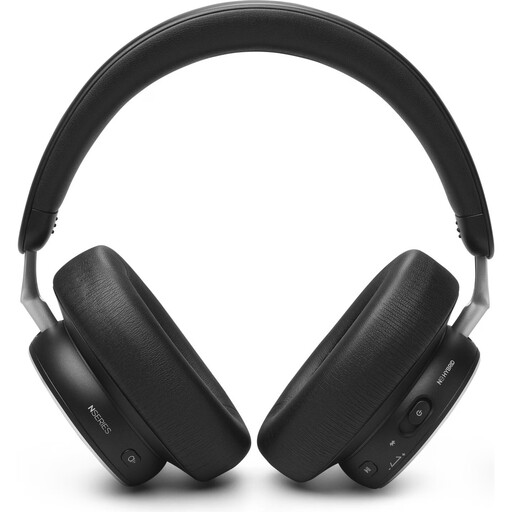
Joybuy headphones with a wired option for editing spoken intros at home.
 No image available
The closed-back, over-ear design and wired option suit monitoring close to a speech microphone; check the fit and connection with your device.
A 3.5 mm wired connection is listed. Check that it matches the output on your computer or audio interface.
If you monitor through headphones while recording, closed-back headphones are the more natural choice for helping to reduce sound leakage into the microphone. For editing only in a quiet room, Focusrite Support also mentions open-back or semi-open designs.
No, impedance alone isn’t enough. Focusrite Support also lists headphone sensitivity, source material and output as factors. Check the plug and connection, and test the volume you can reach without listening unnecessarily loudly.
Keep the volume moderate and take listening breaks. The World Health Organization illustrates the relationship between level and duration with up to 40 hours per week at an average of 80 dB; this isn’t a guaranteed safe setting for any particular pair of headphones.
According to Verbraucherzentrale, online purchases generally come with a 14-day right of withdrawal; you must notify the seller that you wish to withdraw. Statutory rights relating to faulty goods are claims against the seller, while a guarantee is offered voluntarily. For wear and tear later on, check the availability of replacement ear pads and cables for the exact model.
According to information from the Federal Ministry for the Environment, old electrical and electronic equipment must be taken to authorised collection points. These include local authority collection points, manufacturers or retailers; a local authority collection point is another option.