
Lieferung heute & morgen

Qualitätsgarantie

Willkommens-Angebote freischalten: KOSTENLOSE Lieferung | Bis zu 80 % RABATT | Kostenlose 30-Tage-JoyPlus-Testphase
App herunterladen
An open wardrobe can provide storage in small bedrooms, hallways or dressing rooms without needing to be fixed to a wall. However, open storage systems vary considerably in terms of their footprint, load capacity, materials and assembly. If you focus only on appearance, you could quickly end up with a piece of furniture that doesn’t offer enough space for everyday use or doesn’t suit the height of your room.
A telescopic clothes rail can be adjusted in width or height. Even so, measure the floor, ceiling and surrounding furniture before you buy. Low ceilings, sloping ceilings and skirting boards can all make the available space smaller than you expect.
The maximum load capacity often refers to the entire frame or assumes that weight is evenly distributed. Heavy winter coats hanging on one side can put more strain on the structure than lightweight shirts. Check whether the figures apply separately to the clothes rail, shelves and drawers, or only to the system as a whole.
An open clothes rail gives you quick access to your clothes, but it doesn’t protect them from dust like a closed wardrobe does. Without baskets, drawers or shelves, it can quickly look untidy. Extra compartments are useful for accessories, underwear and smaller items.
First, measure the width, depth and height of the space you have in mind. As well as checking the product dimensions, make sure there’s enough room to move around in front of the furniture. A compact depth of around 40 cm can work well in a narrow hallway or small bedroom, while larger systems can hold more clothes but take up more space.
If you’re choosing a freestanding wardrobe, also consider whether you’ll need to open any doors nearby. An open system doesn’t need clearance for doors to swing open, which can make it more practical in tight spaces. The height of your room will determine whether an adjustable-height clothes rail or a fixed model is the better choice.
Look for clear information about the maximum load capacity. A metal clothes rail with sturdy connectors may be designed to hold plenty of clothing, while lightweight MDF structures are generally better suited to a more limited amount of clothing and accessories. Don’t assume the stated figures for one product apply to other models.
It’s also important to distribute weight evenly:
MDF panels are easy to care for and can be cleaned with a dry or slightly damp cloth. Metal frames may be put under strain if they’re moved frequently or assembled incorrectly. Check that all the connections are secure and that the floor is level.
A coat stand with shelves or a wardrobe with drawers will usually take more steps to assemble than a simple clothes rail. Before you buy, check whether the product comes with assembly instructions and all the necessary fittings. For telescopic systems, also check whether they really can be installed without drilling, and how they’re positioned between the floor and ceiling.
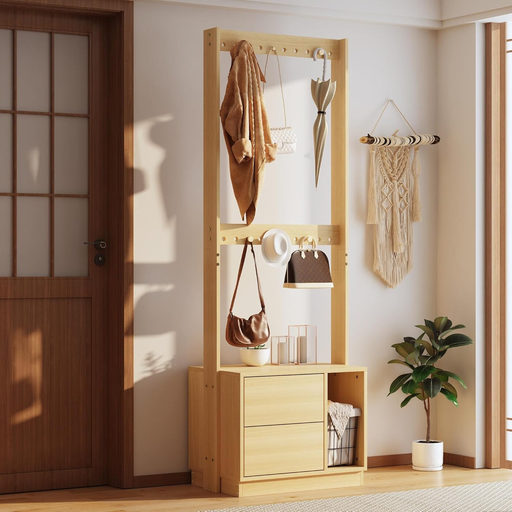
Why this product suits these needs: Its compact 60 × 40 cm footprint makes it a good fit for smaller rooms, hallways or entrances where space is limited. Two drawers add extra storage alongside the open hanging sections.
The product details specify its dimensions, materials and maximum load capacity of 5 kg. This makes it easier to match how you use it to the amount of clothing you plan to store.
MDF and metal construction, two drawers, a row of hooks and two hanging sections; dimensions: 60 × 40 × 175 cm.
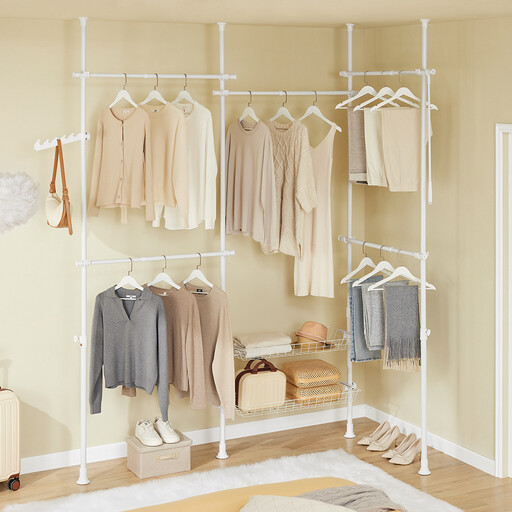
Why this product suits these needs: This telescopic system is designed for larger dressing areas or wide sections of wall. According to the product details, its width adjusts from 209 to 311 cm and its height from 200 to 295 cm.
The adjustable dimensions reduce the risk of choosing a frame that’s too short or too low. Before buying, check the room’s height and width, and make sure the surface is suitable.
Metal tubes, plastic connectors, four adjustable rails, five clothes hooks and two baskets; rated for a load capacity of up to 65 kg, according to the product details.
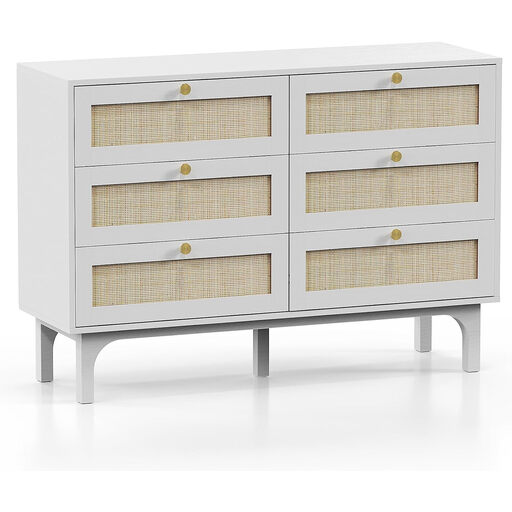
Why this product suits these needs: A chest of drawers with 6 drawers complements an open wardrobe, giving you a neat place to store folded clothes, accessories or smaller household items.
The six separate drawers mean small textiles don’t have to be left on open shelves, where they can quickly gather dust or make the space look untidy.
Six drawers and a width of 120 cm with a depth of 40 cm; suitable as an extra storage unit for a bedroom or hallway.
We’ve put together a complete, regularly updated list of products that meet these strict selection criteria and fully comply with the safety regulations in force in the EU.
Stability depends on the frame material, connectors, floor surface, assembly and how the weight is distributed. Clear information about load capacity is essential. A metal frame isn’t automatically suitable for every load; the manufacturer’s specifications for the particular model are what matter.
Use baskets, boxes or drawers for folded clothes and accessories. You can protect hanging clothes with a suitable garment cover. Wiping the shelves regularly and keeping everything neatly arranged will also help keep maintenance to a minimum.
Yes, as long as its dimensions suit the space available. A shallow design, open front and additional drawers can help with space-saving clothes storage. Before ordering, consider the floor space, room height, walkways and how much clothing you need to store.