
Lieferung heute & morgen

Qualitätsgarantie

Willkommens-Angebote freischalten: KOSTENLOSE Lieferung | Bis zu 80 % RABATT | Kostenlose 30-Tage-JoyPlus-Testphase
App herunterladen
An open wardrobe can create flexible storage in the bedroom, hallway or dressing room. Clothes stay visible, frequently needed items are easy to reach, and the assembly can be adapted to the size of your room depending on the model. Solutions that don't require permanent wall mounting are particularly appealing for rented flats and smaller households.
However, product images and general advertising claims don't always lead to the right purchasing decision. There are three typical pitfalls you should check before buying:
Before buying, measure the width, depth and height of the intended area. Also take into account doors, windows, radiators and walkways. A narrow freestanding wardrobe around 40 cm deep is better suited to a hallway than a model with several deep shelves.
With a telescopic clothes rail, the adjustment range is particularly important. A system with a width of 124 to 226 cm doesn't need a fixed alcove width, but it must stand securely between the intended surfaces in the chosen position. The room height should also fall within the specified range.
Compare the maximum total load with your actual needs. Hanging winter clothing is significantly heavier than lightweight summer textiles. You also need to check whether the figure applies to the whole system, a single clothes rail, or an individual shelf.
A clothes rail with shelves is practical if you need to store shoes, bags and folded clothes. A clothes rail with drawers offers extra storage for accessories or smaller textiles. The drawers should be able to open fully without hitting a wall or piece of furniture.
Metal tubes offer a clearly visible frame construction in open systems. Plastic connectors can simplify assembly, but they must be fully clicked into place. With MDF or chipboard surfaces, material thickness, edge sealing and care instructions are all relevant.
Read the assembly instructions before putting it together. A freestanding system should not be used as a climbing frame. Depending on the model, heavy traditional wardrobes must be secured to the wall using the supplied anti-tip fittings. With a tension-pole or telescopic system, you should regularly check that all connections are still tight.
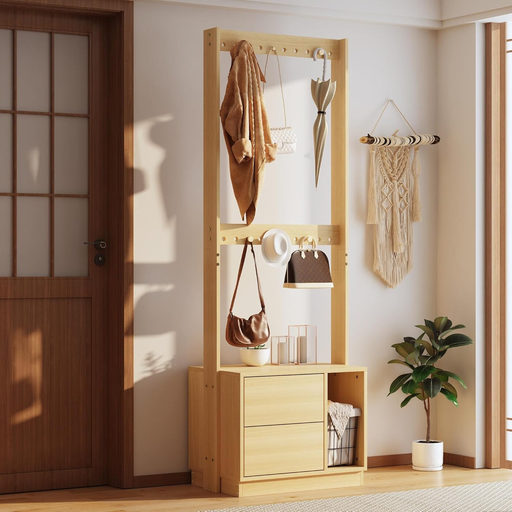
Why this product fits the profile: At 60 × 40 × 175 cm, this compact model is ideal for smaller bedrooms, hallways or entrance areas with limited floor space.
The dimensions and stated maximum load capacity of 5 kg are clearly listed. This makes it easier to plan for use with lightweight everyday clothing.
MDF and metal construction, two pull-out drawers, a hook rail and two hanging compartments. The surface can be cleaned with a dry or slightly damp cloth.
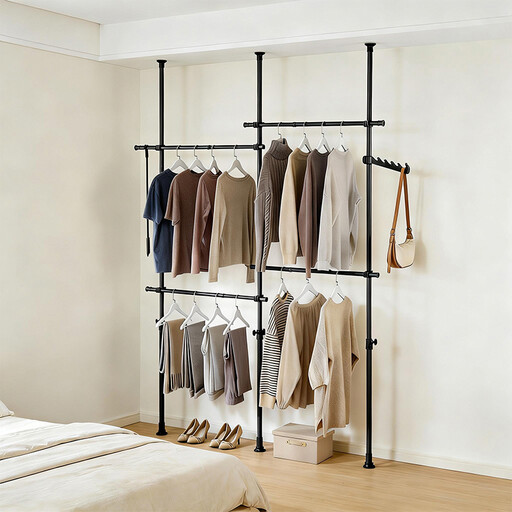
Why this product fits the profile: This system combines a wide adjustment range with multiple clothes rails and is designed for households with an extensive hanging wardrobe.
The width can be adjusted from 124 to 226 cm and the height from 200 to 295 cm. The stated load capacity is up to 65 kg; the weight should be distributed evenly.
Metal tubes, three adjustable poles, four clothes rails, side hooks and ten additional hangers. According to the product information, no wall fixing is required.
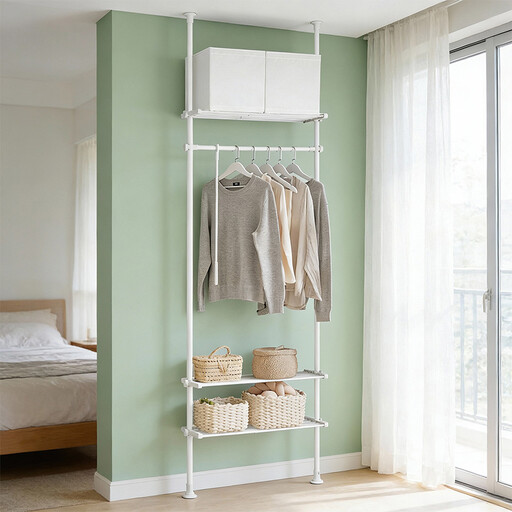
Why this product fits the profile: The narrow width of 52 to 80 cm makes use of alcoves and unused corners. Three adjustable shelves complement the clothes rail for shoes, bags or folded clothing.
The load capacity is stated as 16 kg, which limits its practical use. Before buying, you can realistically assess whether this capacity is sufficient for your intended area.
Clamp mounting between floor and ceiling, three telescopic shelves and an adjustable width of 52 to 80 cm. The construction is intended for areas where drilling should be avoided.
We've put together a complete, regularly updated list of products that fully meet these strict selection criteria and the safety regulations in force in the EU.
An open wardrobe system makes items easy to access and can be set up without extensive furniture assembly. However, clothes are on display and more exposed to dust. A traditional wardrobe protects its contents behind doors, but takes up more floor space and is often harder to move.
For a large, permanently planned wardrobe, a closed model with shelves, a clothes rail and drawers can make sense. For rented flats, seasonal clothing or changing storage needs, an adjustable clothes rail offers more flexibility. What matters isn't just the look, but the footprint, weight capacity, type of assembly and the planned amount of clothing.
Yes, provided the width and depth fit the room. Particularly narrow models or a telescopic clothes rail can make use of alcoves. Before buying, make sure you leave enough space for walking past and for opening drawers or doors.
That depends on the design. Freestanding models sit on their own feet, while tension-pole systems are fixed between floor and ceiling. Assembly must be carried out exactly according to the instructions. Check the connections regularly and do not exceed the stated load capacity.
It's not possible to give a general lifespan. It depends on the material, load, assembly and care. Even weight distribution, a dry environment and regular checks of the connections can help maintain usability. Damaged tubes, connectors or shelves should not be loaded further.