Choose a microphone based on how you’ll record the person telling their story: a lapel microphone clips to their clothing, a desk microphone works well at a fixed recording spot when they speak close to it, and a portable recorder lets you record without a laptop running. If you also want the interviewer to be clearly audible later, you’ll need a suitable setup for their voice. Before recording a private conversation, check that you’re authorised to do so; before sharing it, make sure you know who is allowed to hear it.
The right option for different needs
Recording in lively spaces
If you can hear other conversations in the room, it helps to choose a setup that lets you record the seated storyteller close to the microphone. Check the position at the actual seat and listen back to a short test recording.
Recording with a smartphone
If you want to record the conversation on the table with minimal equipment, check your smartphone’s connection, whether the recording app supports the microphone and how the cable will be routed.
Recording without a laptop at the table
A standalone recorder is worth considering if you’ll be recording in different locations. Plan where it will go and which storage media you’ll need before the conversation.
What to look for when buying
| Priority |
What to check before buying |
Who this matters most to |
| Clear speech despite room noise |
Check the microphone position and polar pattern; listen to a test recording from the intended seat. |
When I can hear other conversations as well as the storyteller, I want to capture their voice as clearly as possible. Around 28% of consumers prioritise clear speech despite room noise. |
| Recording on a smartphone |
Check the device connection, app support and cable length; also test whether the microphone rubs against clothing. |
If I want to clip the microphone to the seated person and record on a smartphone, I need a compatible connection and enough freedom to move. Around 22% of consumers prioritise discreet smartphone recording. |
| A fixed computer setup |
Check the USB connection, available desk space and whether you can monitor the audio with headphones. |
If the table is set up for recording, I want to position the microphone close enough to the person without clipping it to their clothing. Around 22% of consumers prioritise an easy setup at a fixed computer station. |
| Recording without a laptop |
Check the storage media and recording function; test the recorder in the planned location. |
If I don’t want a computer running at the interview location, I want to record directly on a standalone device. Around 17% of consumers prioritise recording without a laptop. |
| Recording both voices separately |
Check whether you need two separate microphone signals and whether the recorder and connections support them. |
If I want my questions to be clear on their own later, a microphone on the storyteller may not be enough. Around 11% of consumers prioritise having two separately audible voices. |
Common buying and recording mistakes
-
Assuming one microphone is a complete two-person recording setup
A microphone on the storyteller won’t automatically record the interviewer’s questions as a separate voice. For oral history interviews, Oral-History.Digital recommends using a lapel microphone for both the storyteller and the interviewer wherever possible.
Recording separate voices may require a second microphone and a recorder with suitable separate inputs.
Before buying, decide whether you need both voices to be audible on their own, and check how many channels the device can actually record.
-
Assuming 32-bit float will automatically make speech clear
With the Zoom H1essential, the built-in microphones are positioned wherever you place the recorder. The recording format alone doesn’t tell you how clearly you’ll hear the seated person in the room.
Poor placement could mean you have to record again.
Place the recorder where you intend to use it and listen to a test recording for speech clarity and room noise.
-
Packing the recorder without its storage media
According to the user manual, the Zoom H1essential cannot record or play back audio without a microSD card inserted.
If you don’t already have a suitable card, remember to factor one in.
Insert the card before the conversation and test recording and playback.
Brands and suitable microphone ranges
Sennheiser
The XS Lav USB-C is a wired lapel microphone for a compatible mobile device or computer.
- Sennheiser specifies USB-C, a 2 m cable and an omnidirectional polar pattern.
- The recording device needs a compatible connection. A single microphone won’t provide a separate track for the interviewer, and the omnidirectional pattern also picks up ambient sound.
Shure
The MV7+ is a dynamic microphone for a fixed position and close-mic recording.
- Shure specifies USB-C and XLR outputs, plus a direct headphone connection.
- The person needs to be positioned well in relation to the microphone. The manufacturer’s claim about voice isolation is no guarantee of a particular result in a village hall.
RØDE
The NT-USB Mini is a USB condenser microphone with a desk stand for a fixed recording position.
- RØDE specifies a cardioid polar pattern, a removable desk stand and direct headphone monitoring.
- You’ll need a suitable USB recording device and the right position at the table. It’s still worth making a test recording.
Zoom
The H1essential is a standalone recorder with built-in microphones, offering an alternative to a separate microphone.
- Zoom specifies built-in X/Y microphones and 32-bit float recording.
- According to the user manual, the device cannot record or play back audio without a microSD card inserted. The recording format doesn’t replace good positioning.
Joybuy products for seated oral history recordings
The products below include desk microphones, lapel microphones and standalone recorders for voice recording. Before buying, check that the connections, recording device and planned seating position suit your setup.
 No image available
FIFINE AM8 USB/XLR dynamic microphone
For a fixed seating position where the storyteller can speak close to the microphone.
USB-C and XLR connections; a separate cable is required for XLR. Includes a desk stand, headphone connection, gain control and mute function. The product description recommends a speaking distance of 2–6 Zoll.
Joybuy
 No image available
Razer SEIRÉN V3 Mini White USB desk microphone
For someone seated at a fixed table who wants a USB microphone rather than a lapel microphone.
Supercardioid polar pattern, adjustable stand and tap-to-mute function. Position the desk microphone in line with the seat and check the sound with a test recording.
Joybuy
 No image available
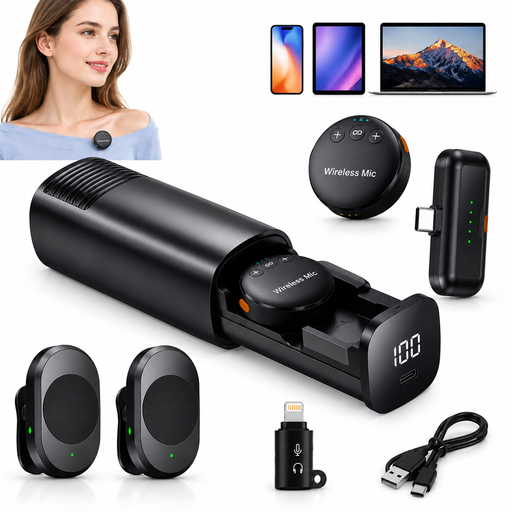
Wireless lapel microphone kit with two transmitters
For a setup with two transmitters, for example when you want to record both people in the conversation.
Includes one receiver and USB-C and Lightning connections. The microphones pick up sound from all directions, so position them to suit the room and the people speaking.
Joybuy
 No image available
Moman MS1X(C) wireless lapel microphone kit
For a seated storyteller when using a USB-C Android smartphone as the recording device.
Includes two transmitters and one USB-C receiver. Compatibility is specified for USB-C Android smartphones. The microphones pick up sound from all directions, so their position in the room matters.
Joybuy
 No image available
Rexsun 64GB portable digital voice recorder
For recording at the interview location without a computer running.
Features one-button recording and a 64-GB TF card. The built-in microphones pick up sound from all directions, so where you place the recorder affects how clearly you can hear the storyteller against the background noise.
Joybuy
Frequently asked questions
Do I need an extra microphone for an oral history interview?
Not necessarily. Start by making a short test recording from the actual seat and listen back to it. If the storyteller’s voice is too quiet compared with the room noise, consider a microphone placed closer to them or clipped to their clothing.
How do I prepare a portable recorder?
Before your appointment, insert a suitable microSD card into the Zoom H1essential and test recording and playback. The user manual says that neither is possible without a card inserted.
What extra equipment should I allow for?
Check whether your setup requires a separate XLR cable, a suitable microSD card or a second microphone with separate inputs. What you’ll need depends on the device you choose and whether you want to hear both people separately.
Can I record someone’s story in Germany without asking and then share it with my club?
As the German Federal Ministry of Justice explains in the wording of the law, recording another person’s private spoken words without authorisation, or making such a recording available to third parties without authorisation, is covered by section 201 of the German Criminal Code (StGB). So check separately that you’re authorised to make the recording and who it is intended for. If consent under the GDPR is used for the organised processing of personal data, the Data Protection Conference says it must be freely given, informed and specific to the situation. Whether the GDPR applies to use that is exclusively private can’t be answered in general terms.


