What should you look for when choosing?
Wired lapel microphone
A good choice if: The person telling their story needs to move freely or you don’t want them to have to speak towards a desk microphone throughout.
Things to consider: Clothing and cables can cause noise. The RØDE Lavalier GO needs a suitable 3.5-mm TRS input with plug-in power on the recording device.
Directional USB desk microphone
A good choice if: You’re recording on a computer and can position the microphone close to someone who is sitting down.
Things to consider: USB can make it possible to connect directly to a computer, but a single microphone won’t automatically pick up two people sitting opposite each other equally well.
Two microphones with a recorder or interface
A good choice if: Both the questions and answers matter, or you want to edit the voices separately.
Things to consider: Allow for extra microphones, suitable inputs, cables and setup time. An XLR microphone on its own isn’t a complete recording solution for a computer.
For stereo recordings, the Oral History Society recommends using two external microphones, preferably with professional XLR connections. The University of Leicester’s East Midlands Oral History Archive advises positioning desk microphones as close as possible to the interviewee.
| Priority |
What to check before buying |
Who is this particularly important to? |
| Clarity of the speaker’s story |
Pick-up pattern and achievable microphone position; desk or lapel attachment |
If I want to record someone’s story clearly from a fixed seat, I’ll first check the microphone position in the room. Around 33% of consumers prioritise clarity of the person telling their story. |
| Both speakers |
Two independent microphone inputs; separate tracks if you want to edit each voice individually later |
If the questions and answers matter equally, I want to capture both speakers clearly and edit their voices separately if needed. Around 27% of consumers prioritise recording both voices. |
| Connection and setup |
USB, XLR or 3.5-mm TRS connection; plug-in power as well for the Lavalier GO |
If I want to record using my existing computer or recorder, the signal path needs to work without any connection surprises. Around 20% of consumers pay particular attention to connection and setup. |
| Monitoring and archiving |
Headphone monitoring and level control; support for your preferred recording format and a file backup |
During a long interview, I want to spot recording problems as early as possible and be able to use the file again later. Around 20% of consumers prioritise monitoring and preservation. |
Joybuy products for oral history interviews
The products featured here range from lapel microphones for individual voices to USB/XLR desk microphones and wireless kits with two transmitters. When choosing, make sure the connection and recording setup suit your interview and your device.
 No image available
FIFINE K688CTW USB/XLR dynamic microphone with boom arm
For recording one person sitting down, when you want to be able to adjust the microphone position at your recording spot.
USB and XLR connections, headphone monitoring and a recommended speaking distance of 2 to 6 inches are listed.
The boom arm is included; the description says an XLR cable is not included. The desk clamp is specified for desks less than 2 inches thick.
View at Joybuy
 No image available
FIFINE AM8 USB/XLR dynamic microphone
An option for recording one voice at close range from a fixed position, if USB or XLR suits your recording device.
USB/XLR, a gain control and headphone monitoring with volume control are listed; a desk stand is described.
The description says an XLR cable and boom arm are not included.
View at Joybuy
 No image available
DJI Mic Mini 2S (2 TX + 1 RX + charging case)
This kit is worth considering for interviews with two speakers, if a wireless recording setup suits your device.
It is described as having two transmitters, internal 32-bit float recording and storage for up to 28 hours; PC compatibility is also listed.
View at Joybuy
 No image available
SYNCO S8 lavalier microphone
A lapel option for recording someone’s story, if your recording device supports the wired connection.
A clip attachment, omnidirectional pick-up pattern, wind shield and adapter set are described. A 3.5-mm connection is listed.
Check that the connection works with your particular smartphone, computer, laptop or camera.
View at Joybuy
 No image available
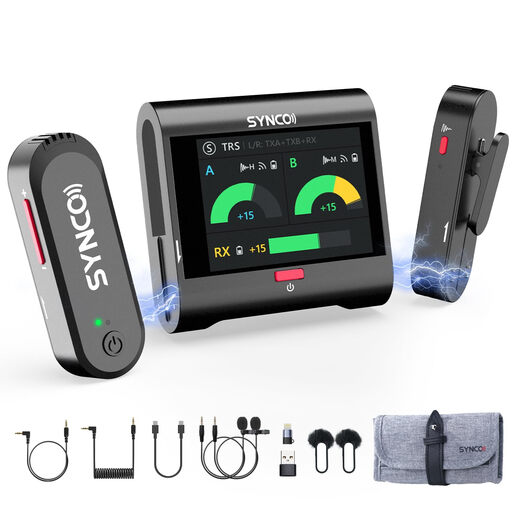
SYNCO G3PRO 2.4 GHz wireless lavalier microphone system
This kit is designed for interviews with two people when you want to record both wirelessly at the same time.
It is described as having two transmitters and recording two people simultaneously. The listed outputs are TRS, TRRS and USB-C; real-time monitoring and gain control are also included.
View at Joybuy
Frequently asked questions
Is one microphone enough for a conversation between two people?
If the main focus is on the person telling their story, one microphone positioned nearby may be enough; the questions from the person opposite could sound quieter. If both voices matter, plan for two microphones and suitable inputs, then check the recording with a test.
How can I check the microphone position before a long interview?
Record a short passage from the actual seating position and listen back. Check the voices, levels and room echo. With lapel microphones, also listen for noise from clothing or cables, and adjust the position before you begin.
What extra equipment and rights should I allow for?
Depending on the connection, you may need a recorder or audio interface, a second microphone, cables, a mount and headphones; check exactly what’s included. The statutory warranty you have against the seller is separate from any voluntary guarantee.
Can I record an oral history interview in Germany without permission?
Section 201(1) of the German Criminal Code covers the unauthorised recording of another person’s private spoken words. Make sure you have permission before recording. For oral history work, the Oral History Association also recommends obtaining and documenting informed consent; this professional guidance is not the same as the wording of German criminal law.
Which recording format is suitable for archiving later?
The Oral History Society lists uncompressed PCM WAV recordings at 44.1 kHz and 16-bit and/or 48 kHz and 16-bit as possible formats. Check that your recorder or recording software supports the format you want, and plan to back up the file.


