Interviewers recording with a fan running
You want to capture the story clearly and can test the microphone position and room beforehand. Shure notes that an omnidirectional microphone picks up sound from different directions.


For an oral history interview with a fan running, a good starting point is a lavalier microphone attached close to the person speaking, tested at the actual recording location. Neither an omnidirectional pickup pattern nor advertised noise reduction guarantees a recording free from fan noise. A compatible wired microphone may be enough for someone who will mostly be sitting down, while two people speaking or a story that cannot easily be retold may call for a two-transmitter set or a verified local backup recording. Before the interview, check the connection and recording mode, then make sure a test file has actually been saved and can be played back.
You want to capture the story clearly and can test the microphone position and room beforehand. Shure notes that an omnidirectional microphone picks up sound from different directions.
You want to record both the story and your own questions close to the speakers. Check what’s included in the set and how it records both people; DJI and RØDE describe sets with two transmitters or two lavalier microphones.
If you may not be able to repeat a conversation, it’s important to have a verified local recording and files you can find easily. The Oral History Association highlights preparation and preservation as key parts of oral history work.
A good fit if: one person will mostly be sitting down and the microphone, input and cable routing all work together.
Bear in mind: the cable limits movement and may rub against clothing.
A good fit if: both the interviewer and the person telling their story need to wear a microphone.
Bear in mind: the set configuration, receiver connection and power supply must all work with your recording device.
A good fit if: you want an additional recording made directly on the transmitter during an interview that may be hard to repeat.
Bear in mind: you’ll need to activate the right mode and transfer the saved file afterwards.
A good fit if: you want to record one person’s voice locally, separately from a wireless or smartphone recording.
Bear in mind: the memory card, power supply and file transfer are all part of the recording process; one recorder won’t automatically capture two voices.
| What matters | What to check before buying | Who needs this? |
|---|---|---|
| Clear speech with fan noise | Microphone position, distance from the speaker, contact with clothing and a test recording with the fan running. | If I want to capture the story clearly with the fan running, I’d listen to a recording made at the actual location. Around 33% of consumers put speech intelligibility first. |
| Connection to the recording device | Device model, compatible microphone input, any adapters needed and playback of a test file. | If I want to record using my existing smartphone, computer or recorder, the whole signal path needs to work. Around 27% of consumers prioritise device compatibility. |
| Recording the story and the questions | Number of microphones and transmitters included, as well as the recording mode and the tracks actually saved. | If I want to capture my own questions clearly as well as the person telling their story, I’ll check that both voices are recorded. Around 20% of consumers prioritise capturing two voices. |
| Backing up a recording that may be hard to repeat | Whether the exact model records locally, which mode is active and whether the test file can be opened and saved. | If the story may not be possible to repeat, I want a local file I can check. Around 20% of consumers prioritise recording backup. |
An omnidirectional microphone also picks up sound from other directions. DJI’s stated reduction of fan noise is a manufacturer claim; it doesn’t tell you how the specific voice and room noise will sound in your recording.
Make a test recording with the fan running, then listen to the available settings with the person’s actual voice.
A 3.5 mm TRRS plug alone doesn’t confirm that the recording device will use it to capture the microphone audio you need.
Before buying, check the microphone input and the recording app or recorder. Then make a test file and play it back.
Depending on your recording device, you may need a suitable adapter.
The ability to pair two transmitters doesn’t, by itself, tell you how the recording is saved or whether local recording has started.
Check what’s included in the set, the recording mode and the saved files for both voices before the oral history interview begins.
According to the manufacturer, the Zoom F2 records to microSD media and runs on two AAA batteries.
Before the conversation, check the power supply, available storage, recording status and playback of a short file.
The Zoom F2 workflow requires a memory card and, if needed, spare batteries.
Wired XS-Lav models for interviews; the XS Lav Mobile is described as having a 3.5 mm TRRS plug and a 2 m cable.
The Mic Mini is a wireless option for interviews with one or, depending on the set, two people wearing microphones.
According to RØDE, the Wireless PRO combines two Lavalier II microphones with wireless transmission and local recording on the transmitters.
The F2 is a portable recorder supplied with a lavalier microphone for recording one voice locally.
The Joybuy products below include wired lavalier microphones and wireless sets for interviews. Check that each model has the right connection and the exact set configuration you need.
 No image available
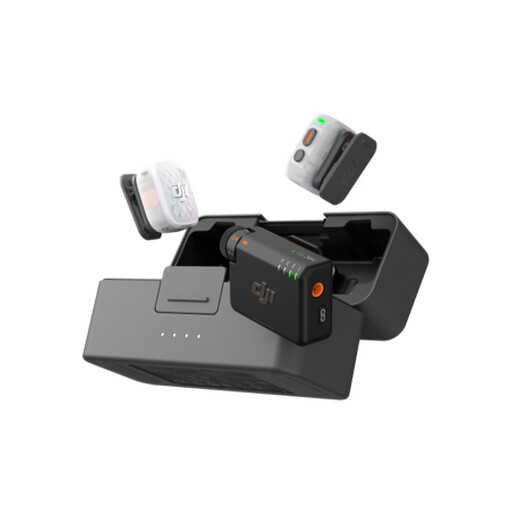
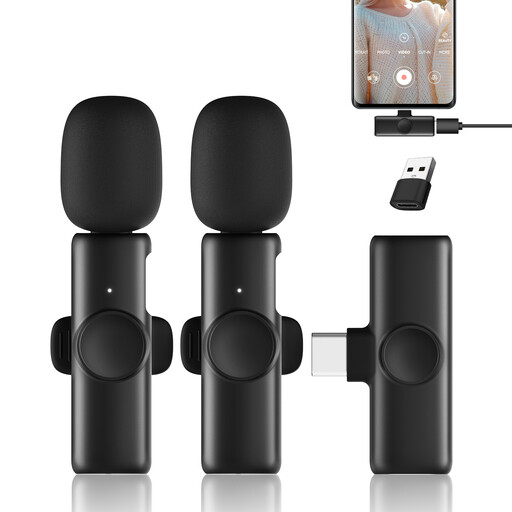
The product description lists two transmitters and internal recording. This may be useful for an interview with two people wearing microphones, as well as an additional local file.
Noise reduction doesn’t guarantee that fan noise will disappear from your specific recording. Check what’s included in the set, the recording mode and the saved test files.
 No image available
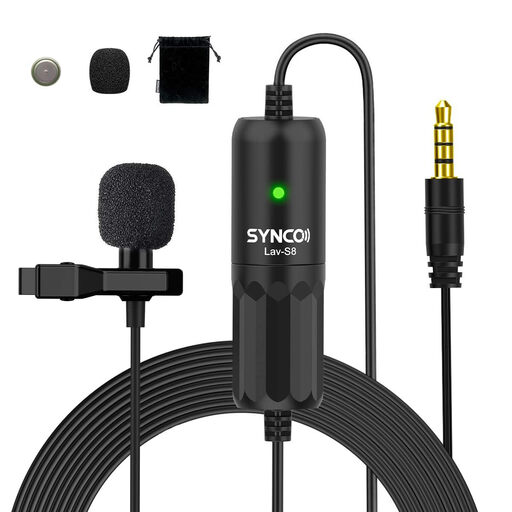
A wired lavalier may be suitable for recording someone who is sitting down, provided the microphone is compatible with the recording device.
The product description lists a 3.5 mm connection and an adapter set. Check that the microphone input and adapter you need are compatible with your recording device.
 No image available
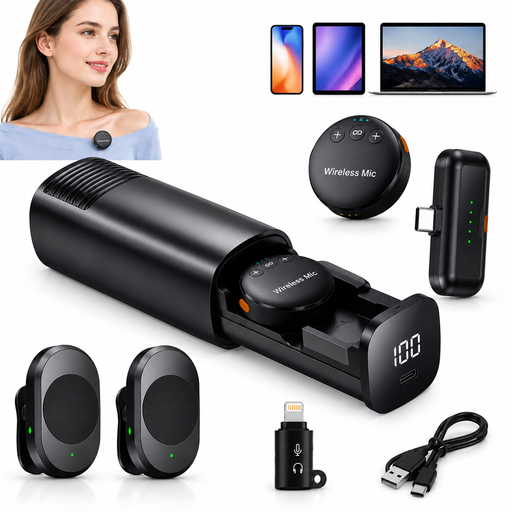
The product title lists two transmitters and USB-C and Lightning connections, which may be useful for an interview with two people wearing microphones.
Check which connection option works with your recording device. The stated DSP noise reduction doesn’t prove that fan noise will disappear from your specific recording.
 No image available
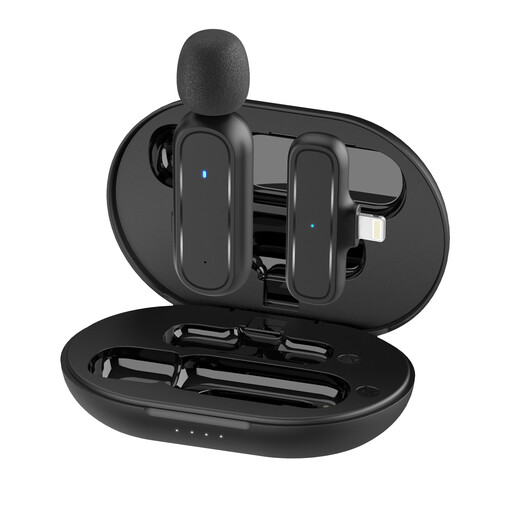
The product title describes a wireless lavalier set with a transmitter and receiver for an interview with one person wearing a microphone.
Before buying, check the connection option for the version on offer and whether it’s compatible with your specific recording device.
 No image available
A wireless lavalier system may be suitable for recording someone telling their story, provided the receiver and recording device work together.
Before buying, check the exact connection option and set configuration for the Moman MS1X(C).
You can’t assume it will do so in a particular room with a particular voice. DJI describes a setting on the Mic Mini that reduces sounds including fan noise. Listen to a recording made with the fan running to check that the voice and the room atmosphere you want to keep are still clear. Microphone position and room noise still matter.
Attach the microphone so the capsule and cable don’t rub against clothing, then listen to a short recording made with the fan running and the person moving as they actually will. Shure describes clothing friction as a cause of contact noise. If you’re using a local recorder, also check the power supply, storage and that a test file can be played back.
Depending on your setup, you may need a suitable adapter or, for the Zoom F2, a memory card and AAA batteries. As Your Europe explains, most online purchases from a trader in the EU are covered by a 14-day right of withdrawal, subject to exceptions. The statutory guarantee for faulty goods, which applies against the seller, is separate from a voluntary manufacturer’s warranty, as the Verbraucherzentrale points out.
Section 201 of the German Criminal Code makes it a criminal offence to record another person’s non-public speech without authorisation. For a non-public interview, agree the recording with the person beforehand and discuss any later sharing or publication separately. You’ll also need an appropriate legal basis to process personal data. According to the Federal Commissioner for Data Protection and Freedom of Information, consent is one possible basis, but not the only one.