What should you look for?
For a seated oral history interview, focus on a clear voice, a compatible connection and whether you want to record one or both speakers. Oral-History.Digital at Freie Universität Berlin and the Archives of Contemporary History at ETH Zurich also emphasise the importance of choosing a quiet room.
| Consideration |
What to check before buying |
Who should pay particular attention? |
| Clarity of the interviewee’s voice |
Check for room noise and echo with a test recording; make sure the microphone doesn’t rub against clothing. |
If I want to capture the account clearly, I’ll listen to a test recording first and check how the microphone is attached. Around 33% of consumers put voice clarity first. |
| Connection to the recording device |
Check the wiring, microphone input and power requirements; test the intended app or recorder. |
If I’m using a smartphone I already own, I want to make sure the microphone, socket and any adapter work together. For around 27% of consumers, compatibility with their existing device comes first. |
| Second voice |
Decide in advance whether you want to record the questions; check how many microphones and suitable inputs or channels you’ll need. |
If I want my questions to be audible later, I’ll plan to record the interviewer’s voice too. Around 20% of consumers prioritise recording both speakers. |
| Keeping the recording safe |
Check the batteries or charge level; if you’re using a recorder, check the storage and recording status too. |
For a longer conversation, I want to be able to check the power, storage and recording status before we begin. Around 20% of consumers prioritise making sure the full recording is captured. |
Key brands at a glance
The brands below represent different connection and recording approaches. The features listed relate to the product ranges described and don’t replace checking compatibility with your own recording device.
RØDE
Lavalier microphones for a range of wired inputs.
- RØDE describes the smartLav+ as a TRRS microphone and recommends a suitable TRRS-to-TRS adapter for connecting it to a Wireless GO transmitter. The Lavalier GO has a TRS connector and requires plug-in power.
- Check the specific input and power requirements; a matching plug size alone doesn’t guarantee compatibility.
Shure
The MVL is designed for compatible mobile devices with a 3.5 mm connection or a suitable CTIA adapter.
- Shure says a clip and windscreen are included.
- Check that the connection and adapter are compatible with your specific mobile device.
Audio-Technica
The ATR3350x is a wired lavalier microphone for compatible camera or recorder inputs.
- Audio-Technica lists a 3 m cable, an on/off switch, a clip, a windscreen and an LR44 battery as included.
- Make sure the cable length, battery condition and input suit your seating arrangement and recording device.
DJI
The Mic Mini is available in a configuration explicitly listed with two transmitters, one receiver and a charging case.
- DJI describes this configuration for recording two people and notes that an adapter is required for Lightning smartphones.
- Check the set configuration, device connection and power requirements. Manufacturer claims about battery life and transmission don’t guarantee interference-free operation at your interview location.
Zoom
The F2 combines a body-worn recorder with an included lavalier microphone.
- Zoom lists a HOLD switch, microSD storage and 32-bit float WAV as F2 features.
- If you want to record the interviewer’s voice separately, you’ll need to plan for another recording option. You’ll also need to transfer the files afterwards.
Joybuy products for interviews
This selection includes wired lavalier microphones for different devices, as well as wireless sets whose product names specify two transmitters for interviews. Before buying, check the exact connection and, for wireless systems, the regulations that apply to use in Germany.
 No image available
DJI Mic Mini 2S (2 TX + 1 RX + Charging Case)
For interviews where both people need to wear a microphone; the product name specifies two transmitters and one receiver.
Includes a charging case. Before using this wireless set in Germany, check the regulations that apply to its specific frequencies.
View at Joybuy
 No image available
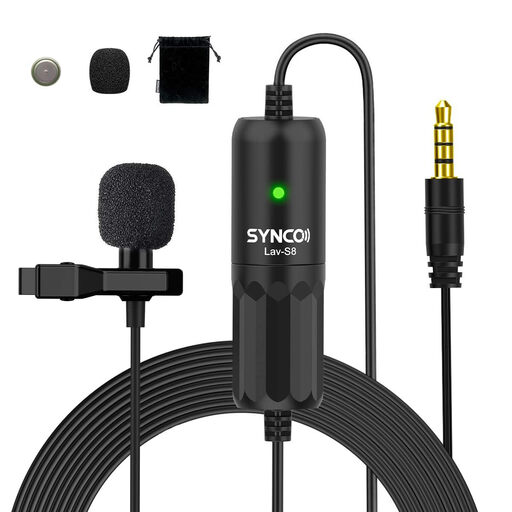
SYNCO S8-Lavaliermikrofon für Smartphone, PC, Laptop und Kamera
A wired option if you want to use one of the devices listed in the product name.
Check the connection on your specific device first and whether you need a suitable adapter.
View at Joybuy
 No image available
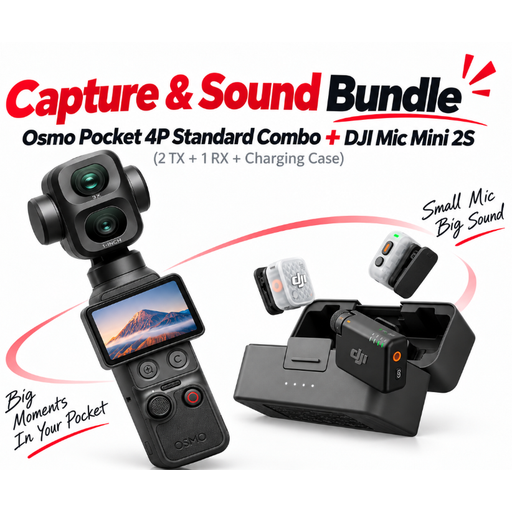
DJI Osmo Pocket 4P Pro Audio Bundle – Pocket 4P Standard Combo + Mic Mini 2S (2 TX + 1 RX + Charging Case)
For an interview where you want to record both speakers using microphones; the product name specifies a Mic Mini 2S with two transmitters and one receiver.
According to the product name, the bundle includes a Pocket 4P Standard Combo and a Mic Mini 2S with a charging case. Check the regulations that apply to the specific system before using it wirelessly.
View at Joybuy
 No image available
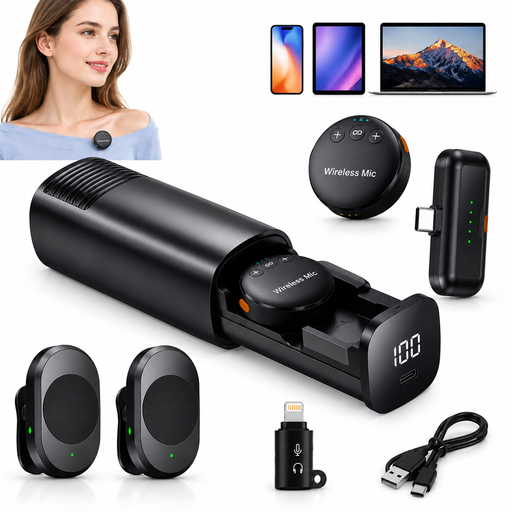
Wireless Lavalier Microphone Set, 2 Transmitters, 2.4 GHz, USB-C and Lightning
For an interview with two people to record; the product name specifies two transmitters and USB-C and Lightning connections.
The product name specifies 2.4 GHz. Before using this set in Germany, check the regulations that apply to its specific frequencies.
View at Joybuy
 No image available
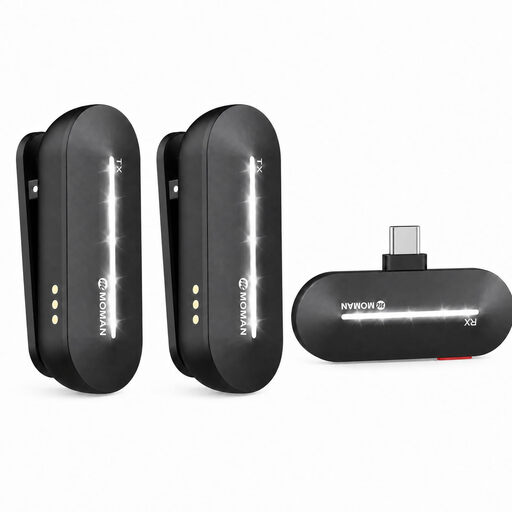
Moman M1CXT Wireless Lavalier Microphone (USB-C, 2 TX + 1 RX)
For an interview with two people to record; the product name specifies two transmitters and one receiver.
USB-C is specified in the product name. Check compatibility with your recording device and, before using the system wirelessly, the regulations that apply to its specific frequencies in Germany.
View at Joybuy
Frequently asked questions
How should I prepare the recording space and lavalier microphone?
Choose a quiet room with as little echo as possible, then listen to a short voice test. The technical guidance from the Archives of Contemporary History at ETH Zurich names air conditioning and other equipment as possible sources of interference. Also check that the attached microphone doesn’t rub against clothing during normal movement.
Can I connect a smartphone lavalier microphone directly to a camera or wireless transmitter?
Not just because it has a 3.5 mm plug. RØDE describes the smartLav+ as a TRRS microphone and recommends a suitable TRRS-to-TRS adapter for use with a Wireless GO transmitter; the Lavalier GO, by contrast, is specified as a TRS microphone.
How can I record the questions as well during an oral history interview?
Plan a suitable way to record the interviewer’s voice separately. Before choosing your equipment, check whether both people need a microphone and whether you have enough transmitters, inputs or recording channels for both voices.
Can I record a private oral history interview in Germany without permission?
No. Section 201(1) of the German Criminal Code (StGB) covers the unauthorised recording of another person’s private spoken words. Before you begin, make sure you have the necessary permission; making the recording accessible to others later is a separate matter. This is a legal restriction on use, not a feature of a microphone.
Can I use any wireless microphone set in Germany without checking anything first?
No, there’s no blanket answer. Check the frequency band and technical conditions for using the specific set against the current German allocations. In its decision 37/2026 of 15 April 2026, the Federal Network Agency revoked earlier general frequency allocations, including 109/2025. An older frequency reference therefore isn’t enough to confirm that a set can still be used.


