Preserving a life story
If the narrator needs to remain clear despite background noise in the flat, a microphone close to the speaker can help. A test recording from the intended position will show whether it works well in the room.


If the main priority is the narrator’s voice, a microphone close to the speaker is a sensible starting point; a lapel mic can be discreet. If you also want questions and answers to be clear, plan for two microphones and suitable separate inputs or recorders. Finding a good position and listening back to a test recording are still important: a directional pickup pattern and digital signal processing won’t automatically eliminate all the noise in your flat.
If the narrator needs to remain clear despite background noise in the flat, a microphone close to the speaker can help. A test recording from the intended position will show whether it works well in the room.
If you want to capture questions and answers as a complete conversation, plan for two microphones and suitable separate inputs. Oral-History.Digital recommends using two lapel microphones where possible: one for the narrator and one for the interviewer.
If you want to use equipment you already own, check its inputs and required cables, and make sure the microphone suits your planned recording setup. The recorder’s file format may also matter for storing your recordings later.
First decide whether you want to capture just the narrator’s voice or the conversation as well. You can then choose a microphone position, connections and recording format to suit your plans.
The figures below show how the main priorities for oral history recordings in a noisy flat compare.
| Priority | What to look for when buying | Who it matters most to |
|---|---|---|
| A clear voice from the narrator | Check the way the microphone is attached and that it’s compatible with the input; listen back to a test recording from the planned seating position. | If my main aim is to preserve someone’s life story clearly, a microphone positioned close to them is important to me. Around 36% of consumers prioritise a clear voice from the narrator. |
| Both sides of the conversation | Check the number and type of microphone inputs, and whether you can monitor both voices separately. | If my questions are important for understanding the answers, I want to be able to record and check both voices. Around 29% of consumers prioritise capturing the full conversation. |
| A straightforward setup | Check how the microphone is attached, whether you can monitor the recording, and make a test recording before the conversation. | If I want the equipment to demand as little attention as possible during a longer conversation, a simple setup matters to me. Around 21% of consumers put a straightforward setup first. |
| Connection and file format | Check that the recorder’s available USB or XLR connections and recording format are compatible. | If I want to use equipment I already own and store the recordings appropriately, the setup needs to suit my connections and workflow. Around 14% of consumers prioritise connections and storage. |
A cardioid pickup pattern can reduce sound coming from the sides and rear, but it can’t block out every unwanted noise.
Point the microphone towards the voice you want to capture and keep it close. Reduce noise sources where possible, then listen back to a test recording made in the room you’ll be using.
If the questions are important for understanding the story, a good recording of the narrator alone may leave the conversation incomplete.
Before buying, decide whether you need to document both sides of the conversation, then choose suitable microphones and inputs.
A two-person setup may require a second microphone, extra cables or a recorder with additional inputs.
This feature relates to handling recording levels; it doesn’t replace positioning the microphone close to the speaker.
Assess the recording format and how clearly you can hear the voices in the intended room separately.
The DR-10L Pro is a portable recorder supplied with a lavalier microphone for one speaker.
According to Zoom, the H4essential has two XLR/TRS inputs, while the H1essential records using built-in microphones.
The ATR2100x-USB is a dynamic handheld microphone with USB and XLR outputs, designed to capture a voice from close up.
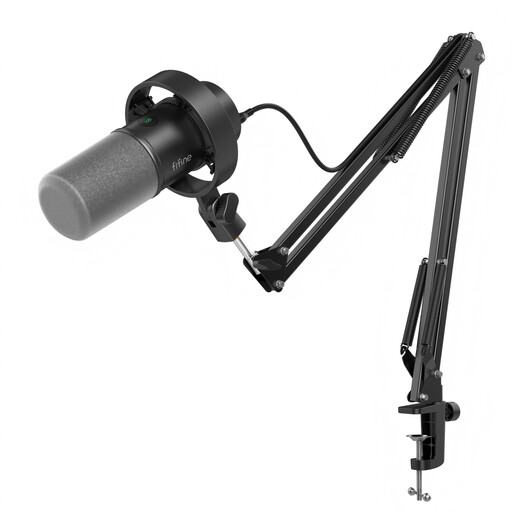
The MV7+ is a USB-C/XLR microphone for speech, designed for a fixed recording position.
The AmpliGame AM8 is a dynamic USB/XLR microphone with a cardioid pickup pattern, designed for a fixed speaking position.
These products are intended for close-up voice recording, using either a dynamic microphone or a lavalier set for two speakers. Before buying, check that the connections and recording equipment suit your specific setup.
 No image available
For one voice at a fixed recording position; the included arm lets you adjust the microphone’s position.
USB-C and XLR connections; unidirectional pickup pattern, according to the product description. The recommended recording distance is 2 to 6 inches. An XLR cable is not included, according to the description.
 No image available
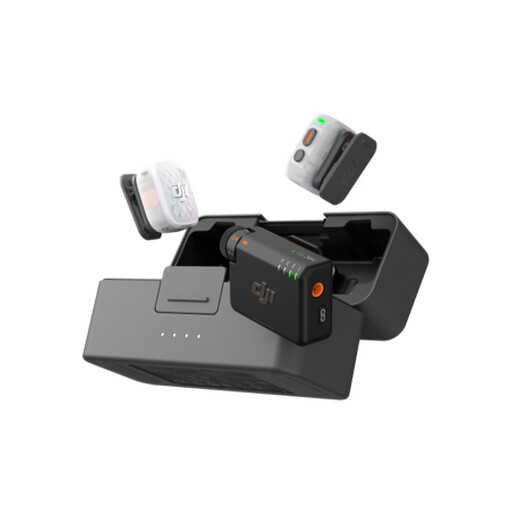
With two transmitters and one receiver, this set is worth considering for recording both sides of a conversation.
The description lists 32-bit float recording and compatibility with cameras, smartphones and PCs. The transmitters can be attached with clips or magnets, according to the description; check your recording equipment’s connections beforehand.
 No image available
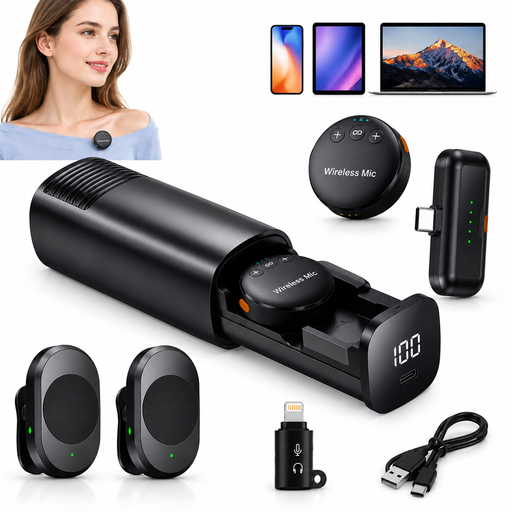
This set is listed with two transmitters and one receiver for conversations between two people.
The product name lists 2.4 GHz, latency under 20 ms, a range of up to 40 m and a 500 mAh charging case. It also lists USB-C and Lightning; check compatibility with your specific recording equipment.
 No image available
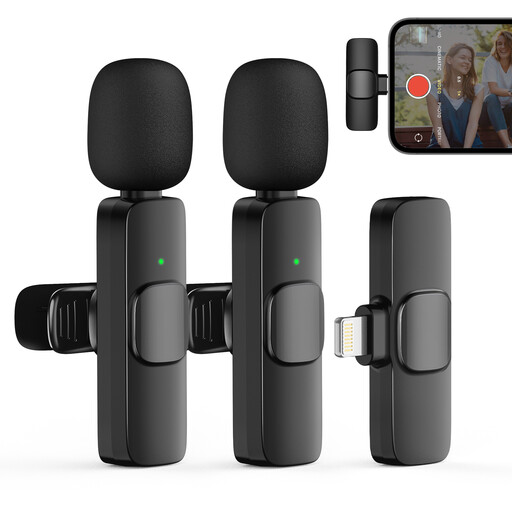
This lavalier set is listed with two transmitters and one receiver for voice recording.
The receiver is described as a USB-C model. Before buying, check that it’s compatible with your specific phone and its connection.
No. This kind of feature won’t automatically eliminate every sound. Shure lists a real-time denoiser on the MV7+; don’t assume how well it will work in your room—check with a test recording instead. A cardioid pickup pattern can reduce sound coming from the sides and rear, but it won’t block it out completely either.
Decide in advance whether you want your questions included in the recording. If both voices matter, check that you have two suitable microphones and inputs, listen back to a test recording of both voices, and make sure lapel microphones don’t rub against clothing.
A two-person setup may require a second microphone, suitable cables or a recorder with two inputs. Check what’s included against the connections you already have before choosing a single microphone.
In Germany, recording another person’s non-public speech without their permission may be a criminal offence under § 201 StGB. Discuss the recording with the speaker beforehand; you should also agree separately with them before publishing it later.