
Lieferung heute & morgen

Qualitätsgarantie

Willkommens-Angebote freischalten: KOSTENLOSE Lieferung | Bis zu 80 % RABATT | Kostenlose 30-Tage-JoyPlus-Testphase
App herunterladen
Organic baby food with carrots is a practical choice when you need a quick, portioned meal for weaning. However, carrot baby jars vary considerably in their recommended age, consistency, ingredients and pack size. An eye-catching organic label alone does not tell you whether a meal is suitable for your child’s stage of development.
The recommended age is an important guide, but it is not a general approval for every product. A finely puréed carrot baby food may be intended for the start of weaning, while a meal with fine pieces may only be suitable from 8 months. Your child’s individual development also plays a role. If you are unsure about introducing new foods, it may be helpful to seek advice from a paediatrician or qualified nutrition professional.
Baby food with no added sugar can still contain sugar from carrots, fruit or other ingredients. The key is to check the ingredients list: if no added sugar or equivalent sweetening ingredient is listed, this does not automatically mean the product is sugar-free. For example, fruit and carrot purées generally contain more naturally occurring sugar than a vegetable-only meal.
Organic labels such as the EU organic logo or the German organic seal provide information about production standards. However, they do not answer every question about the recipe. Parents should also check whether salt has been added, which source of protein is included, and whether milk, gluten or fish are among the relevant allergens.
For baby food from 5 months, finely puréed meals are usually easier to portion and feed. Products for children from 8 months more often contain fine pieces, which can help support learning to chew. The right consistency depends on your child’s stage of development and should not be selected based on the product name alone.
You should move gradually towards chunkier textures. A jar labelled “from 8 months” is therefore not simply a larger version of carrot baby food from 5 months; it may have a different consistency and composition.
Before buying, pay particular attention to:
A baby food with no added salt or a meal with no added sugar may be a suitable choice, provided that the other ingredients and the recommended age are also appropriate.
An organic baby food multipack can make shopping easier. With 6 x 190 g or 6 x 220 g, however, you should consider how quickly your child accepts the particular variety and how much is actually eaten at each meal. Once opened, any leftovers that have not been heated should be kept in the fridge and used according to the pack instructions, often by the following day.
Single portions are practical when you are out and about. For regular use at home, a multipack can reduce the number of shopping trips. Always check the best-before date and the condition of the jar before use.
The following recommendations categorise specific products based on their stated age suitability, ingredients and pack size. Please also check the information on the label of the product delivered, as recipes and labelling may be updated.
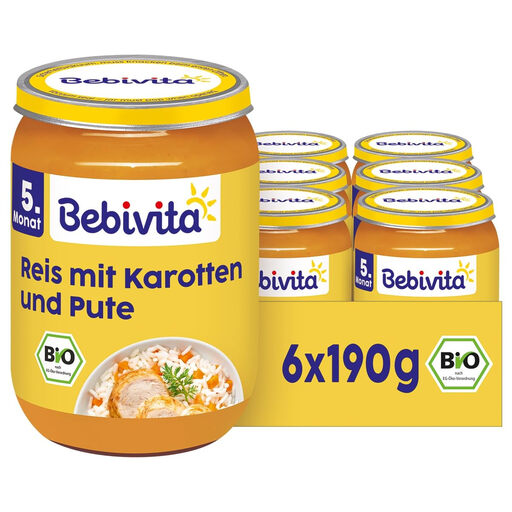
Why this product suits this profile: The multipack of six 190 g jars is designed for the start of weaning from 5 months and contains finely puréed carrots, rice and turkey.
The recommended age and puréed consistency make the choice more transparent. According to the product information, no salt is added.
6 x 190 g, finely puréed, with 35% carrots and 8% turkey meat according to the product description.
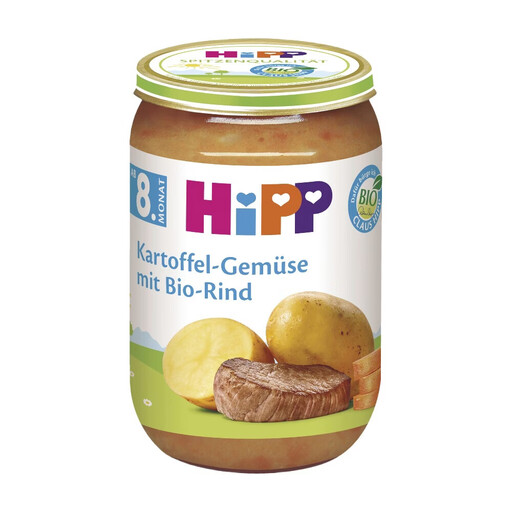
Why this product suits this profile: This organic baby meal for children from 8 months combines potatoes, carrots and beef in a chunkier consistency.
The product information expressly states that it contains no added salt, dairy products, flavourings, preservatives or colourings.
Organic certification, 65% vegetables and 8.2% beef according to the product information.
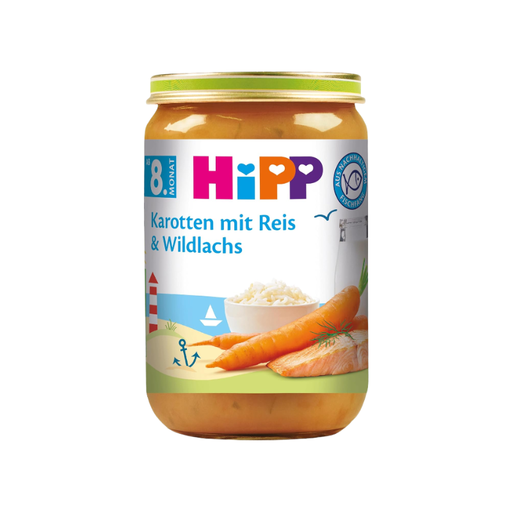
Why this product suits this profile: For families specifically looking for a salmon option from 8 months when choosing a vegetable meal with fish.
The recipe states the fish content and that no salt has been added. Fish and any possible milk ingredients should be checked in advance.
41% carrots, 8% wild salmon and 6 x 220 g according to the product description; the fine pieces help children become accustomed to different textures.
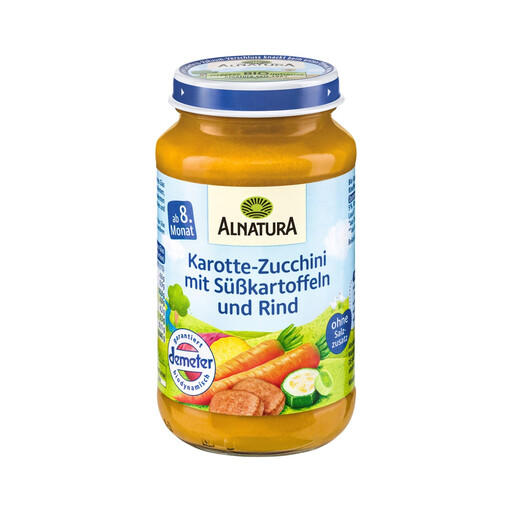
Why this product suits this profile: This single jar offers an everyday meal alternative with carrots, courgettes, sweet potatoes and beef.
The product information states Demeter quality, 46% carrots and no added salt. The chunky consistency is suitable for the stated age group.
Demeter content of 88% of the agricultural ingredients according to the product description, plus 8% beef.
We have put together a complete, regularly updated list of products that fully meet these strict selection criteria and the safety regulations applicable in the EU.
Store unopened jars in a dry place, following the manufacturer’s instructions. Check that the jar is intact before feeding. The required portion can be heated in a bain-marie or in the microwave. Stir well afterwards and check the temperature.
If feeding directly from the jar, use a clean spoon. Any leftovers that have not been heated should be sealed, stored in the fridge and generally used the next day. An opened pack should not be used for longer than stated on the label.
Products with the appropriate age label and a finely puréed consistency are intended for this stage. According to the product information, the Bebivita meal with rice, carrots and turkey is suitable from 5 months. Your child’s individual readiness for weaning and the instructions on the packaging remain the most important considerations.
No. Carrots and other ingredients naturally contain sugar. “No added sugar” means that no extra sugar has been used. You should therefore compare the ingredients list and nutritional information, particularly for products containing fruit.
Any leftovers that have not been heated should be sealed, stored in the fridge and used according to the manufacturer’s instructions, often by the following day. For hygiene reasons, leftovers from a jar that has been fed from directly are not intended to be stored for longer.