
Lieferung heute & morgen

Qualitätsgarantie

Willkommens-Angebote freischalten: KOSTENLOSE Lieferung | Bis zu 80 % RABATT | Kostenlose 30-Tage-JoyPlus-Testphase
App herunterladen
Organic baby food should be suitable for your child’s age, practical for everyday life and made with a clear, easy-to-understand ingredients list. The choice ranges from baby porridge and jars of baby food to fruit purées, pouches and children’s meals. When shopping online, it is particularly important to look closely, as the product name, marketing claim and actual composition are not always the same.
Fruit purée with no added sugar can still naturally contain a lot of sugar. Apples, bananas, berries and other fruits contain their own naturally occurring sugars. It is therefore important to check the full ingredients list and the nutritional information per 100 grams.
For a product labelled baby food with no added sugar, parents should check:
‘No added sugar’ describes the recipe, not the total sugar content.
Baby food from 6 months is not automatically suitable for every child from the first day of their sixth month. The development of swallowing ability, tolerance and eating skills varies from child to child. Products for different age groups may also contain gluten, milk, quark, spices or larger pieces.
The age recommendation on the current packaging takes precedence over older online information. This is particularly important for HiPP baby food and Bebivita baby food, as recipes or labelling may change.
When buying baby food online, a pack of six or eight may initially seem practical. Before buying, however, parents should compare the portion size, best-before date and shelf life after opening. If a product has a short refrigerated shelf life, buying a large supply may be impractical if your child does not accept a particular variety.
For the transition to complementary foods, finely puréed products are often easier to portion. Depending on the recipe, organic baby porridge with cereals, fruit or milk may be intended as part of a meal or as a snack. For products containing cereals, check the ingredients list for wheat, oats, spelt and the presence of gluten.
As children get older, finer pieces or a firmer texture can support independent eating. Suitability depends on the stated age range and your child’s individual development.
The EU organic logo and inspection body number provide information about organic certification. However, organic does not automatically mean that a product is free from allergens, sugar or milk ingredients.
Pay particular attention to:
If there is a family history of allergies or you are unsure, introducing individual ingredients should be discussed with a medical or nutritional professional.
Jars, pots and pouches each have different advantages. Jars can be portioned with a clean spoon. Pots are shatterproof and suitable for taking out and about. A baby food pouch is easy to transport, but your child should ideally not suck directly from the pouch on a regular basis. The products described in the information provided sometimes recommend feeding with a spoon and supervising the child while eating.
After opening, follow the instructions on the label. Depending on the product, leftovers may need to be consumed refrigerated within one day or within three days, for example. Unopened products are generally stored in a dry place at room temperature. Damaged or swollen packaging should not be used.
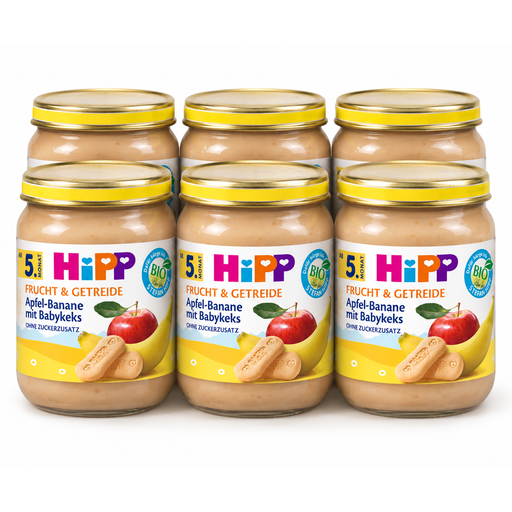
Why this product suits this profile: The six-pack with 190 g portions is suitable for parents planning a straightforward fruit-and-cereal meal as they introduce complementary foods. The stated suitability from five months should be checked against the current packaging before purchase.
According to the product information, it contains no added sugar, flavourings or preservatives. Nevertheless, the nutritional table lists 10.9 g of sugar per 100 g.
Apple, banana and cereals; according to the information provided, with no added sugar. Contains gluten, milk and other declared allergens.
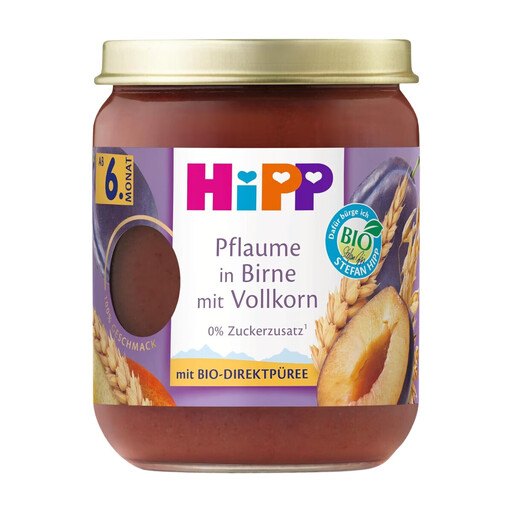
Why this product suits this profile: The recipe combines a stated fruit content of 75% with wholegrain cereals and, according to the product information, is intended for children from six months.
The ingredients specify the fruit and cereal content clearly. ‘No added sugar’ is not presented as meaning that the product is sugar-free.
EU organic labelling according to the product information; six-pack of 160 g jars. Contains wheat, oats and gluten.
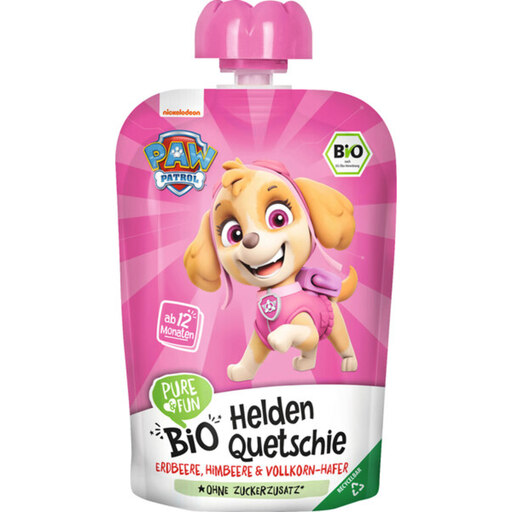
Why this product suits this profile: According to the product information, the 100 g pouch is vegan, lactose-free and intended for children from twelve months. This makes it suitable for specific dietary requirements and for taking out and about.
The age range and dietary information are stated clearly. The pouch should not be used without supervision and should be stored in the fridge after opening.
Organic fruit purée with oats; vegan and lactose-free according to the product description. Contents: 100 g per pouch.
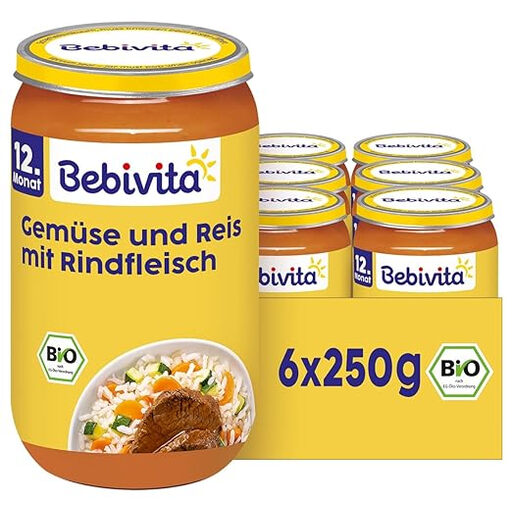
Why this product suits this profile: The 250 g portions are designed as a warm meal for children from twelve months and can make planning several family meals easier.
The ingredient quantities are specified, including carrots, beef, courgette and rice. After opening, leftovers should be refrigerated and used the following day.
Six-pack with 250 g per portion; according to the information provided, organic ingredients and an age recommendation from twelve months. Contains skimmed milk and iodised salt.
We have put together a complete, regularly updated list of products that fully meet these strict selection criteria and the safety regulations applicable in the EU.
That depends on the individual product. Products on the market are available from five, six, eight, ten or twelve months. The key factors are the age recommendation on the packaging, the consistency and the ingredients. When introducing new foods, parents should take their child’s individual development into account and seek professional advice if they are unsure.
The shelf life after opening varies depending on the recipe and packaging. Some fruit-and-cereal products should be consumed within three days when refrigerated, while other products should be used within one day or 48 hours. Leftovers should be removed with clean cutlery, sealed, refrigerated and disposed of once the manufacturer’s stated period has elapsed.
A pouch is generally intended as a snack or part of a meal. The product information may recommend a daily maximum amount or feeding with a spoon. For a varied diet, parents should also offer different textures and food groups. An adult must supervise the child while eating, particularly because of caps and the option to suck directly from the pouch.