What should you look for when buying?
First, decide how many bars you actually want to hand out. Then check the specific variety for suitable ingredients, allergens, nutritional values and organic certification.
| Criteria |
What to check |
Who it matters most to |
| Portions to share |
Compare the number of bars and grams per bar: the product examples range from 3 × 25 g and 3 × 35 g to 6 × 24 g and 6 × 25 g. |
For several lunchboxes, I need enough individual bars rather than relying on the total weight. Around 31% of consumers would prioritise portion size. |
| Allergens and dietary requirements |
Read the ingredients, declared allergens, precautionary allergen information and any specific claims made about the variety you’ve chosen. |
If I need to avoid certain ingredients, the recipe of each individual bar matters more than the pack size. Around 31% of consumers would put this check first. |
| Sugar and ingredients |
Compare sugar and other nutritional values per 100 g on a like-for-like basis; for one portion, also take the bar’s weight into account. |
I want to understand what’s in a bar rather than relying solely on claims on the front of the pack. Around 23% of consumers would prioritise comparing ingredients and nutritional values. |
| Organic certification |
For the specific pack, check the EU organic logo, control body code and country of origin; different labelling rules apply to non-prepacked products and certain imports. |
When shopping at an organic food store, I want to be able to verify the organic information on the pack I’ve chosen. This would be the top criterion for around 15% of consumers. |
Brands to help you choose
These product ranges show different types of bars and pack formats. The information on the specific variety you choose is what matters.
Alnatura
According to Alnatura, its chocolate cereal bars are available in an organic pack of six, weighing 150 g in total – an example of six 25 g bars.
- The number of bars and total weight are stated for this variety.
- The chocolate variety contains oats, wheat, spelt and milk ingredients, among other things; according to the product information, it may also contain traces of various nuts.
dennree
dennree’s product range lists fruit and nut bars as well as fruit slices alongside classic cereal bars.
- The range makes it easier to narrow down your choice between fruit and nut varieties.
- Compare the number of bars, ingredients, allergens and nutritional information on the specific pack you choose.
MadeGood
MadeGood’s mixed berry granola bars are listed by dm in a pack of six, weighing 144 g in total – equivalent to six 24 g bars.
- The product description identifies this variety as free from nuts, gluten, soya, milk and eggs.
- The nutritional table listed by dm states that this variety contains 27 g of sugar per 100 g. Always refer to the information on the specific pack you’re choosing.
REWE Bio
REWE’s product range includes an organic oat and chocolate bar in a 3 × 35 g format – three individual bars rather than six smaller ones.
- The stated format can be matched to the number of individual portions you need.
- Check the ingredients, allergens and organic information for the specific variety you choose.
EDEKA Bio
EDEKA offers an organic sesame crunch bar in a 3 × 25 g format. A sesame crunch bar isn’t the same as every type of cereal bar.
- The product information states the number of bars and the weight of each one.
- This variety contains sesame; according to EDEKA, it may contain traces of peanuts and tree nuts. Check the pack of the variety you choose.
Products to try at Joybuy
These organic cereal bar multipacks suit two different portioning needs: six 25 g bars and 24 smaller 20 g bars. The HiPP product is specifically intended for children aged 12 months and over; for both products, the information on the specific pack is key to choosing the right one.
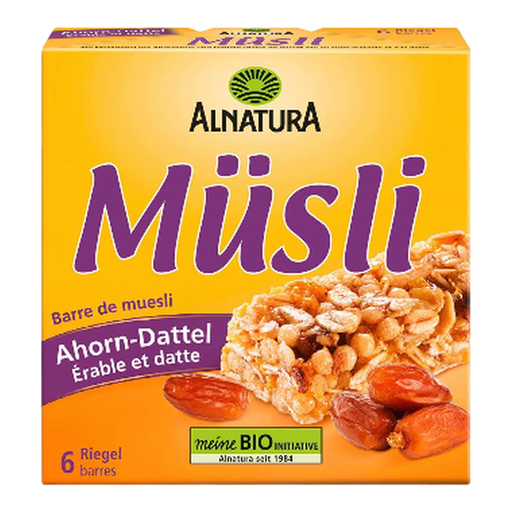 Image unavailable
Alnatura organic maple and date cereal bars, 6 × 25 g
With six bars in the pack, you can plan portions for several lunchboxes or for sharing. The pack contains 6 × 25 g; if you need to avoid any ingredients, check the information on the specific pack.
View at Joybuy
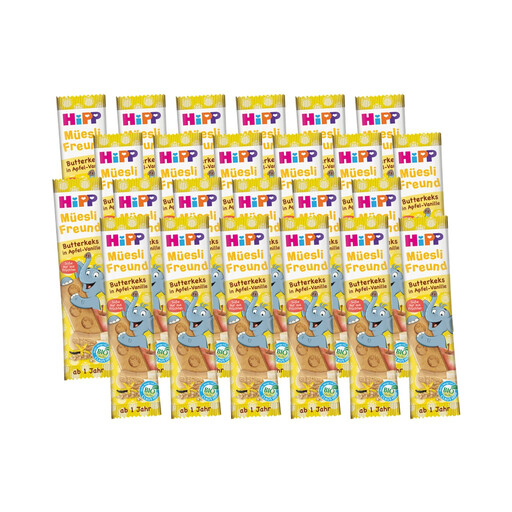 Image unavailable
HiPP organic butter biscuit, apple and vanilla cereal bars, from 12 months, 24 × 20 g
This multipack of 24 × 20 g bars may suit households planning snacks for children aged 12 months and over. Children should be supervised while eating and should not eat the bar lying down or walking. If you want to put each bar individually into a lunchbox, check its packaging as well as the ingredients and allergen information before buying.
View at Joybuy
Frequently asked questions
How can I identify the organic certification on a prepacked bar?
According to the Federal Ministry of Agriculture, Food and Regional Identity, the EU organic logo has been compulsory on prepacked organic food produced in the EU since 1 July 2010. Also look for the organic control body code and the country of origin of the agricultural ingredients. Different labelling rules apply to unpackaged products and certain imports.
Is organic certification enough if I need to avoid certain allergens?
No. Organic certification doesn’t tell you about allergens. For the cereal bar variety you choose, read the ingredients, declared allergens and, where relevant, precautionary allergen information. Depending on the recipe, cereals containing gluten, tree nuts, sesame or milk may be among the ingredients to look out for.
Does “naturally sweet” tell me anything about a bar’s sugar content?
No. The consumer advice centre points out that wording like this doesn’t give you a reliable indication of the actual sugar content. Compare the sugar per 100 g and, for an individual portion, take the weight of the bar into account.
How should I store cereal bars after buying them?
Follow the storage instructions on the specific pack. The product examples listed for Alnatura, MadeGood and dmBio should be stored in a dry place; Alnatura also advises protecting them from heat, while MadeGood recommends cool storage.


