Organic-minded shoppers stocking up
You plan several breakfasts in advance and want to check the organic certification on the pack using the EU organic logo, control body code and origin statement.


For your weekly shop, consider chocolate cereal with organic certification you can verify on the specific pack, and a pack size that suits the amount of breakfast cereal you plan to keep in stock. Then compare the sugar content per 100 g and check the ingredients and allergens: the organic logo doesn’t answer these questions.
You plan several breakfasts in advance and want to check the organic certification on the pack using the EU organic logo, control body code and origin statement.
You’re shopping for a household where certain ingredients or precautionary allergen statements can limit the options. What matters is the information for the specific variety, not the labelling on a different one.
You’re looking for a chocolate flavour, but want to compare sugar per 100 g and the ingredients in different products rather than choosing on the organic logo alone.
First, check the organic certification on the specific pack. Then you can decide what quantity suits your household and which ingredients and nutritional information matter most when choosing.
| Criteria | What to check | Who it matters to |
|---|---|---|
| Organic certification | According to the Federal Ministry of Agriculture, Food and Home Affairs, the EU organic logo is required on pre-packaged organic food from the EU. Also check the control body code and origin statement on the pack. | I want to know whether the pack I’ve chosen is labelled as organic before comparing varieties. For around 33% of consumers, this proof comes first. |
| Pack size and availability | Compare the pack size with how much you plan to use, and check whether the specific variety is available at your chosen shop or in your delivery area. | If I’m planning several breakfasts, I need a pack that suits my household’s consumption and is available locally. Around 25% of consumers put this need first. |
| Sugar and ingredients | Compare sugar content on the same basis, such as per 100 g, and read the ingredients list for the specific variety. | Chocolate flavour matters to me, but I want to know the sugar content and ingredients before choosing. Around 25% of consumers say these are their main priorities. |
| Dietary requirements and allergens | Check the ingredients, highlighted allergens and precautionary allergen statements. Don’t assume that labels such as vegan or gluten-free apply to other varieties. | If my household needs to avoid an ingredient, the labelling on the individual pack is what matters. This requirement takes priority for around 17% of consumers. |
Organic certification doesn’t tell you how much sugar a product contains. EDEKA states that its organic chocolate muesli contains 10.5 g of sugar per 100 g; this figure applies to the product named.
Compare the nutritional information per 100 g and read the ingredients list too.
Organic chocolate muesli may contain milk or gluten-containing cereals. Precautionary allergen statements may also affect your choice.
Check the ingredients and allergen information on each specific pack, especially when switching between varieties.
A listed variety may not be available at every shop. EDEKA also notes that the information on the packaging is the one to rely on.
Check whether the variety is available at your local shop or delivery address, and check the label again when you buy it.
For your weekly shop, REWE lists several products, including organic chocolate crunchy muesli and organic chocolate muesli, both in 500 g packs.
EDEKA’s listed organic chocolate muesli comes in a 750 g pack and includes nutritional and allergen information.
REWE lists several mymuesli chocolate varieties in its organic chocolate muesli range, including one labelled vegan.
You can compare these two 750 g chocolate mueslis by variety and pack size to find one that suits your planned breakfast stock. If organic certification is a must, check the label on the specific pack.
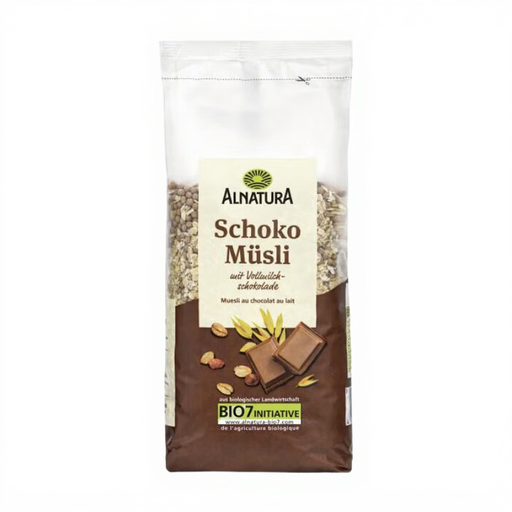 No image available
For stocking up on breakfast cereal, if 750 g suits how much your household gets through.
Before buying, check the organic certification, nutritional information and allergens on the specific pack.
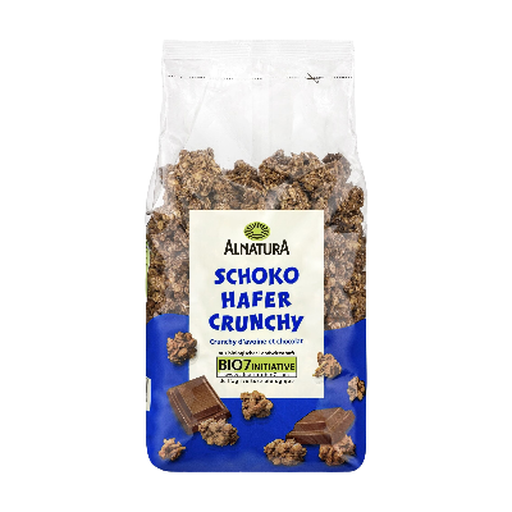 No image available
For your breakfast cupboard if you’re looking for chocolate oat crunchy muesli and 750 g suits the amount you have in mind.
Compare the sugar content per 100 g and check the organic and allergen labelling on the pack.
Check for the EU organic logo, the control body code and the country of origin of the agricultural ingredients. According to the Federal Ministry of Agriculture, Food and Home Affairs, the EU organic logo is required on pre-packaged organic food from the EU.
No. Organic certification doesn’t tell you how much sugar a product contains. Compare the sugar content of the specific products on the same basis, for example per 100 g.
Choose a pack size that suits how much your household plans to use. REWE lists organic chocolate muesli in 500 g packs, while EDEKA lists an organic chocolate muesli in a 750 g pack. Then check which variety is available where you shop.
No. You need to check the ingredients, allergen information and precautionary allergen statements on the individual pack. Labels such as vegan, gluten-free or lactose-free shouldn’t be assumed to apply to other varieties.