Campers who prioritise organic food
You want to verify the organic claim on each corn snack, so look for clear certification rather than general claims about naturalness.


When choosing an organic corn snack for camping, don’t rely on a description such as ‘natural’ alone. Check the organic certification, ingredients, allergen warnings and storage advice on the specific pack. If you plan to eat it on its own, a short ingredients list may be a deciding factor. If you’re looking for crisps to enjoy with a dip, or specifically need a vegan or gluten-free product, compare the product type and labelling separately. The right pack size depends on how you’ll store the snack while you’re away and how quickly you’ll eat it once opened.
You want to verify the organic claim on each corn snack, so look for clear certification rather than general claims about naturalness.
You need a pack size that suits your group, and you’ll want to consider whether the snack can be kept somewhere dry and away from heat in your tent, rucksack or vehicle.
You may be looking for a product that’s specifically labelled vegan or gluten-free, or prefer a short ingredients list. If you have allergies, also check the ingredients and any ‘may contain’ information on the specific pack.
First, decide whether organic certification is a must-have for you. Then compare the storage and pack information, as well as the ingredients and nutritional information for the type of product you actually want to eat.
| Criteria | What to check | Who is it important to? |
|---|---|---|
| Organic certification | Check the organic seal or EU organic logo and the inspection body code on the specific product. According to the Federal Office for Agriculture and Food, using the German organic seal requires compliance with EU organic standards and regular inspections. | If I specifically want to take clearly certified organic corn snacks camping, the word ‘natural’ isn’t enough for me. Around 40% of consumers put this organic verification first. |
| Storage and quantity | Check the pack size and storage advice, and plan to use a tightly sealed container or clip for any leftovers. | In my rucksack or tent, I only want to take as much as I can store and eat under the stated conditions. Around 30% of consumers prioritise being able to store and handle their snacks appropriately. |
| Ingredients and labelling | Check the ingredients, highlighted allergens and ‘may contain’ warnings. If needed, compare fat and salt using the nutritional information per 100 g. | If I need a snack to meet specific ingredient requirements, I need information about the particular variety, rather than making assumptions based on ‘corn’ or ‘organic’. These requirements are a priority for around 30% of consumers. |
Organic certification doesn’t tell you whether a particular corn snack is gluten-free or may contain traces of other allergens. Even products labelled gluten-free may carry other ‘may contain’ warnings.
For each variety, read the ingredients, highlighted allergens and ‘may contain’ warnings on the pack. Don’t assume these details from the corn base or organic seal alone.
A larger quantity can be ideal for sharing, while a smaller group may need to store leftovers after opening. The pack size alone doesn’t tell you how long the contents can be kept once opened.
Choose a pack size that suits your group, and follow the storage advice on the specific pack once it’s been opened.
These product types can have different ingredients and nutritional values. REWE lists its organic corn puffs as containing 1.2 g of fat per 100 g, while EDEKA24 lists 22 g per 100 g for Alnatura Organic Corn Chips Natural. This doesn’t mean that all puffs or crisps have the same nutritional profile.
Compare the nutritional information per 100 g for the varieties you’re considering, and take ingredients and portion size into account separately.
The products mentioned come with advice to store them in a dry place and protect them from heat or light. The consumer advice centre also recommends protecting dry foods from significant temperature fluctuations.
Keep your snack somewhere dry and protected while you’re away, seal any leftovers securely and follow any additional advice on the specific pack.
The information below relates to the specific product range or variety named, not every corn snack from that brand.
REWE Bio Corn Puffs are an option to eat on their own, with corn semolina from certified organic farming listed as an ingredient.
EDEKA24 describes Alnatura Organic Corn Chips Natural as vegan corn crisps that can be eaten on their own or with a dip.
Rossmann stocks Pufuletti Organic Corn Snack, a salted corn snack labelled organic, vegan and gluten-free.
biozentrale describes its Natural Corn Corners as non-fried organic corn snacks, and labels this variety vegan and gluten-free.
Lidl Germany mentioned a Snack Day Organic Corn Snack in a 2023 press release.
These two organic corn snacks suit different snacking occasions: a small pack of corn and millet puffs, and corn rolls to enjoy on their own or with a dip. For both, check the pack information against your ingredient and storage requirements.
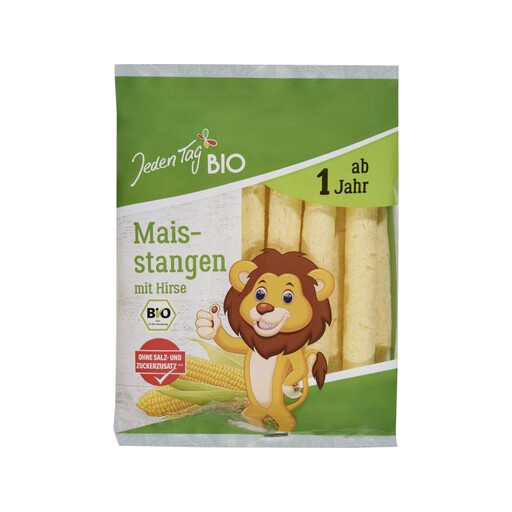 No image available
The 50-g pack is a handy option if you want to take a small amount of snacks with you. Seal the pack securely after opening and eat the contents within two days. If you need a gluten-free label, check that it appears on the pack you receive.
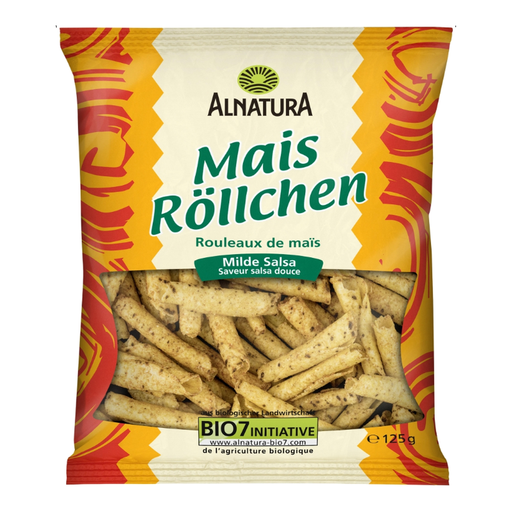 No image available
The 125-g pack of corn rolls is a good option for sharing, whether you eat them on their own or with a dip. Check the pack for storage advice once opened. If you have a soya allergy, also check the information about possible traces.
Look for clear organic certification and the inspection body code on the specific pack. The Federal Office for Agriculture and Food explains that the German organic seal may only be used when EU organic standards are met and regular inspections are carried out. A description such as ‘natural’ isn’t a substitute for this certification.
No. You can’t assume either from the word ‘organic’ or from corn being an ingredient. Look for an explicit claim on the specific variety, and if you have allergies, also check the ingredients and ‘may contain’ warnings on the pack.
Follow the pack’s instructions and store them somewhere dry and away from heat. Some varieties also need to be protected from light. Seal any leftovers securely after opening and follow any stated time limit for eating them.