Organic-minded shoppers planning portions
You want to check the organic label on the product itself and decide how much of the snack to have before you start eating.


Don’t choose an organic corn snack based on its organic label alone. When comparing similar snacks, check the energy per 100 g and consider how much you actually plan to eat. Organic certification relates to how a product is produced, not its calorie content. Ingredients, salt and any allergens should also inform your decision.
You want to check the organic label on the product itself and decide how much of the snack to have before you start eating.
You compare similar corn or tortilla crisps using the nutritional information, rather than assuming that ‘organic’ means a certain energy content. If available, a Nutri-Score can help you compare products within a suitable category.
You pay close attention to the recipe or need a clearly stated feature such as ‘gluten-free’. These claims apply to the specific product: Alnatura says its Mais Chips Natur may contain traces of soya, while Pural describes its Chips’O maïs Natur as gluten-free.
First, check that the corn snack meets your organic requirements. Then compare the nutritional information for similar snacks and take your planned portion into account.
| Criterion | What to check | Who it matters to |
|---|---|---|
| Energy and portion size | Compare the energy in kcal per 100 g and the pack size. If you’re planning your portion, remember to include any dips or toppings. | If you want to plan how much you snack on, look at the amount you’ll actually eat as well as the value per 100 g. For around 36% of consumers, managing energy intake and portion size is the main priority. |
| Organic labelling | Check the EU organic logo, control body code and country of origin on the product itself. | If you specifically want to buy organic, look for clear certification rather than packaging that simply looks natural. Around 29% of consumers prioritise this. |
| Salt and recipe | Compare the salt per 100 g on the nutritional information, as well as the order of ingredients and the oil used in similar snacks. | If a straightforward recipe matters to you, check how the salt content differs between savoury options. Ingredients and salt are the most important buying criteria for around 21% of consumers. |
| Allergens and dietary requirements | Read the ingredients, allergen information and any clearly stated dietary claims on the current pack. | If you need to avoid certain ingredients or are looking for a product that meets a particular dietary requirement, you can’t tell whether it’s suitable from the word ‘corn’ alone. Around 14% of consumers prioritise these checks. |
Organic labelling doesn’t tell you how much energy a corn snack provides. Organic corn crisps can still contain oil.
Compare the energy values of similar products, then decide separately how much you want to eat.
The nutritional information on the snack pack won’t automatically include a dip, cheese or other topping.
Compare the whole portion you plan to eat when weighing up different options.
Ingredients and product information vary. Alnatura says its Mais Chips Natur may contain traces of soya; Pural describes its Chips’O maïs Natur as gluten-free. These claims don’t apply to all corn snacks.
If you have specific dietary requirements, check the label on the current pack of the exact product you’re considering.
Alnatura’s product information for Mais Chips Natur lists corn flour, sunflower oil and 0.8% sea salt.
dennree describes its salted tortilla chips as being made with organic corn flour, organic sunflower oil and sea salt.
Pural describes Chips’O maïs Natur as organic tortilla crisps made with corn flour and sunflower oil.
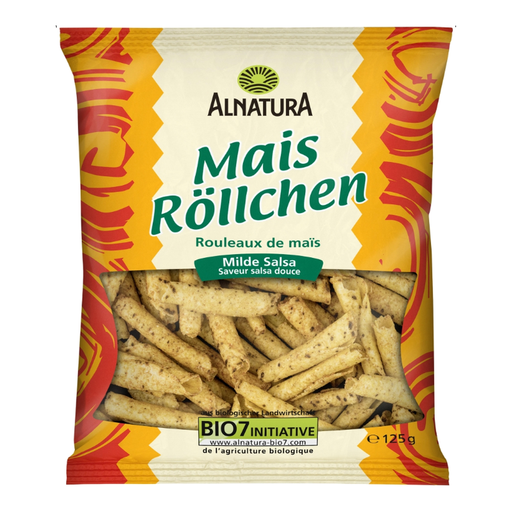
This selection features organic corn rolls with a mild salsa seasoning. To plan your portion, check the pack size and nutritional information on the current packaging.
 No image available
A good choice if you’re looking for organic corn rolls with a mild salsa seasoning. The pack contains 125 g. For your planned portion, check the nutritional information on the current packaging.
Check the EU organic logo, control body code and country of origin on the product itself. A description such as ‘natural’ isn’t a substitute for organic certification.
No. Organic describes how a product is produced, not its energy content. When comparing similar snacks, check the energy per 100 g and consider how much you’ll actually eat.
Compare the salt content per 100 g of similar products. If you’re having your snack with a dip, check its nutritional information too, rather than looking at the crisps alone.
According to the German Federal Centre for Nutrition, the Nutri-Score can help you compare products intended for the same eating occasion. It doesn’t replace the nutritional information or ingredients list, or help you decide on your portion size.