
Lieferung heute & morgen

Qualitätsgarantie

Willkommens-Angebote freischalten: KOSTENLOSE Lieferung | Bis zu 80 % RABATT | Kostenlose 30-Tage-JoyPlus-Testphase
App herunterladen
Organic fruit purée can be an easy way to complement your baby’s weaning diet. However, there are clear differences between jars, portion pots, pouches and multipacks. What matters is not eye-catching flavour claims, but the age recommendation, ingredients list, added sugar, consistency, portion size and storage instructions.
This guide from the Joybuy Product Recommendation Officer explains what parents and carers should look out for when buying. Clear differentiation is also important for adults looking for tinned fruit for desserts or fruit salads: sweet tinned fruit is not automatically suitable for babies.
Fruit naturally contains sugar. A product can therefore contain no added sugar and still have a comparatively high sugar content per 100 grams. Check the ingredients list when comparing products:
With organic baby food containing no added sugar, the naturally occurring sugar content should not be confused with a sugar-free food.
Baby food from 4 months, baby food from 5 months and baby food from 6 months are not interchangeable. The age recommendation on the packaging indicates the intended use specified by the manufacturer. New foods should be introduced according to the child’s individual development and after consulting a paediatrician or midwife.
Allergens and the recommended age range must be considered particularly carefully with blends containing yoghurt, quark, oats, wheat or spelt. Fruit purée for babies from 4 months is therefore not automatically suitable for every baby of this age.
A fruit pouch is convenient when you are out and about, but sucking directly and frequently from the pouch can prolong contact between the teeth and fruit sugar. For this reason, several products recommend emptying the contents onto a spoon. At home, jars or pots are often easier to portion.
Once opened, different products have different time limits: some specify 12 hours, others one or two days, while others allow up to three days in the fridge. Always follow the current label.
An organic seal or the EU organic logo indicates the relevant certification. Demeter products may also state that they come from biodynamic agriculture. Depending on the product, the ingredients may originate from the EU or from EU and non-EU countries.
A short ingredients list makes choosing easier. Pure fruit purée, for example, consists of one or more types of fruit. Variants containing cereals, milk or quark have a different composition and should be checked more carefully because of possible allergens.
Comparing products per 100 grams is useful when pack sizes differ. Relevant values include:
Nutritional values describe the composition, but they are not the only measure of suitability. A purée containing fruit and oats, for example, cannot be directly compared with a pure fruit purée.
Individual 125- or 190-gram jars are suitable when you want to try different varieties or offer smaller amounts. An organic baby food multipack can be more practical for regular use. However, consider the actual portion per jar or pouch, not just the total quantity.
Glass is sturdy for storage but fragile. Pouches are light and resealable, but should not be left with a baby to suck from continuously. For adults and desserts, larger tins of fruit such as 245 or 425 grams are a separate product category; they often contain sugar or syrup and should therefore not be treated as equivalent to baby fruit purée.
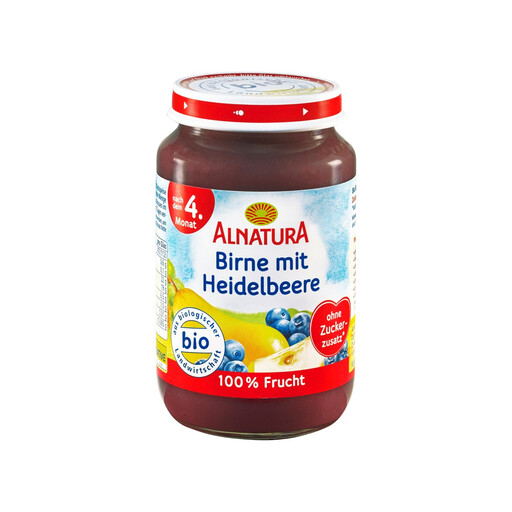
Why this product suits this profile: The 190g jar is labelled as suitable for babies from 4 months and combines pear with blueberry. The ingredients list contains 90% pears and 10% blueberries from organic farming.
The product declaration does not list any added sugar; the stated sugar comes from the fruit. The age recommendation and finely puréed consistency are stated directly in the product information.
100% organic fruit according to the product description, gluten-free and suitable for refrigerated storage for up to two days after opening.
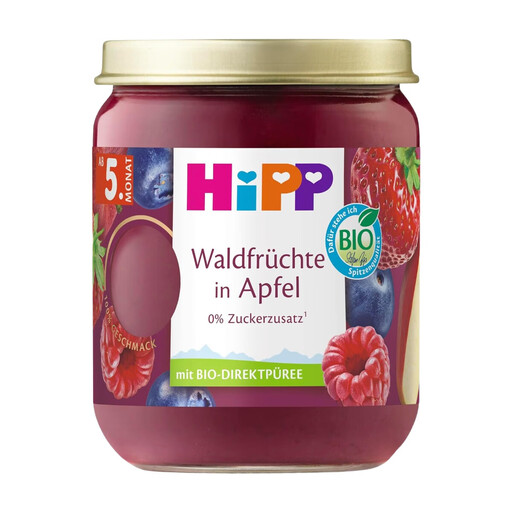
Why this product suits this profile: The multipack contains six 160g jars and is aimed at households planning to serve fruit purée regularly to babies from 5 months. The blend contains apples, strawberries, blueberries and raspberries.
The product information states a 99.7% fruit content and no added sugar. This means the composition can be assessed using specific details rather than general marketing claims.
EU organic certified, free from the 14 major allergens according to the product description, and suitable for refrigerated storage for up to three days after opening.
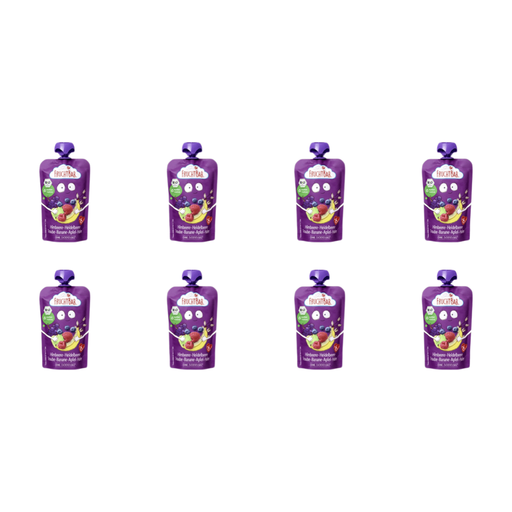
Why this product suits this profile: Eight resealable 100g pouches provide convenient, predictable portions for trips out, days with a carer or keeping a supply at home. According to the product information, it is suitable from 6 months.
The pouches are portioned and are not intended for long-term storage after opening. The advice not to suck continuously from the pouch should be followed.
Organic fruit blend with apple, banana, grape, raspberry, blueberry and oats; no added sugar according to the product description.
We have put together a complete, regularly updated list of products that fully meet these strict selection criteria and the safety regulations applicable in the EU.
This depends on the individual product. The selection includes products labelled as suitable from the 4th, 5th, 6th, 8th or 10th month. The manufacturer’s information on the label is decisive. New foods should be introduced in line with the child’s development and, if you are unsure, discussed with a medical or nutrition professional.
No. “No added sugar” means that no additional sugar has been added. The natural sugar from apples, pears, bananas and other fruit remains. This is why the ingredients list and nutritional table should be considered together.
Different products have different time limits. Some jars should be used within 12 hours, while others should be consumed within one, two or three days. Opened fruit purée should be kept in the fridge and should not be fed directly from the jar or pouch if you intend to store leftovers. Always follow the instructions on the relevant packaging.