What to look for when buying
First decide whether you want ready-made popcorn or would rather prepare it before your hike. Then check the labelling and the specific recipe of the pack you’re considering.
| What to consider |
What to check |
Who it matters to |
| Organic certification |
Check the pack for the EU organic logo, inspection body code and statement of origin. |
If organic farming matters to me, I want to be able to check the certification on the product I’m taking with me. This is a priority for around 38% of consumers. |
| Ready to eat and easy to carry |
Choose ready-popped popcorn in a suitable pack size, and check the storage instructions. |
If I don’t have time to prepare it, I need a snack I can eat straight away while out and about. This is a priority for around 31% of consumers. |
| Ingredients and nutritional information |
Compare ingredients, sugar and salt per 100 g; if you have allergies, read the may-contain warnings on the specific pack. |
If I want to choose the sweetness and seasoning carefully, the recipe matters more to me than the flavour name. This is the top priority for around 31% of consumers. |
Brands to consider
The details below refer to specific product ranges or products, not every type of popcorn sold by each brand.
Heimatgut
Ready-to-eat organic popcorn for hikes when you don’t want to prepare your own.
- For its 60 g Bio Popcorn Salzig, Heimatgut lists corn, coconut oil and sea salt as ingredients.
- According to the manufacturer, this particular variety contains 0.9 g of sugar and 1.5 g of salt per 100 g; other varieties have their own nutritional information.
Alnatura
Organic popcorn kernels to prepare at home, as well as ready-to-eat sweet and salty organic popcorn.
- According to Alnatura, its Demeter-certified organic popcorn kernels contain popcorn kernels as their only ingredient; you choose the seasoning when you prepare them.
- Possible traces are listed for the popcorn kernels. For the ready-made sweet and salty popcorn, the ingredients list shows that beet sugar makes up 27% of the recipe.
Davert
Organic popcorn kernels for preparing a snack yourself before your hike.
- Davert lists popcorn corn as the only ingredient in its popcorn kernels.
- The product information warns of possible traces of, among other things, cashews, almonds, tree nuts and sesame.
REWE Bio
A supermarket own brand with ready-to-eat organic popcorn options.
- REWE publishes the ingredients and nutritional information for its Bio Popcorn Pumpkin Spice.
- According to REWE, this variety contains 28 g of sugar per 100 g. Check the specific pack and availability at your local store.
EDEKA Bio
An organic own brand to look out for when shopping at your local EDEKA store.
- EDEKA describes its organic products as coming from certified organic farming.
- Check the specific product to see whether a particular organic popcorn or popcorn kernels are available and what ingredients they contain.
Suitable products at Joybuy
These popcorn kernels are a good choice if you want to pop and season your hiking snack yourself before setting off. They aren’t ready-to-eat popcorn for taking on the trail.
 No image available
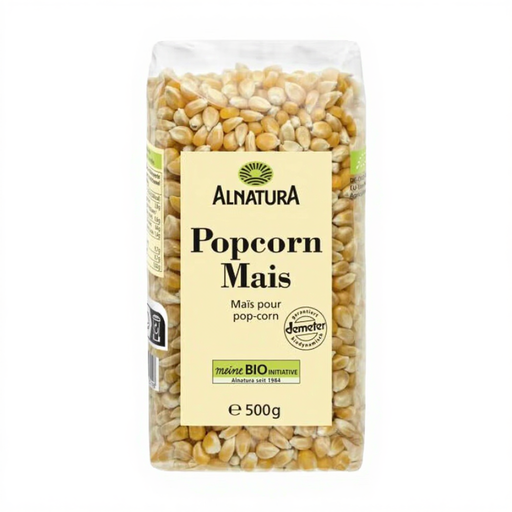
Alnatura organic popcorn kernels 500 g
For a homemade hiking snack, with the seasoning chosen by you before you set off.
Alnatura describes these popcorn kernels as an organic Demeter product and lists popcorn kernels as the only ingredient. They’re designed to be prepared in a saucepan with a lid.
Alnatura warns that these popcorn kernels may contain traces of gluten, soya, milk, almonds, nuts, sesame and lupins. If you have allergies, check the current labelling on the pack.
Joybuy
Frequently asked questions
How can I identify organic popcorn on the packaging?
Look for the EU organic logo, along with the inspection body code and the stated origin of the agricultural ingredients. According to the Federal Ministry of Agriculture, Food and Home Affairs, the EU organic logo has been mandatory on pre-packed organic food from the EU since 1 July 2010. The information on the actual pack is what matters.
Is organic popcorn automatically low in sugar?
No. Organic certification doesn’t describe the sugar content of a recipe. REWE lists 28 g of sugar per 100 g for its Bio Popcorn Pumpkin Spice, while Heimatgut states that its Bio Popcorn Salzig contains 0.9 g of sugar per 100 g. Compare the nutritional information for the variety you want to take with you.
When is it worth popping your own popcorn for a hike?
Organic popcorn kernels are a good choice if you have time to prepare them before your hike and want to choose the oil and seasoning yourself. You’ll need to pop the corn and then pack it for the journey; if you want a snack that’s ready to eat straight away, choose ready-made popcorn.
Is a short ingredients list enough if I have allergies?
No. Also read the allergen and may-contain warnings on the specific pack. Both Davert and Alnatura warn of possible traces in their popcorn kernels, even though each lists popcorn kernels as the only ingredient.
How should I carry an opened pack of popcorn?
Keep it dry and seal the pack as airtight as possible once opened. Alnatura recommends storing its ready-made popcorn in a dry place and protecting it from heat; choosing a pack size you can finish during your hike means you won’t need to transfer any leftovers to another container.


