For those who want control over the fat
You want to choose the type and amount of oil you add, and are happy to prepare your popcorn in a pan.


If you want to control how much added fat, sugar and salt you use, unprepared organic popcorn kernels are a good choice. Ready-to-eat popcorn and microwave bags save you the effort of preparing it, but give you less control over the recipe. Alnatura states that its unprepared kernels contain 3.8 g of fat per 100 g, and its stovetop instructions call for oil. The nutritional values of the finished popcorn therefore depend on your recipe – the organic label alone tells you nothing about its fat content.
You want to choose the type and amount of oil you add, and are happy to prepare your popcorn in a pan.
You want to verify the organic label on the specific pack and check which ingredients have been added to that particular variety.
You prefer ready-to-eat popcorn or a microwave bag, and compare the fat, sugar and salt per 100 g before buying.
A good fit if: You want to choose which ingredients to add during preparation.
Bear in mind: Preparing the kernels in a pan takes time, and Alnatura’s instructions call for oil. The stated 3.8 g of fat per 100 g applies to the unprepared kernels.
A good fit if: You want to enjoy popcorn without preparing it yourself.
Bear in mind: The recipe is already set. HEIMATGUT states that its salted organic popcorn contains 17 g of fat and 1.5 g of salt per 100 g.
A good fit if: You want to make popcorn when you fancy it and have a microwave to hand.
Bear in mind: The salted HEIMATGUT product listed by REWE contains 18 g of fat and 2 g of salt per 100 g. Follow the instructions on the bag when heating and opening it.
| Criterion | What to check | Who it matters to |
|---|---|---|
| Fat and preparation | Check the fat per 100 g and any added oils in the ingredients list. If you’re buying popcorn kernels, also factor in the oil you’ll use to prepare them. | If you want to choose how much fat to add, kernels are a better fit, as you prepare them yourself. This is the main priority for around 50% of consumers. |
| Organic labelling | Check the EU organic logo, control body code and country of origin of the agricultural ingredients on the specific pack. | If you value clear, verifiable organic labelling, you’ll want to check the information for your chosen variety. This is the main concern for around 30% of consumers. |
| Flavour and convenience | For sweet and salted varieties, compare sugar, salt and fat per 100 g. If you’re choosing a microwave bag, read the preparation instructions too. | If you’re short on time, don’t let your choice of flavour distract you from the nutritional information. Around 20% of consumers put this comparison ahead of other buying criteria. |
Organic labelling relates to how a product is farmed, not to a specific fat content. According to EUR-Lex, EU rules set the threshold for a ‘low-fat’ claim on solid foods at no more than 3 g of fat per 100 g. HEIMATGUT states that its ready-to-eat salted organic popcorn contains 17 g per 100 g.
Check the organic label and nutritional information separately, and compare the fat content per 100 g for the specific variety.
Alnatura lists 27% beet sugar among the ingredients of its sweet and salted popcorn. The sweet organic popcorn from Ährenbrüder listed by REWE contains 34 g of sugar per 100 g.
For sweet varieties, compare the sugar per 100 g as well as the fat, and bear the pack size in mind.
A microwave bag contains a ready-made recipe. The salted HEIMATGUT product listed by REWE contains 18 g of fat and 2 g of salt per 100 g. Hot steam and fat may escape when you open the bag.
Check the ingredients and nutritional information before buying. When preparing it, follow the power, timing and safety instructions on the specific bag.
Alnatura offers unprepared organic popcorn kernels as well as ready-to-eat sweet and salted organic popcorn.
The products considered here are ready-to-eat salted organic popcorn and a salted organic microwave bag.
Ährenbrüder offers sweet organic popcorn among other products.
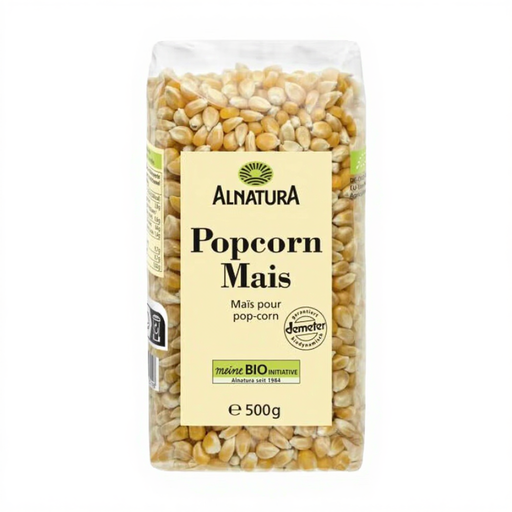
These popcorn kernels are intended for you to prepare at home. You choose which ingredients to add, but you’ll also need to consider how much you use and follow the preparation instructions.
 No image available
For preparing at home when you want to control how much oil, sugar and salt you add.
Alnatura states that the unprepared kernels contain 3.8 g of fat and 0.02 g of salt per 100 g. The stovetop instructions call for oil, so these nutritional values don’t apply to the finished popcorn.
No, the organic label doesn’t guarantee a low fat content. According to EUR-Lex, EU rules set the threshold for a ‘low-fat’ claim on solid foods at no more than 3 g of fat per 100 g. Even unprepared organic popcorn kernels contain 3.8 g per 100 g according to Alnatura, so always compare the nutritional values of the specific variety.
Check the EU organic logo, control body code and country of origin of the agricultural ingredients on the pack. The Federal Ministry of Agriculture, Food and Home Affairs describes the EU organic logo as compulsory labelling for pre-packed organic food from the EU that meets the relevant requirements.
With unprepared popcorn kernels, you can control the ingredients you add. Follow the preparation instructions: Alnatura’s instructions for its popcorn kernels call for oil in the pan, so the nutritional values of the kernels won’t be the same as those of your finished portion.
First, check the ingredients and nutritional information. When preparing the popcorn, follow the instructions on the specific bag for microwave power and cooking time. REWE warns that hot steam and fat may escape when opening the salted HEIMATGUT product listed on its site.