If you want to control how much oil, sugar and salt you add, organic popcorn kernels are a good starting point for movie night – but you’ll need to prepare them first. Ready-to-eat organic popcorn can be served straight away, but its recipe is already set. So when choosing a ready-made variety, compare the ingredients and nutritional information rather than relying on the organic label alone.
Which type is right for you?
If you like to season it yourself
If you want to control how much oil, sugar, salt and seasoning you add, and have a saucepan to hand, organic popcorn kernels could be just the thing. Alnatura and Davert both list popcorn kernels as an ingredient in their respective products.
If you want a snack straight away
Ready-to-eat organic popcorn is more convenient for a movie night when you don’t want to do any preparation. Whether a sweet, salty or sweet-and-salty variety suits you best depends on its specific recipe.
If you want to check the organic certification
If clear labelling matters to you, look for the organic designation, the EU organic logo and the code of the inspection body. Lebensmittelklarheit lists these as useful points to check when buying organic food.
What to look for when buying
Organic popcorn kernels
Best if: You want to season sweet and savoury portions yourself.
The trade-off: You’ll need time, a saucepan with a lid and oil to prepare them; the nutritional information for the unpopped kernels doesn’t reflect the finished, seasoned popcorn.
Ready-to-eat organic popcorn
Best if: You want to serve the snack without cooking.
The trade-off: The ingredients and seasoning are already decided, so check the information for the variety you’re considering.
| Criteria |
What to check |
Who it matters to |
| Choose your own ingredients |
For ready-made popcorn, compare the ingredients and nutritional information per 100 g; for kernels, factor in the oil and seasoning you’ll use to prepare them. |
If I want to control how much sugar, salt and oil I use, I’m happy to prepare the popcorn in a saucepan. For around 33% of consumers, having this control is a key consideration when buying. |
| Serve without preparation |
Distinguish ready-to-eat popcorn from microwave popcorn; for the latter, read the preparation instructions for the specific variety. |
If I want the snack ready when the film starts, I don’t want to wait for kernels to pop. Around 25% of consumers prioritise being able to eat the snack straight away. |
| Organic certification |
Check the organic designation, EU organic logo and inspection body code on the pack. |
I want to know what the organic claim on the popcorn I choose is based on. This certification is the most important buying criterion for around 25% of consumers. |
| Flavour |
For sweet-and-salty varieties, read the ingredients list; with plain kernels, you can season separate portions differently. |
If we fancy both sweet and salty popcorn on movie night, I want to choose a recipe that suits us. Around 17% of consumers prioritise their choice of flavour. |
Common pitfalls
-
Assuming organic means specific nutritional values
Organic certification doesn’t tell you how much sugar, fat or salt a ready-made variety contains. Alnatura says its sweet-and-salty popcorn recipe contains 27% beet sugar; according to the information listed by REWE, Heimatgut’s salty organic popcorn contains 17 g of fat and 1.5 g of salt per 100 g.
Compare ready-made varieties using their ingredients lists and nutritional information, on the same 100 g basis.
-
Treating kernels and ready-made popcorn as the same thing
Popcorn kernels need to be prepared first, while ready-to-eat popcorn can be eaten straight away. Microwave popcorn is another type of product, with its own preparation instructions.
Before you buy, decide whether you want to season it yourself, prepare popcorn in the microwave or snack without any preparation.
You’ll also need oil for the kernels and, if you like, ingredients for seasoning.
-
Overlooking the information on the pack
Davert says its popcorn kernels may contain traces of cashews, almonds, nuts and sesame. Heimatgut’s salty organic popcorn also carries a warning that some kernels may not have popped.
If you have allergies, check the information on the specific pack, and look out for hard, unpopped kernels when serving.
Key brands to consider
Alnatura
Alnatura offers both popcorn kernels to prepare yourself and ready-to-eat organic sweet-and-salty popcorn.
- For its popcorn kernels, Alnatura lists kernels from Demeter-certified organic farming as the ingredient.
- According to Alnatura, its ready-made sweet-and-salty variety contains 27% beet sugar; check its recipe separately from the unpopped kernels.
Davert
Davert offers organic popcorn kernels to prepare in a saucepan.
- Davert lists organic popcorn kernels as the ingredient; you can add sugar or salt after popping.
- The kernels aren’t ready to eat. Davert also warns that they may contain traces of cashews, almonds, nuts and sesame.
Heimatgut
Heimatgut has ready-to-eat salty organic popcorn and organic microwave popcorn listed.
- For its ready-to-eat salty popcorn, REWE lists corn, coconut oil and sea salt as ingredients.
- This variety contains 17 g of fat and 1.5 g of salt per 100 g; these values don’t apply to all Heimatgut varieties.
REWE Bio
REWE Bio is a supermarket own brand. REWE also lists products from other brands in its organic popcorn category.
- REWE says its own brand aims to offer short ingredients lists without unnecessary additives.
- This doesn’t tell you what’s in every popcorn variety, so read the label on the specific product.
Popcorn kernels at Joybuy
These popcorn kernels are worth considering for a movie night when you want to season them yourself. They need to be prepared before eating.
 No image available
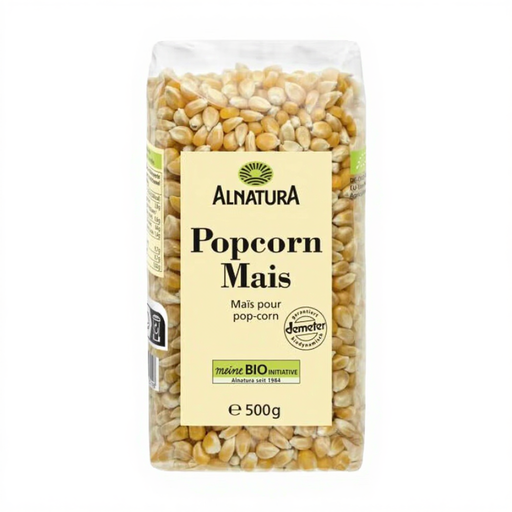
Alnatura organic popcorn kernels, 500 g
For popcorn you can season yourself on movie night: Alnatura lists kernels from Demeter-certified organic farming as the ingredient in these popcorn kernels.
The pack contains 500 g of unpopped kernels. You’ll need a saucepan with a lid and some oil to prepare them; you can choose any other ingredients yourself.
View at Joybuy
Frequently asked questions
How can I tell if popcorn is organic?
Look for the organic designation, the EU organic logo and the code of the organic inspection body. Lebensmittelklarheit lists these as useful things to check; also look at the country-of-origin information on the pack.
Does organic popcorn automatically contain less sugar or salt?
No, organic certification doesn’t determine the recipe. Alnatura says its sweet-and-salty popcorn contains 27% beet sugar; REWE lists Heimatgut organic salty popcorn as containing 1.5 g of salt per 100 g. So compare the specific variety using its ingredients list and nutritional information.
How do I prepare organic popcorn kernels in a saucepan?
Heat oil in a saucepan, add the popcorn kernels and put the lid on, as Davert recommends for its kernels. Take the pan off the heat when the popping stops, then season the popcorn to taste.
How should I store popcorn kernels and ready-made organic popcorn?
Store the products according to the instructions on each pack. The varieties described should be kept somewhere dry and protected from heat; Heimatgut also advises keeping its product out of direct sunlight.


