Start with organic certification
For families who want to check the EU organic logo and the stated organic control body before choosing packaged popcorn. You can then compare flavours, ingredients and pack sizes.


Ready-to-eat organic popcorn is a good choice for a school lunchbox when you need a snack that requires no preparation. If you’d rather choose the amount of sugar, oil and salt yourself, you can make organic popcorn at home and leave it to cool. Whichever option you choose, organic certification is no substitute for checking the ingredients, nutritional information and any allergens.
For families who want to check the EU organic logo and the stated organic control body before choosing packaged popcorn. You can then compare flavours, ingredients and pack sizes.
For families who want to put popcorn straight into a lunchbox and compare the sugar, fat and portion information on the specific pack when choosing sweet varieties.
For households with time to pop and cool the popcorn before the school day, and who want to decide how much oil, sugar and salt to use.
A good fit if: You want a snack that can go straight into the lunchbox, with no preparation at home.
The trade-off: The recipe is already set. REWE lists 28 g of sugar per 100 g and three portions per 90 g pack for Heimatgut Bio Popcorn Süß. Check the pack you buy rather than relying on the stated portion size alone.
A good fit if: You can make the popcorn before the school day and want to decide how to season it yourself.
The trade-off: Alnatura says to pop the kernels in a pan with heated oil. The popcorn then needs to cool before you pack it to take with you.
| What to check | What to look for when buying | Who it matters to |
|---|---|---|
| Organic certification | Check the EU organic logo and organic control body on the pack; green packaging alone is not enough. | If organic certification is a must for your snack, you’ll want to see the label before choosing a flavour. For around 36% of consumers, this is the top priority. |
| Ingredients and nutritional information | Compare the ingredients list and the sugar and fat figures per 100 g. For popcorn kernels, the figures apply to the unprepared kernels, not to any seasoning added later. | With sweet popcorn, you’ll want to know what’s in the finished portion or choose the seasoning yourself. Around 29% of consumers prioritise this. |
| Preparation | Choose between ready-to-eat popcorn and kernels to pop yourself. If you’re making it at home, allow time for cooling and packing. | If there’s no time to cook in the morning, you’ll need a snack that’s ready to take with you. This is the main concern for around 21% of consumers. |
| Allergen information | Read the current ingredients list and any ‘may contain’ information on the specific pack. | If allergens affect your choice, don’t rely on an old product image. This information takes priority for around 14% of consumers. |
The organic logo tells you how the food was produced, not how much sugar it contains. REWE lists 28 g of sugar per 100 g for Heimatgut Bio Popcorn Süß and 34 g for Ährenbrüder Bio Popcorn süß.
Before deciding on a lunchbox portion, compare the nutritional information per 100 g and the ingredients list for the variety you’re considering.
Nutritional information on a pack of popcorn kernels applies to the unprepared kernels. Oil and any other ingredients you add will change the finished snack.
Take the ingredients you actually use into account, and wait until homemade popcorn has cooled before putting it in the lunchbox.
Check the ingredients and ‘may contain’ information on each individual pack. For its organic popcorn kernels, Alnatura lists possible traces of several allergens, including gluten, soya, milk, almonds, nuts, sesame and lupin.
If you have relevant allergies, check the current labelling and follow any individual medical advice.
Alnatura offers both ready-to-eat organic popcorn and organic popcorn kernels to prepare at home.
REWE stocks Heimatgut ready-to-eat organic popcorn varieties.
REWE stocks Ährenbrüder Bio Popcorn süß, labelled ‘regional’.
Here, REWE is a useful reference point for comparing own-brand products, other organic popcorn varieties and organic popcorn kernels.
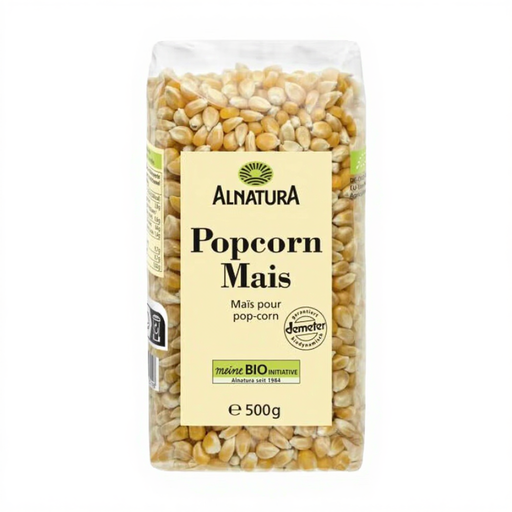
This selection of products is for households that want to make a break-time snack themselves before the school day.
 No image available
For popcorn you can prepare and season at home for a school lunchbox; the kernels are not ready to eat.
The unprepared kernels contain 1.4 g of sugar per 100 g. Alnatura says to cook them in a pan with heated oil; the oil and seasoning will change the composition of the finished snack.
Alnatura lists possible traces of several allergens. Check the current pack for the organic certification and any ingredients or ‘may contain’ information relevant to you.
Check the EU organic logo and the organic control body listed on the specific pack. The Verbraucherzentrale explains that the EU organic logo is required on packaged organic foods produced within the EU.
No. You can’t tell how much sugar it contains from the organic label. REWE lists 28 g and 34 g of sugar per 100 g respectively for the sweet Heimatgut and Ährenbrüder varieties. Compare the figures for the variety you’re planning to buy.
Read the current ingredients list and any ‘may contain’ information on the specific pack. Alnatura’s organic popcorn kernels may contain traces of allergens including gluten, soya, milk, almonds, nuts, sesame and lupin. If you have a relevant allergy, also follow your individual medical advice.