Make-it-yourself fans stocking up
You have a saucepan or suitable lidded frying pan and want to portion and season popping corn yourself for several evenings.


If you’re looking for an organic popcorn base that you can portion yourself and have a way to cook it, organic popping corn is a good choice: you decide how much oil and seasoning to use. If you don’t have access to cooking facilities, ready-to-eat organic popcorn is more practical; check the ingredients and nutrition information first. Popcorn on its own isn’t a varied evening meal.
You have a saucepan or suitable lidded frying pan and want to portion and season popping corn yourself for several evenings.
You want to check organic certification by looking at the logo and information on the pack, rather than relying on packaging that simply looks natural.
You need popcorn that’s ready to eat straight away, with no saucepan required, and want to check the recipe before you buy.
First decide whether you can cook unpopped kernels or need ready-to-eat popcorn. Then check the organic certification and ingredients, and consider what role the popcorn will play in your evening meal.
| What to consider | What to check | Who it matters to |
|---|---|---|
| Stock and portions | Pack weight and how much you can portion yourself; any ingredients needed to prepare it. | I want to spread a pack of popping corn over several evenings and choose the size of each portion myself. This flexibility is a priority for around 33% of consumers. |
| Organic certification | The EU organic logo, control body code, country of origin and ingredients list on the pack. | I’d rather be able to verify the organic certification than rely on the packaging design. This is the main concern for around 27% of consumers. |
| Cooking facilities | For unpopped corn, check the preparation instructions and make sure you have a suitable saucepan or lidded frying pan. | If I don’t have access to a usable kitchen, I need popcorn that’s ready to eat. Around 20% of consumers prioritise being able to eat it without any preparation. |
| Its place in your evening meal | For ready-to-eat popcorn, check the ingredients and nutrition information per 100 g; plan to have other foods with your evening meal. | If popcorn is part of my evening meal, I don’t want to treat it as a complete meal. This is the priority for around 20% of consumers. |
Organic certification describes how a food is produced and labelled; it doesn’t tell you whether it makes a complete evening meal. The German Nutrition Society recommends a varied selection of foods for healthy adults in Germany, including vegetables and pulses.
Enjoy popcorn as a snack or as part of your evening meal, and serve it with other foods.
Popping corn needs to be cooked before you eat it. dmBio specifically states that its popping corn isn’t intended to be eaten raw and must be heated thoroughly. Allergen information varies by product.
Check the preparation instructions, your cookware and the allergen information on the specific pack.
Ready-to-eat popcorn has a set recipe. According to Alnatura’s ingredients list, its ‘sweet and salty’ variety contains, among other ingredients, 27% beet sugar, sunflower oil and sea salt. This doesn’t apply to every ready-to-eat popcorn product.
Check the ingredients list and nutrition information per 100 g for each product. If you’d rather season it yourself, unseasoned popping corn is an option.
dmBio offers organic popping corn in a 500-g pack for cooking in a saucepan.
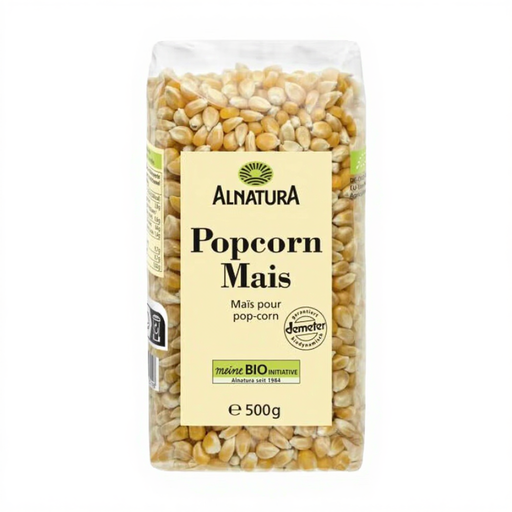
Alnatura sells popping corn from Demeter-certified organic farming, as well as ready-to-eat organic popcorn in a ‘sweet and salty’ variety.
Rapunzel offers organic popping corn for cooking in a saucepan, with the EU organic logo and Austrian agriculture listed as the country of origin.
Davert offers a 500-g pack of organic popping corn to pop at home.
This selection features unpopped organic corn for making popcorn yourself. It’s a good fit if you have cookware and want to season your portions yourself.
 No image available
For popcorn you can portion and season yourself, if you have access to cooking facilities.
500 g of popping corn; according to the product description, you’ll need a saucepan, oil and a lid to prepare it. Check the allergen information on the specific pack.
Check the EU organic logo, control body code and country of origin on the pack. The German Federal Ministry of Agriculture, Food and Homeland explains that pre-packed organic food from the EU must carry the EU organic logo.
According to the manufacturer, dmBio popping corn isn’t intended to be eaten raw and must be heated thoroughly. Prepare unpopped kernels according to the instructions on the relevant pack.
Organic popcorn on its own isn’t a varied evening meal. If you eat it in the evening, combine it with other foods. For a varied diet for healthy adults in Germany, the German Nutrition Society recommends, among other things, vegetables, pulses and wholegrains.
Compare the ingredients list, allergen information and nutrition information per 100 g. This helps you see what’s in the specific product, including whether sugar, oil and salt have been added.