For a break around the university canteen when you don’t have access to a kitchen, ready-to-eat organic popcorn is a better choice than popping corn. A small pack gives you a defined snack portion before you open it, while a larger bag is ideal for sharing. Popping corn is an option if you can use a suitable kitchen later and want to choose your own toppings. Check the organic certification and nutritional information separately: ‘organic’ on its own tells you nothing about the sugar or fat content of a particular variety.
Which option is right for you?
On the go, without a kitchen
If you’re taking a snack in your rucksack and want to eat it during your break, ready-to-eat organic popcorn could be just the thing. A 30-g pack is already portioned for one; with a larger bag, you can decide how much to take out.
If you’re checking the certification and ingredients closely
If organic status and ingredients matter to you, check the certification on the specific pack. The ingredients list and nutritional information can then help you compare sweet varieties, regardless of their organic label.
With access to a kitchen at home or in your accommodation
If you have a suitable pan, oil and a heat source, you can make your own popcorn from popping corn. You choose how to sweeten and season it as you prepare it. However, unpopped corn isn’t suitable for an impromptu break when you don’t have access to a kitchen.
What should you look for when buying?
First, decide whether your popcorn needs to be ready to eat during your university canteen break or whether you’ll prepare it later. Then check the organic certification, ingredients, nutritional information and pack size for the variety you’ve chosen.
| Criteria |
What to check |
Who it matters to |
| Ready to eat |
Is the popcorn already popped? Is the pack size right for your break? |
If I want to eat my snack straight from my rucksack, I don’t want to need a pan or heat source; around 42% of consumers prioritise this convenience. |
| Organic status and ingredients |
Check the organic certification, ingredients list and the sugar, fat and salt per 100 g. |
I want to know what the organic claim on the pack confirms and what goes into a sweet variety; around 33% of consumers say this is their main priority. |
| Make it yourself |
Check that you can use a pan, oil and a heat source, and read any allergen precautionary statements on the pack. |
If I’m making popcorn at home, I want to choose how to sweeten and season it, and I’m happy to put in the preparation time; around 25% of consumers consider this control their most important criterion. |
Common selection mistakes
-
Assuming ‘organic’ tells you about the nutritional values
Organic certification doesn’t tell you how much sugar or fat a product contains. REWE lists 28 g of sugar and 21 g of fat per 100 g for REWE Bio Popcorn Pumpkin Spice. Those figures apply to this variety, not to organic popcorn in general.
Check the organic information, then compare the ingredients lists and nutritional information for the varieties you’re considering.
-
Planning to eat popping corn during a break without kitchen access
Popping corn is a raw ingredient and isn’t ready to eat. Davert recommends preparing its popping corn with oil in a large pan with a lid.
Choose ready-to-eat popcorn for a university canteen break when you don’t have access to a kitchen. Buy unpopped corn if you can prepare it somewhere else.
-
Overlooking allergen warnings on popping corn
For the popping corn in question, Davert warns that it may contain traces of cashew nuts, almonds, other tree nuts and sesame. These warnings apply to specific products and shouldn’t be assumed to apply to other popping corn.
If an allergen matters to you, read the information on the pack you’re actually buying.
Brands and product ranges to consider
The examples below cover different product types: ready-to-eat popcorn in smaller or larger packs, and popping corn for you to prepare yourself. Information about individual varieties doesn’t apply to a brand’s entire range.
REWE Bio
REWE offers REWE Bio Popcorn Pumpkin Spice, a ready-to-eat 90-g variety.
- For this variety, REWE lists organic ingredients, the inspection body CZ-BIO-001 and nutritional information per 100 g.
- The variety listed contains 28 g of sugar and 21 g of fat per 100 g; other REWE Bio products may have a different composition.
HEIMATGUT
HEIMATGUT offers ready-to-eat sweet organic popcorn in packs including 30 g and 90 g.
- The 30-g pack gives you a pre-portioned snack for when you’re out and about.
- For the sweet variety in question, HEIMATGUT lists 28 g of sugar per 100 g; check the information on the specific pack when choosing.
Davert
Davert offers organic popping corn in a 500-g pack for you to prepare yourself.
- You can choose how to sweeten and season it after popping.
- The preparation described requires oil, a large pan with a lid and a heat source. Davert also warns that the product may contain traces of certain nuts and sesame.
Popping corn at Joybuy
This product is popping corn to prepare at home or in a suitable kitchen in your accommodation. For a university canteen break without kitchen access, you’ll need popcorn that’s already popped.
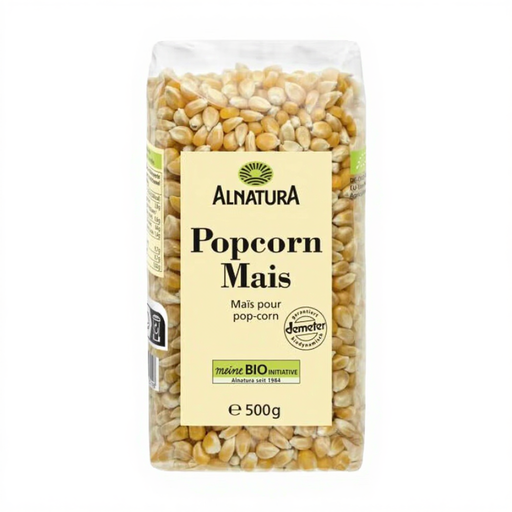 Image unavailable
Alnatura Organic Popping Corn Kernels, 500 g
For anyone with access to a kitchen who wants to make their own popcorn; the kernels aren’t a ready-to-eat snack for a university canteen break.
500 g of popping corn. Check the organic certification and, if relevant to your allergies, the precautionary allergen information on the specific pack.
View at Joybuy
Frequently asked questions
How can I identify packaged organic popcorn?
Look for the EU organic logo and check the other organic information on the pack. The Federal Ministry of Agriculture, Food and Regional Identity explains that the logo has been mandatory on pre-packaged organic food in the EU since 1 July 2010; a word such as ‘natural’ isn’t a substitute for organic certification.
Is popping corn suitable for a short university canteen break?
Only if you’ve prepared it beforehand; raw kernels aren’t ready to eat. Davert recommends preparing its popping corn with oil in a pan, so you’ll need access to a suitable kitchen.
Is sweet organic popcorn automatically low in sugar?
No. Organic certification doesn’t tell you how much sugar a product contains. REWE and HEIMATGUT each list 28 g of sugar per 100 g for the sweet varieties mentioned here; compare the nutritional information on the specific packs to choose the right one for you.
How should I store opened popcorn?
Store popcorn that’s already been popped in a dry place, in an airtight container if possible. HEIMATGUT notes that popcorn absorbs moisture; for unpopped corn, Davert recommends storing it somewhere dry and away from heat.


