What should you look for when buying?
First, decide whether a bar is suitable for your child at all. Only then is it worth comparing individual products.
Age-appropriate finger foods
When it works: When starting baby-led weaning, you can adapt the preparation to your child’s development and the meal in question.
Things to consider: Preparing food takes time. The Healthy Start Network also points out that a diet consisting exclusively of foods with lumps may not provide enough nutrients.
Organic bars from 12 months
When it works: As an occasional snack for a child who meets the age guidance for that specific bar and can eat it upright under supervision.
Things to consider: A packaged portion is convenient, but it is no substitute for a complementary feeding meal. Check organic certification separately from information about added sugar and nutritional values.
| Criterion |
What to check when buying |
Who it matters most to |
| Age and eating situation |
Read the age guidance and advice on supervision and posture; assess the texture in relation to your child’s ability to pick up and swallow food. |
If my child is just getting used to food with lumps, I don’t want to offer a bar just because it is convenient to hold. For around 31% of consumers, development and safety are the top priorities. |
| Role as a snack |
Consider whether the bar will remain an occasional snack; continue to offer a varied range of other meals. |
A quick snack shouldn’t take the place of a complementary feeding meal for us. Around 25% of consumers give greatest weight to nutritional needs. |
| Ingredients and nutritional values |
Check the ingredients, allergens, and sugar and salt levels in the nutritional information; compare sugar levels using the same measure, such as per 100 g. |
If fruit or juice concentrates are on the ingredients list, I want to know the actual sugar content and check the allergen information. For around 25% of consumers, ingredients and nutritional values are the main buying criteria. |
| Organic certification |
For packaged organic products, look for the EU organic logo and the stated organic inspection body; check age guidance and nutritional values separately. |
It matters to me that the organic claim can be verified, but I don’t want to assume that this makes the bar suitable as a meal. Around 19% of consumers put certification ahead of other buying criteria. |
Brands to consider
The information below relates to a specific bar in each case, not the brand’s entire range.
dmBio
dm-drogerie markt describes its dmBio Apple and Mango Fruit Bar as suitable from 1 year.
- The age guidance, organic inspection body DE-ÖKO-001, ingredients and nutritional information are listed for this bar.
- The recipe contains fruit and juice concentrates. According to dm-drogerie markt, the nutritional information lists 39,9 g of sugar per 100 g; nuts and soya are listed as allergens.
HiPP
The HiPP Organic Raspberry in Banana and Apple Bar described by Müller is labelled as a snack for children from 1 year.
- For this product, the information lists organic ingredients, the claim ‘no added sugar’, and advice to eat under supervision and not while lying down.
- The ingredients list contains fruit and juice concentrates. Müller states that each 23-g portion contains 9,5 g of sugar.
FruchtBar
REWE lists the FruchtBar Organic Strawberry, Apple and Oat Bar as suitable from 12 months.
- For this bar, REWE lists oats as the main ingredient, the organic inspection body CH-BIO-004 and the claim ‘no added sugar’.
- The recipe contains apple concentrates; REWE states that it contains 27 g of sugar per 100 g and may contain traces of milk, soya and tree nuts. Be sure to follow the supervision advice too.
Organic muesli bars at Joybuy
The following muesli bar is labelled ‘from 12 months’, making it an option as an occasional snack for a child of the appropriate age – not as complementary food for starting baby-led weaning. Check the specific bar to see whether its texture is right for your child’s ability to pick up and swallow food.
 No image available
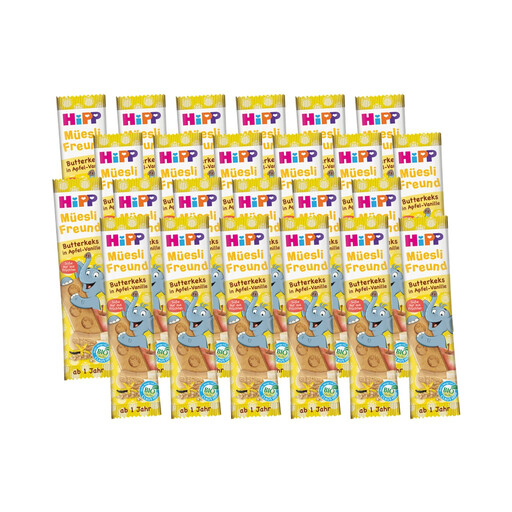
HiPP Organic Muesli Bar Butter Biscuits in Apple-Vanilla, from 12 months, 24 × 20 g
This is a bar snack for a child who has reached the stated age, not a replacement for a complementary feeding meal.
Pack of 24 bars, 20 g each. Before offering one, check the ingredients and nutritional information on the pack, as well as the texture and advice on the eating situation.
View at Joybuy
Frequently asked questions
Is an organic snack bar automatically suitable for baby-led weaning?
No. According to the Consumer Advice Centre, the EU organic logo indicates compliance with European organic regulations; it doesn’t assess your child’s development or the texture of a bar. Check the specific product and eating situation separately from its organic certification.
From what age might an organic bar be suitable for my child?
First, follow the age guidance for the specific bar; the brand examples described here are labelled from 12 months or from 1 year. Your child must also be able to manage food with lumps. The Federal Institute of Public Health highlights picking up and swallowing food in particular.
Does ‘no added sugar’ mean the bar contains little sugar?
No. To find out how much sugar a specific bar contains, check the nutritional information, including if it contains fruit or juice concentrates. Compare products using the same measure, such as per 100 g.
Can a bar replace breakfast or a baby-led weaning meal?
A fruit or cereal bar shouldn’t be planned as a regular replacement for a varied complementary diet. The Healthy Start Network points out that baby-led weaning may not provide enough nutrients; a convenient snack doesn’t solve this issue.
What should I bear in mind when my child eats a bar?
Follow the safety advice for the specific product and don’t leave your child unattended while they’re eating. The bars described by dm-drogerie markt, Müller and REWE specifically warn against eating while lying down; also check the allergen information on the pack.


