Shoppers who pay attention to portion size
You want to plan a single bar as a snack, so you compare not only the kcal per 100 g but also the weight and kcal per bar.


When choosing a snack bar by calorie content in an organic shop, first compare the kcal per 100 g, then check the kcal in the bar you actually plan to eat. A smaller portion may contain fewer kcal, even if the energy value per 100 g is similar. An organic label or fruity packaging is no substitute for checking the sugar, ingredients and allergens.
You want to plan a single bar as a snack, so you compare not only the kcal per 100 g but also the weight and kcal per bar.
When shopping, you look for clear organic labelling and also want to check the ingredients list and sugar content.
You may look for vegan or gluten-free labelling, or check for specific allergens. What matters is the information for the particular bar, not just its product category.
The kcal per 100 g provide a common basis for comparing calories; the weight of an individual bar then shows how many kcal are in the portion you choose. Check sugar, organic labelling and allergens as separate buying criteria.
| Criterion | What to check | Who it matters most to |
|---|---|---|
| Calories per bar | Compare the kcal per 100 g and the weight of an individual bar. For multipacks, check the size of each bar, not the total pack weight. | If I’m planning to have exactly one bar as a snack, I want to know the kcal in that portion. Around 33% of shoppers put calories per portion first. |
| Sugar and ingredients | Check ‘of which sugars’ per 100 g and the ingredients list; compare bars of different sizes using the same basis. | When a bar is marketed as fruity, I want to see which sweetening ingredients it contains rather than relying on the front of the pack. This is the main consideration for around 27% of shoppers. |
| Organic labelling | For products labelled as organic, look for the EU organic logo and the organic control body code. Compare the nutritional values separately. | If I’m specifically buying organic, I want to be able to check the bar’s labelling. This is the top priority for around 20% of shoppers. |
| Allergens and dietary requirements | Check the highlighted allergens and ‘may contain’ warnings on the specific pack, as well as any explicit claims such as ‘vegan’ or ‘gluten-free’. | If I have a specific allergy or dietary requirement, the individual bar needs to meet it. Around 20% of shoppers put this first. |
These features alone tell you nothing about the energy value. A smaller bar may contain fewer kcal per bar without having a lower energy value per 100 g.
First compare the kcal per 100 g, then take into account the weight of the bar you plan to eat.
The Verbraucherzentrale (German consumer advice centre) points out that claims such as ‘naturally sweet’ or ‘sweetened only with fruit’ don’t tell you the actual sugar content.
Check ‘of which sugars’ in the nutritional information and see which fruits, syrups or other sweetening ingredients are listed.
An oat bar isn’t automatically gluten-free. A sesame bar labelled as gluten-free may still be unsuitable for someone with a sesame allergy; the EDEKA Bio product described here also warns that it may contain traces of peanuts and tree nuts.
Check the allergen information, ‘may contain’ warnings and, where relevant, the explicit gluten-free labelling on the pack you choose.
The Bundeszentrum für Ernährung (German Federal Centre for Nutrition) considers protein bars more suitable as an occasional snack when you’re short on time, rather than as a complete meal. What’s more, the term ‘protein bar’ doesn’t tell you how many kcal are in a portion.
If you’re considering one as a snack, compare its energy value, portion size and ingredients just as you would with any other bar.
Alnatura sells a range of organic bars. Its Strawberry Oat Bar is a 60-g product containing 55% wholegrain oat flakes, according to Alnatura; it shouldn’t be taken as representative of the brand’s other varieties.
The REWE Bio Oat and Chocolate Bar shows why portion size matters as well as the value per 100 g: REWE states that one 35-g bar contains 144 kcal.
According to EDEKA, its Organic Sesame Crunch Bar is labelled gluten-free and lactose-free, and is sold in a pack of 3 × 25 g.
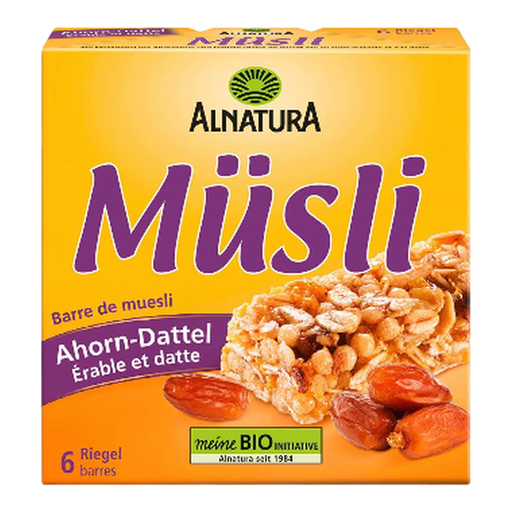
This muesli bar is worth considering if you’re shopping at an organic shop and want to compare the size of individual snacks, with each bar portioned into a separate 25-g serving. For a calorie and sugar comparison, also check the nutritional information on the specific pack.
 No image available
The individual 25-g bars are ideal for comparing clearly defined snack portions.
Pack of six muesli bars, 25 g each. To help you choose, compare the kcal per bar, along with the sugar, ingredients and allergens, using the information on the specific pack.
No. Organic labelling doesn’t tell you how many kcal a bar contains. Compare the energy value per 100 g and the weight of an individual bar, then check the sugar content separately.
No, that claim alone doesn’t mean the sugar content is low. When a product makes claims about fruit sweetness, the Verbraucherzentrale recommends checking ‘of which sugars’ in the nutritional information and reading the ingredients list.
For packaged organic food produced in the EU, the EU organic logo and the details of the responsible organic control body are important indicators, as the Verbraucherzentrale explains. To check whether the bar meets your calorie or allergen requirements, you’ll need to look at the other information on the pack too.
Check them on the pack of the bar you’re actually buying. This is especially important if you need to avoid a particular ingredient or are looking for a specific dietary option. Also check the storage instructions and best-before date on that pack.