Office buyers focused on organic products
You want to choose bars for the office cupboard and be able to verify the organic status of each variety from its labelling.


For a shared office biscuit tin, an organic label alone isn’t enough. Check the organic labelling, ingredients, allergens and best-before date for every type of bar. A selection of oat or muesli bars, alongside clearly labelled alternatives, can cater for different needs. Bars containing nuts or sesame should only be included with your team’s requirements in mind. The more varieties you stock, the more time you’ll need to spend checking and sorting them.
You want to choose bars for the office cupboard and be able to verify the organic status of each variety from its labelling.
As well as organic options, you may need varieties specifically labelled as vegan, gluten-free or lactose-free. These qualities aren’t guaranteed by organic status.
You’ll need to check the ingredients, highlighted allergens and precautionary allergen information for each variety. Depending on your team’s requirements, bars containing nuts or sesame should be offered separately or left out altogether.
First, decide which varieties are suitable for your team’s dietary requirements. Then compare the organic labelling, ingredients and pack size of the specific bars you’re considering.
A good choice if: You’re looking for a classic bar with verifiable organic labelling to keep in the office cupboard.
Bear in mind: An organic muesli bar may still contain nuts, cereals containing gluten or relevant precautionary allergen information.
A good choice if: Someone in your team needs a variety specifically labelled as vegan or gluten-free.
Bear in mind: The claim must apply to the variety you’ve chosen; ingredients and precautionary allergen information still matter.
A good choice if: You’d like to add another flavour and your team’s requirements allow you to offer it.
Bear in mind: Don’t add bars containing nuts or sesame to a shared, self-service tin without checking first.
| Criteria | What to check when buying | Who it matters to |
|---|---|---|
| Organic labelling | Check the organic claims on the specific pack against its logo, control body code and country of origin. The European Commission explains the EU organic logo for prepacked food produced in the EU and sold there as organic. | I want to choose only varieties for the office tin whose organic status can be verified from the pack. Around 36% of consumers prioritise this. |
| Allergens and dietary requirements | Read the ingredients, highlighted allergens and precautionary allergen information for each variety. Only rely on claims such as “vegan” or “gluten-free” for the variety specifically labelled as such. | If colleagues need to avoid certain ingredients, I need varieties that I can check individually before putting them out. For around 29% of consumers, this reassurance comes first. |
| Ingredients and sugar | Compare the ingredients list and sugar content per 100 g; also check the per-portion figure if one is provided. | I want to know what’s in each bar rather than assume that “organic” or “no added sugar” means it’s low in sugar. Around 21% of consumers focus on this first. |
| Stock and variety | Check the portion size, best-before date and storage instructions for the varieties you choose. | I want the tin to cater for different tastes without bars being left uneaten for too long. Stock planning is the top priority for around 14% of consumers. |
An organic bar may contain nuts, sesame or milk, for example. The consumer advice centre recommends checking the ingredients and allergen information on each product’s packaging.
Check every variety, including its precautionary allergen information. Before filling a shared tin, find out whether bars containing nuts or sesame can be kept separately or need to be left out.
The consumer advice centre points out that claims like this don’t prove the finished product is low in sugar.
Compare the ingredients list and sugar content per 100 g. A per-portion figure, if provided, makes it easier to compare individual bars.
A category page won’t show all the information that matters for a specific variety or dietary requirement.
Check the organic labelling, ingredients and allergens for the exact variety you’ve chosen.
According to the German Food Federation, the best-before date applies to unopened food stored appropriately.
Buy an amount you’re likely to use, follow the storage instructions and move packs with the soonest best-before dates to the front.
These examples show a range of bars and labelling. For the office biscuit tin, what matters is the information on the specific pack you choose.
dmBio’s range includes the 35 g Hafer Kakao muesli bar. dm-drogerie markt describes this variety as organic and vegan.
REWE’s organic bar range includes an oat and chocolate bar, as well as other types of bar.
MadeGood offers organic granola and oat bars. dm-drogerie markt describes a Cinnamon Bun bar as vegan and gluten-free.
EDEKA stocks organic crispy bars, including a sesame variety that it describes as lactose-free and gluten-free.
biozentrale offers bars in a range of flavours. One snack set includes bars alongside other snacks.
These bars offer one nut and chocolate variety and two oat flapjacks as possible additions to your office cupboard. Before buying, check the organic labelling on each pack, as well as the ingredients, allergens, individual wrapping and best-before date.
 No image available
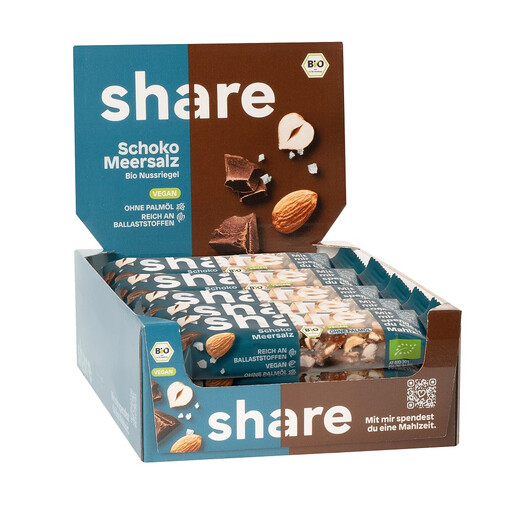
A nut and chocolate variety to consider if these ingredients are suitable for your office selection. The product name lists 15 bars at 35 g each, but the information on vegan suitability and milk ingredients is contradictory. Check the current pack to confirm whether it’s suitable, and whether the bars are individually wrapped.
 No image available
An oat flapjack with blueberries for a fruity addition to your selection; the product name lists it as 60 g. If gluten or other allergens are a concern, check the ingredients and precautionary allergen information on the current pack. Also check the organic labelling and whether the format works for a shared tin.
 No image available
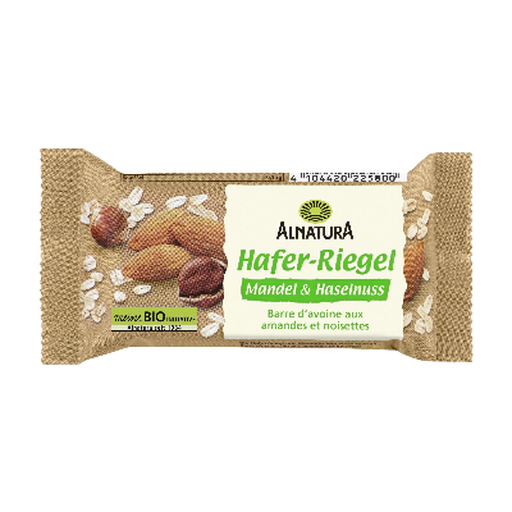
An oat flapjack with almonds and hazelnuts for teams where this type of nut can be included. The product name lists it as 60 g. Before adding it to the biscuit tin, check the current allergen and precautionary allergen information, organic labelling, individual wrapping and best-before date.
Check the EU organic logo, control body code and country of origin on the specific pack. The European Commission describes the logo for prepacked food produced in the EU and sold there as organic. Imported products may be subject to different requirements for using it.
No. Organic labelling doesn’t replace checking for allergens or looking for a product-specific gluten-free claim. Read the ingredients and precautionary allergen information for every variety, and take the specific requirements of those affected into account.
No, organic status alone says nothing about sugar content. “No added sugar” doesn’t mean “low sugar” either. Compare the sugar content per 100 g and the ingredients list for the bars you choose.
Choose quantities based on likely usage, the best-before dates and the storage instructions for each pack. According to the German Food Federation, the best-before date describes the qualities of unopened food when stored appropriately.