Festival campers who prefer organic food
You want to buy a packaged snack for your campsite and be able to identify it as organic from its specific labelling, rather than relying on a product name that simply sounds natural.


If you’re specifically looking for organic snacks for festival camping, start with a nut or nut-and-fruit mix that’s clearly labelled organic. Then check the ingredients, allergens, portion size and storage instructions. A bar is easy to take with you individually, but it isn’t a mix you can share; conversely, a classic party snack mix isn’t an organic option just because it contains a variety of snacks.
You want to buy a packaged snack for your campsite and be able to identify it as organic from its specific labelling, rather than relying on a product name that simply sounds natural.
You’re looking for something to share. A mix can bring together several types of snack, but you’ll need to check the specific product to see whether it meets your organic requirements and suits everyone who’ll be eating it.
Ingredients such as peanuts, tree nuts, wheat, milk, sesame or honey may matter to your group. So check the ingredients, allergen labelling and precautionary statements on the specific pack.
First decide whether organic labelling, sharing with others or individual portions matters most to you. Then compare specific packs by their ingredients, allergens, nutritional information and storage instructions.
| Criteria | What to check | Who it matters most to |
|---|---|---|
| Organic labelling | Check the specific pack for organic labelling; don’t assume that terms such as “natural” mean the same thing. | If organic is my top shopping priority, I want the snack to be clearly labelled as such. For around 36% of consumers, this proof comes first. |
| Snack format and sharing | Compare a loose mix with individually wrapped bars; check the pack size and whether it can be resealed. | For a group, I want a pack everyone can share or individual portions that are easy to hand out. Around 29% of consumers prioritise this suitability for groups. |
| Ingredients and allergens | Read the ingredients list, highlighted allergens and precautionary statements for each variety; check for animal-derived ingredients if needed. | If someone in my group needs to avoid certain ingredients, the specific recipe determines what I can take. This is the most important criterion for around 21% of consumers. |
| Availability and pack format | Check availability where you’re shopping, as well as the net quantity and storage instructions on the pack. | Before setting off, I need a snack I can actually buy and take with me easily. Around 14% of consumers make this their main consideration. |
According to the Federal Ministry of Agriculture, Food and Regional Identity and Ökolandbau.de, organic labelling for relevant food products is regulated in the EU. A product name that sounds natural is no substitute for this labelling.
If you’re shopping for organic food, only shortlist varieties whose specific packaging carries suitable organic labelling.
Even a pack that’s easy to share may not be suitable for everyone. The European Union explains that allergens in prepacked foods must be highlighted in the ingredients list.
Before you buy, compare the ingredients, highlighted allergens and precautionary statements with everyone’s needs. If there isn’t one variety that works for the whole group, choose separate snacks.
A bar comes in a different format and may contain additional ingredients. For example, EDEKA’s Bio Knusperriegel Nussmix contains honey, so it isn’t suitable for a vegan selection.
Compare bars and mixes by their ingredients and nutritional information, rather than assuming that organic labelling tells you about the recipe or whether it suits a particular diet.
ALDI SÜD notes that special-buy items may be available in limited quantities. So a product shown online isn’t a reliable basis for shopping shortly before you leave.
Check what’s available where you shop in good time, and keep another suitably labelled option in mind if needed.
REWE has a category for organic nut mixes, including the REWE Bio Nuss-Mix geröstet & gesalzen, in a 125 g pack.
EDEKA describes its Bio Knusperriegel Nussmix as a bar alternative in a pack of 3 × 25 g.
ALDI SÜD states that products under its ALDI BIO own-label brand meet at least the requirements of the EU Organic Regulation.
Lidl describes Alesto as a brand for nuts, dried fruit and party snacks, and also stocks organic products.
Lorenz describes Snack-Hits as a snack mix containing six different types of snack, designed for sharing.
funny-frisch offers savoury snacks, including crisps, as a possible alternative to a nut mix.
These two products are bars to take with you, not a loose snack mix to share. If organic labelling is important for your shopping, check it on the specific pack, along with the ingredients and allergens.
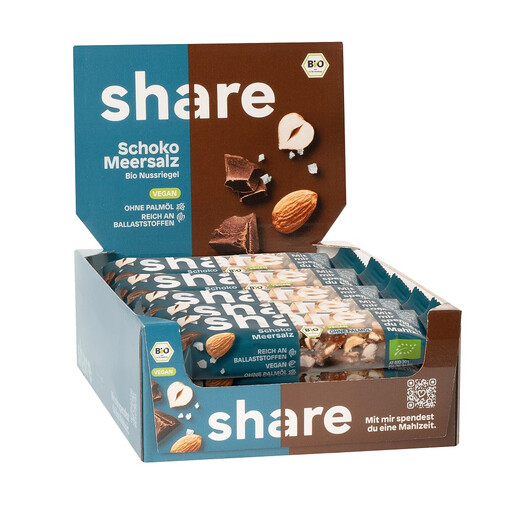 Image unavailable
A pack of bars for anyone who wants to take individual snacks with them or hand them out, rather than share an open mix.
The product name specifies 15 bars of 35 g each. If you’re shopping for organic food, check the labelling and compare the ingredients and allergens with the pack; don’t assume it’s suitable for vegans from the name alone.
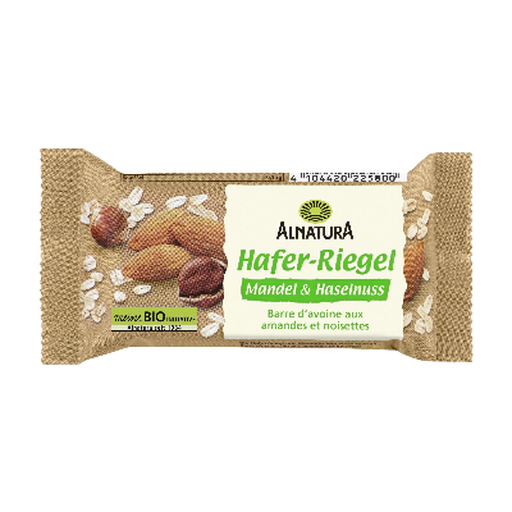 Image unavailable
An oat bar with almonds and hazelnuts for an individual snack on the go, rather than sharing a mix.
The product name specifies 60 g. Before you buy, check the organic labelling and the ingredients and allergen information on the specific pack.
Look for organic labelling on the specific pack. According to the Federal Ministry of Agriculture, Food and Regional Identity and Ökolandbau.de, EU rules apply to organic products produced and sold in the EU; “natural” on its own is not equivalent labelling.
Yes. Organic labelling doesn’t tell you whether a product is suitable for someone with a particular allergy. The European Union explains that allergens in prepacked foods must be highlighted in the ingredients list; also check the precautionary statements on the pack you choose.
No. EDEKA’s Bio Knusperriegel Nussmix contains honey. If you want to avoid animal-derived ingredients, check the ingredients for each specific bar.
A bar is a good alternative when individual portions matter more than sharing from a mix. Compare the pack size and ingredients with your group’s needs, rather than treating the two snack formats as interchangeable.
In particular, check the ingredients, allergens, best-before date, net quantity and any storage instructions. The consumer advice centre explains why this food information matters; for your trip, check what’s stated on the pack you’re actually taking with you.