For shoppers looking for organic options
You want to check the EU organic logo, control body code and country of origin on the packaging of the specific snack mix, rather than relying on a search term.


For an organic late-night snack, choose a mix whose organic credentials you can verify on the packaging. According to the European Commission, the EU organic logo identifies certified products. Whether a savoury nut mix or a portioned nut bar is better for you will then depend on the ingredients, salt and sugar content, and the portion format you prefer. If you have allergies, check the label on the specific product rather than relying on terms such as “organic” or “nut mix”.
You want to check the EU organic logo, control body code and country of origin on the packaging of the specific snack mix, rather than relying on a search term.
You’re looking for something savoury for a late-night bite and want to compare the salt content of a nut mix with the other foods in your meal.
You pay attention to ingredients and may-contain warnings, for example because of peanuts, tree nuts or sesame. If you eat vegan, you’ll also want to check bars for ingredients such as honey and milk.
First, decide whether verifiable organic labelling is a must-have. Then compare a savoury mix with portioned, potentially sweeter alternatives using the information on each pack.
A good choice if: You’d like a savoury snack made mainly from nuts and can check the product’s organic labelling.
Bear in mind: Organic labelling doesn’t tell you how much salt a product contains or whether it’s suitable for someone with a nut or peanut allergy.
A good choice if: Individual portions and ingredients such as dried fruit are part of the snack you’re looking for.
Bear in mind: A bar isn’t the same as a loose nut mix. The EDEKA Bio crunchy nut mix bar contains honey and raisins; EDEKA lists 26,7 g of sugar per 100 g.
A good choice if: Organic certification isn’t essential and you’re looking for a particular nut and fruit recipe.
Bear in mind: The name “nut and fruit” isn’t proof of organic certification; ingredients and nutritional values vary by product.
| What to consider | What to check when buying | Who it matters most to |
|---|---|---|
| Organic labelling | Check the EU organic logo, control body code and country of origin on the specific pack. According to the European Commission, the logo may only be used on appropriately certified products. | If organic is a must for my late-night snack, I want to be able to verify the labelling before I buy. Around 36 % of consumers would make this their top purchase criterion. |
| Savoury recipe | Compare the salt per 100 g with the portion you plan to eat. REWE lists 0,96 g of salt per 100 g for its roasted and salted organic nut mix. | With bread, cheese or dips, I want to choose a savoury snack and factor its salt content into my meal. This recipe preference would be the main priority for around 29 % of consumers. |
| Ingredients and allergens | Read the current ingredients list, highlighted allergens and may-contain warnings. If you eat vegan, check for honey and milk ingredients too. | Before choosing a nut mix or bar, I need to know whether its ingredients are suitable for me. This would be the main consideration for around 21 % of consumers. |
| Portion and availability | Check the pack or portion size, as well as availability at your chosen store or in your delivery area. EDEKA describes its Bio crunchy nut mix bar as three bars of 25 g each. | I want to find a portion format that suits my snack and check that the product is available locally before I shop. Around 14 % of consumers would check this first. |
A natural recipe isn’t proof of organic certification. According to the European Commission, use of the EU organic logo depends on the product being certified.
Check the organic labelling on the pack rather than relying solely on product names or range descriptions.
Even an organic nut mix can contain salt. REWE lists 0,96 g of salt per 100 g for its roasted and salted organic nut mix.
Compare the salt content and consider what else you’ll be having with your snack.
The portion format and recipe can be very different. The EDEKA Bio crunchy nut mix bar contains raisins and honey, among other ingredients; EDEKA lists 26,7 g of sugar per 100 g.
Decide whether you’d prefer a bar or a loose mix, then compare the ingredients and nutritional information per 100 g.
Relevant ingredients and may-contain warnings vary by recipe. Lorenz advises that the ingredients list on the current pack is the one to follow for its products.
Check the labelling on the specific product again before eating it, particularly for peanuts, tree nuts and possible traces of other allergens.
What matters is the labelling on the individual product, not the brand alone. These examples show different types of nut mixes and bars.
REWE describes a roasted and salted organic nut mix containing cashews, almonds, hazelnuts and peanuts.
The EDEKA Bio crunchy nut mix bar is a portioned option containing peanuts, almonds, raisins, pumpkin seeds and honey.
Lorenz offers nut and fruit mixes in a range of recipes for shoppers who don’t require organic certification.
Lidl describes Alesto’s range as including natural nuts and dried fruit, as well as seasoned party snacks.
ALDI Nord describes a roasted and salted nut mix containing peanuts, cashews, almonds and hazelnuts.
This Joybuy selection features a portioned nut bar with chocolate and sea salt as an alternative to a loose mix. If organic certification is a must for you, check the labelling on the current pack.
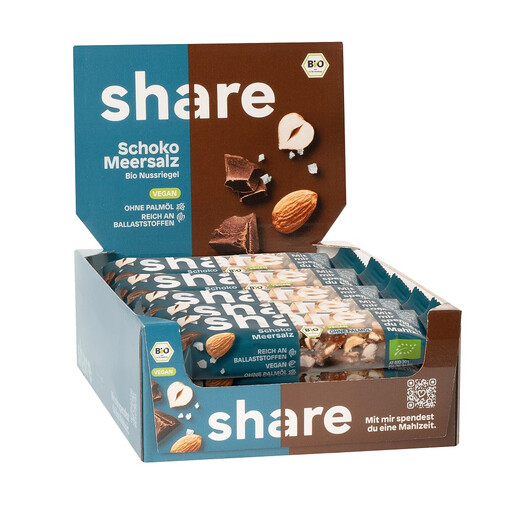 Image unavailable
For a portioned sweet-and-salty nut snack with your late-night bite: the product name lists 15 bars of 35 g each, with dark chocolate and sea salt.
A bar isn’t the same as a loose snack mix. Check the organic labelling, ingredients, allergens and salt content on the current pack. Don’t assume it’s vegan based on the product name.
Check for the EU organic logo on the specific packaging, along with the control body code and country of origin. According to the European Commission, the logo may only be used on products certified as organic by an approved control body.
No. “Natural” doesn’t replace organic labelling. If organic certification is important to your buying decision, check the individual product rather than relying on the range or flavour description.
Compare the salt and sugar per 100 g, and consider the portion you plan to eat. REWE lists 0,96 g of salt per 100 g for its roasted and salted organic nut mix; EDEKA lists 26,7 g of sugar per 100 g for its Bio crunchy nut mix bar. These figures relate to different products and don’t replace checking their other ingredients.
No. Check the current packaging of the specific product before eating it. The EDEKA Bio crunchy nut mix bar contains peanuts, almonds and honey; you should also check for possible traces of other allergens.
Check availability at your local store or in your delivery area before you shop. EDEKA notes that its Bio crunchy nut mix bar may not be available in all stores.