Everyday exercisers who prefer organic food
You want to pack a savoury snack in your gym bag and look first for a clear organic label and a straightforward ingredients list. The pack and its nutritional information are still important, though.


Organic tortilla chips could be a good choice for your gym bag if you’re looking for a packaged snack that keeps well in a dry place. As well as checking the organic label, look at the ingredients, nutritional information and allergen advice on the pack. The varieties from REWE, EDEKA, biozentrale and Heimatgut described here contain 480–502 kcal and 6.0–6.7 g of protein per 100 g. So, if you’re choosing a snack specifically for its protein content, don’t assume that “organic” tells you anything about its nutritional value.
You want to pack a savoury snack in your gym bag and look first for a clear organic label and a straightforward ingredients list. The pack and its nutritional information are still important, though.
You’re looking for a variety that’s explicitly labelled vegan or gluten-free. Check the label and any allergen advice on the current pack rather than assuming it’s suitable just because it’s made from corn.
You want to know how much you’re packing and how much energy, fat, salt and protein it contains. The nutritional information per 100 g, along with the portion you plan to eat, tells you more than the organic label alone.
Start by choosing a variety that meets your needs, such as an organic label or clearly stated dietary qualities. Then compare the pack size, ingredients and nutritional information for the amount you want to take with you.
| What to consider | What to check when buying | Who it matters to |
|---|---|---|
| Organic certification and ingredients | The organic label and organic inspection body on the pack; the ingredients list for the specific variety. | If I choose organic because of how the food is produced, I also want to know what else, besides corn, is in the crisps. Around 33% of shoppers put this first. |
| Portability and shape | Pack size and storage advice; flat crisps or rolled corn snacks, depending on how you plan to use them. | If I want a snack that needs no preparation, I want to take a pack whose size and shape suit my break. This convenience is the main consideration for around 25% of shoppers. |
| Labels and allergen advice | Explicit vegan or gluten-free labelling, plus the ingredients and allergen advice on the current pack. | If I need to avoid certain ingredients or want a variety with a specific label, the details on the pack determine my choice. Around 17% of shoppers focus on this first. |
| Portion size and nutritional information | Energy, fat, salt and protein per 100 g; compare these with your intended portion if needed. | I want to assess the amount I pack based on its nutritional information, rather than assuming “organic” means a particular protein or energy content. This comes first for around 25% of shoppers. |
The varieties from REWE, EDEKA, biozentrale and Heimatgut described here contain 480–502 kcal, 21.5–26 g of fat and 6.0–6.7 g of protein per 100 g. The consumer advice centre also points out that crisps with less fat don’t automatically contain fewer calories.
Use the organic label to check how the product is produced, and look separately at the nutritional information for energy, fat, salt and protein.
The sea-salt products described here from biozentrale and Heimatgut may contain traces of soya. REWE Bio lists possible traces of gluten and milk, while EDEKA Bio lists possible traces of soya.
If you have an allergy or need to avoid certain ingredients, check the ingredients, labels and allergen advice on the current pack.
Even varieties with similar names can differ: REWE Bio, EDEKA Bio and Heimatgut state that the products described contain 0.8 g of salt per 100 g, while biozentrale lists 1.2 g.
Compare the salt content per 100 g if it’s relevant to your choice.
REWE’s salted organic tortilla chips are described as flat corn crisps in a 125-g pack.
The sea-salt variety from EDEKA Bio described here is a corn crisp product in a 125-g pack.
biozentrale describes its organic sea-salt tortilla chips as vegan and gluten-free.
Heimatgut’s organic sea-salt tortilla rolls described here are rolled rather than flat, and the variety is described as vegan and gluten-free.
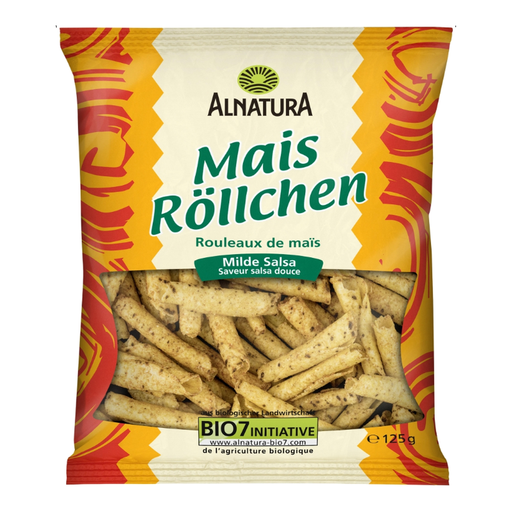
This selection features a rolled organic corn snack with a mild salsa flavour, for anyone looking for a different shape and seasoning from flat sea-salt tortilla chips.
 No image available
An option if you’re looking for rolled corn snacks with a mild salsa flavour for your gym bag, rather than a sea-salt variety.
Pack size: 125 g. Check the ingredients, nutritional information and allergen advice on the current pack to make sure it meets your dietary needs.
Check the organic label and the organic inspection body on the current packaging. According to Germany’s Federal Ministry of Food and Agriculture, products can carry the German organic label if they have been produced and inspected in line with EU organic farming regulations.
If you’re choosing a snack specifically for its protein content, compare the protein listed for the portion you plan to eat. The varieties from REWE, EDEKA, biozentrale and Heimatgut described here contain 6.0–6.7 g of protein and 480–502 kcal per 100 g. The organic label alone doesn’t tell you about nutritional value.
No. It depends on the labelling of each variety. biozentrale and Heimatgut describe their sea-salt products mentioned here as vegan and gluten-free, but also list possible traces of soya. Check the current pack if either of these qualities or an allergen warning is important to you.
No. The sea-salt products described here from REWE Bio, EDEKA Bio and Heimatgut each contain 0.8 g of salt per 100 g, while biozentrale lists 1.2 g. For an accurate comparison, check the nutritional information on the specific pack.