Marathon runners who favour organic products
You want to choose a snack with clear organic certification, while still comparing carbohydrates, fat and salt. The organic logo alone won’t tell you whether a product fits your training nutrition.


Organic tortilla chips can be compared as an occasional snack by looking at their nutritional information, but their organic status alone doesn’t make them suitable fuel for long runs. Of the three organic products considered, REWE Bio and Heimatgut each contain 0.8 g of salt per 100 g; biozentrale has the highest carbohydrate content, at 63 g per 100 g. When choosing, you should also consider your planned portion, the fat content and, where relevant, allergen and dietary labelling.
You want to choose a snack with clear organic certification, while still comparing carbohydrates, fat and salt. The organic logo alone won’t tell you whether a product fits your training nutrition.
You’re looking for a crunchy snack for your training routine and want to weigh up the nutritional values per 100 g, rather than choosing by flavour alone.
You look for clearly stated qualities such as gluten-free, lactose-free or vegan, and also check the ingredients and precautionary allergen information on the specific pack.
Start by comparing the nutritional information per 100 g and the product labelling, then consider how much you actually plan to eat. The Sports Nutrition Working Group of the German Nutrition Society identifies training duration and intensity, as well as individual characteristics, as factors affecting energy and nutrient requirements. So one snack alone won’t determine what you need for a run.
| Criterion | What to check | Who it matters most to |
|---|---|---|
| Carbohydrates and fat | Compare both nutritional values per 100 g, then factor in your planned portion. According to the product information listed by REWE, the three organic products considered contain 59 to 63 g of carbohydrates and 22 to 26 g of fat per 100 g. | If I’m working out where a snack fits into my training routine, I don’t want to consider the carbohydrate content alone. For around 40% of consumers, this is the most important consideration. |
| Salt and ingredients | Compare the salt content per 100 g and read the ingredients list. REWE lists 0.8 g of salt for both REWE Bio and Heimatgut, and 1.2 g for biozentrale. | If you’re looking for a less salty option, check the value on the pack rather than relying on the taste or organic logo. Around 30% of consumers make salt and ingredients their main buying criteria. |
| Product claims and traces | Check the specific pack for stated product claims and allergen information, including precautionary warnings. REWE lists possible traces of gluten and milk for REWE Bio, and possible traces of soya for biozentrale; Heimatgut is labelled gluten-free, lactose-free and vegan. | If I need to check a particular claim or precautionary warning, the information on the specific product determines what I choose. For around 20% of consumers, this is the most important point. |
| Organic certification | Look for the EU organic logo and the organic control body code on the pack; then continue to compare the ingredients and nutritional values. The Verbraucherzentrale explains that the logo indicates compliance with European organic standards. | If you’re specifically looking to buy organic tortilla chips, you’ll want to be able to identify the certification on the product itself. For around 10% of consumers, this check takes priority over the other buying criteria. |
The EU organic logo relates to organic production standards. It doesn’t tell you whether a snack is suitable for a long run; according to REWE, the three organic products considered also contain 22 to 26 g of fat per 100 g.
As well as checking the organic certification, look at the nutritional values, your planned portion and the demands of your run.
Different pack or portion sizes make it harder to compare carbohydrates, fat and salt directly.
Compare the nutritional information per 100 g first, then work out the values for the amount you plan to eat.
Organic certification doesn’t tell you whether a product contains specific allergens or carries precautionary allergen warnings. The information varies between the products considered.
If you have a relevant allergy or intolerance, read the labelling on the pack you’re actually buying.
The information consulted does not identify Chio Tortillas Nacho Cheese as an organic product; Lorenz Crunchips Oriental Style is a potato crisp. Their nutritional values don’t describe the organic tortilla chips considered here.
Check the product type and organic certification for each option separately before comparing nutritional values.
The salted organic tortilla chips in the 125-g pack are one of the specific options considered.
The organic sea salt tortilla chips can be compared with the other two organic options by looking at their declared nutritional values.
The organic sea salt tortilla rolls are labelled gluten-free, lactose-free and vegan.
The Tortillas Nacho Cheese considered here are included only as a conventional comparison product, not as a verified organic option.
Crunchips Oriental Style are potato crisps, so they aren’t a like-for-like organic tortilla chip option.
The Alnatura Corn Rolls shown here are an organic corn snack for comparing different product types. Check the product name on the pack to decide whether Corn Rolls are a suitable alternative to the tortilla chips you’re looking for.
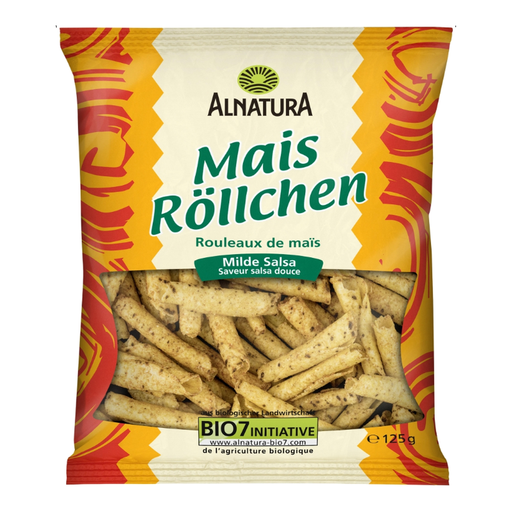 No image available
For shoppers considering an organic corn snack who want to check whether Corn Rolls, rather than tortilla chips, suit their needs before buying.
If you need to check soya labelling, the information on the specific pack is what matters.
Look for the EU organic logo and the organic control body code on the specific pack. The Verbraucherzentrale explains that the EU organic logo indicates compliance with European organic standards; it doesn’t tell you anything about salt, fat or carbohydrate content.
Organic status alone doesn’t make tortilla chips suitable fuel for a long run. Alongside carbohydrates, the three organic products considered by REWE contain 22 to 26 g of fat per 100 g. According to the Sports Nutrition Working Group of the German Nutrition Society, planning your overall nutrition should take into account factors including the duration and intensity of exercise, as well as individual characteristics.
According to the product information listed by REWE, REWE Bio and Heimatgut each contain 0.8 g of salt per 100 g, while biozentrale contains 1.2 g. The respective product pages list 59.4 g of carbohydrates per 100 g for REWE Bio, 59 g for Heimatgut and 63 g for biozentrale. You’ll need to adjust these values to match your planned portion.
No. Organic status doesn’t mean a product is labelled gluten-free or vegan. REWE labels the Heimatgut organic tortilla rolls considered here as gluten-free, lactose-free and vegan; possible traces of gluten and milk are listed for REWE Bio, and possible traces of soya for biozentrale. Always check the labelling on the specific pack you’re buying.