Which questions matter to you?

Breakfast shoppers looking for organic options

If you’re looking for organic chocolate cereals, don’t rely on product names that simply sound natural. The EU organic logo, control body code and country of origin can help you check the product’s certification.

Commuters who need individual portions

If you take breakfast with you, check whether the product is sold as a single portion or in a larger pack that you’ll need to portion out yourself. If you want to eat it without a bowl, check the specific product’s serving instructions too.

Shoppers checking sugar and allergens

If you need to check nutritional values or specific ingredients, compare the sugar per 100 g across similar types of product and read the allergen information on the current pack. Organic certification doesn’t replace either check.

What should you look for when buying?

First decide whether you need breakfast to be pre-portioned or whether you can prepare it yourself. Then check the organic label, nutritional information and ingredients on the specific product.

What to check Buying check Who should consider it?
Organic certification Check the pack for the EU organic logo, control body code and country of origin. I want to identify organic products from their certification, rather than rely on the product name. Around 31% of consumers would check organic certification first.
Format for eating on the go Check how many portions the pack contains; if you want to eat it dry, look for explicit instructions confirming this. If I can’t decant anything in the morning, I need a portion I can take with me or a product that’s clearly suitable for eating on its own. Around 25% of consumers would put this format first.
Sugar and wholegrain Compare the sugar per 100 g across similar types of product and check the ingredients list for wholegrain. If I eat chocolate cereal regularly for breakfast, it’s important to me to distinguish between sugar levels and the types of grain used. Around 31% of consumers would make this their top buying criterion.
Allergens and ingredients Read the ingredients, highlighted allergens and may-contain warnings on the current pack. If I need to avoid certain ingredients, whether the product is suitable depends on the labelling of the product I actually buy. Around 13% of consumers would make this their main check.

Common misconceptions

  • Organic doesn’t automatically mean low in sugar

    REWE and EDEKA list 9.2 g and 10.5 g of sugar per 100 g respectively for their organic chocolate mueslis. The organic logo alone won’t tell you how much sugar a product contains.

    Compare the nutritional information per 100 g across the same type of product, and check separately whether wholegrain is listed as an ingredient.

  • A large pack isn’t ready-made for taking on the go

    Chocolate muesli in a large pack needs to be portioned out before you can take it with you. And even if it comes in a single portion, that doesn’t tell you whether you can eat it on its own or need to add something.

    Check the portion information and serving instructions, and think about how you want to prepare it before you buy.

    If you portion it out yourself, you may need to take a container and whatever you want to add.

  • The organic logo doesn’t replace checking for allergens

    Depending on the product, the organic chocolate cereals described here list ingredients such as milk, cereals containing gluten, soya or nuts, as well as possible traces of other allergens.

    Read the ingredients and allergen information on the current pack rather than assuming the product is suitable because it’s certified organic.

Brands to help you choose

REWE Bio

REWE sells an organic chocolate muesli in a 500 g pack.

  • REWE’s product information lists several wholegrain flakes and 9.2 g of sugar per 100 g.
  • The muesli contains cereals containing gluten and milk chocolate. The pack isn’t sold as a single portion.

EDEKA Bio

The organic chocolate muesli described here combines wholegrain wheat and oat flakes with milk chocolate pieces and cocoa nibs.

  • EDEKA lists 10.5 g of sugar per 100 g for this product.
  • It contains milk and cereals containing gluten. Check the pack for other may-contain warnings and the latest product information before choosing it.

Alnatura

Alnatura’s organic chocolate muesli comes in a 750 g pack and contains wholegrain oat and wheat flakes with milk chocolate.

  • Alnatura specifies the organic quality and the types of grain in this particular muesli.
  • The pack lists milk, soya and cereals containing gluten, and may contain traces of almonds, nuts and sesame. Check the pack carefully.

dennree

The organic chocolate pillows described here are a different type of product from chocolate muesli.

  • dennree says its chocolate pillows can also be eaten on their own.
  • The product information lists wheat, milk and hazelnuts. Check the nutritional information and allergens on the specific pack.

mymuesli

The organic chocolate muesli described here comes in an 85 g pack labelled as one portion.

  • REWE’s product information lists organic certification and a control body for this pack.
  • A single portion doesn’t tell you what you might want to add. Check the nutritional information and allergens on the current pack.

Products at Joybuy to consider

This chocolate muesli could suit a quick breakfast if you’re happy to portion it out from a larger pack and have it with milk, yoghurt or a plant-based drink.
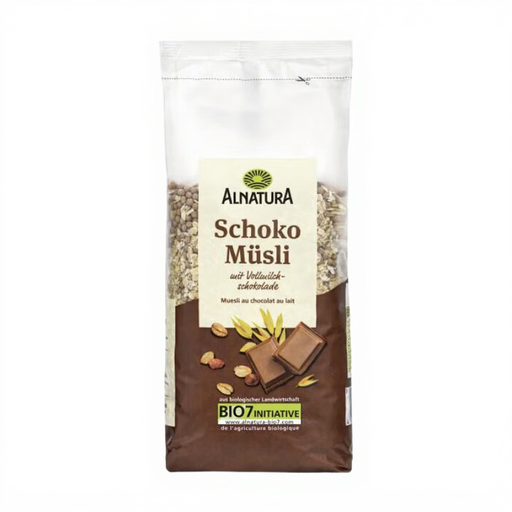
Alnatura organic chocolate muesli, 750 g

Alnatura organic chocolate muesli, 750 g

For breakfast with milk, yoghurt or a plant-based drink, if you can portion the muesli out yourself.

Made with wholegrain oat and wheat flakes and milk chocolate. Contains milk, soya and cereals containing gluten; possible traces of almonds, nuts and sesame are listed. Check the latest pack information if needed.

If you want to eat the muesli without adding anything, check the serving instructions on the pack.

View at Joybuy

Frequently asked questions

How can I tell if chocolate cereals are organic?

For packaged organic products that carry the relevant certification, check the pack for the EU organic logo, control body code and country of origin. The European Commission says that, among other requirements, processed products must contain at least 95% organic agricultural ingredients to use the logo.

Do organic chocolate cereals automatically contain less sugar?

No. Organic certification doesn’t set the sugar content of an individual chocolate cereal. Compare the sugar per 100 g across similar types of product: REWE lists 9.2 g per 100 g for its organic chocolate muesli, while EDEKA lists 10.5 g per 100 g for its own.

Can I eat chocolate muesli on the go without milk?

That depends on the serving instructions for the specific product. REWE says its organic chocolate muesli can also be eaten dry, and dennree says its organic chocolate pillows can be eaten on their own. A single-portion pack alone doesn’t confirm this.

Which allergen information should I check?

Check the ingredients and may-contain warnings on the current pack for any allergens relevant to you. Depending on the recipe, the products described here list ingredients such as cereals containing gluten, milk, soya and nuts. The organic logo doesn’t tell you whether these are present.