Parents short on time in the morning
If you want to make creamy porridge or overnight oats for your own breakfast, look for fine or thinly rolled organic oats. They have a different texture from jumbo varieties.


Fine organic oats are a good choice for a creamy breakfast. If you prefer a little more bite in your muesli or baking, try jumbo or wholegrain flakes. Finely dissolving flakes for homemade baby food serve a different purpose and should only be used once your child is ready to start weaning. If you need to follow a strictly gluten-free diet, an organic label alone is not enough: look for an explicit gluten-free claim on the specific product.
If you want to make creamy porridge or overnight oats for your own breakfast, look for fine or thinly rolled organic oats. They have a different texture from jumbo varieties.
When making baby food at home, your child’s readiness for weaning, the ingredients and the preparation method matter more than the texture you prefer for your own breakfast. The Federal Institute of Public Health gives a window from after the fourth month to the start of the seventh month for introducing complementary foods, while emphasising that every child develops at their own pace.
If you need to follow a strictly gluten-free diet, check for an explicit gluten-free claim on the specific product. According to its product labelling, EDEKA Bio oats may contain traces of other cereals containing gluten.
First, decide whether you’re choosing oats for an adult breakfast or for weaning. For an adult breakfast, it comes down to the texture you prefer. If you need to eat gluten-free, you’ll also need to check for the right labelling.
| Your priority | What to check | Who it matters to |
|---|---|---|
| Creamy breakfast | Look for “fine”, “thinly rolled” or “extra fine”, as well as an organic label. | If a creamy breakfast is my priority in the morning, I don’t want a noticeably coarse texture. Around 40% of consumers would put this need first. |
| Homemade baby food | Check the ingredients and preparation instructions, and make sure your child is ready to start weaning. | If I’m mainly buying oats for baby food, I need a product intended for that purpose, not just flakes for my own muesli. This would be the priority for around 30% of consumers. |
| A chewier texture | Look for “jumbo” or “wholegrain” and check the organic details for that variety. | For muesli, toppings or baking, I want flakes with a noticeable bite. This texture would be the main reason to buy for around 20% of consumers. |
| Gluten-free diet | Check for an explicit gluten-free claim and read the information on the pack you’re buying. | If our household needs to eat strictly gluten-free, I can’t rely on “organic” alone when choosing oats. This would be the top priority for around 10% of consumers. |
Organic does not automatically mean that a product has been processed without gluten. EDEKA says its extra-fine organic oats may contain traces of other cereals containing gluten, while Kölln sells gluten-free flakes as a separate product range.
If you need to follow a strictly gluten-free diet, choose a variety explicitly labelled gluten-free and check the information on the pack you’re buying.
Kölln organic oat melt-in flakes have a fine, easily dissolving texture and are intended for homemade baby food. For muesli with a noticeable bite, jumbo or wholegrain flakes serve a different purpose.
Choose flakes for your own breakfast based on the texture you prefer. Consider a variety intended for weaning if you’re actually making food for your baby.
An age recommendation on the product is no substitute for assessing whether your child is ready to start weaning. The Federal Institute of Public Health recommends introducing complementary foods after the fourth month at the earliest and by the beginning of the seventh month at the latest.
Take your child’s development into account and seek professional advice if you have specific questions about their diet.
Kölln offers organic oats in different textures, as well as organic melt-in flakes for homemade baby food.
Alnatura offers organic oats, including a jumbo variety.
EDEKA Bio offers an extra-fine variety of oats for shoppers looking for a finer texture.
REWE lists organic oats in fine and jumbo varieties, as well as a separate gluten-free organic option.
Seitenbacher lists organic oats and oat flake mixes as ingredients for home cooking.
Brüggen describes how oats are processed and its work as a manufacturer of milling products.
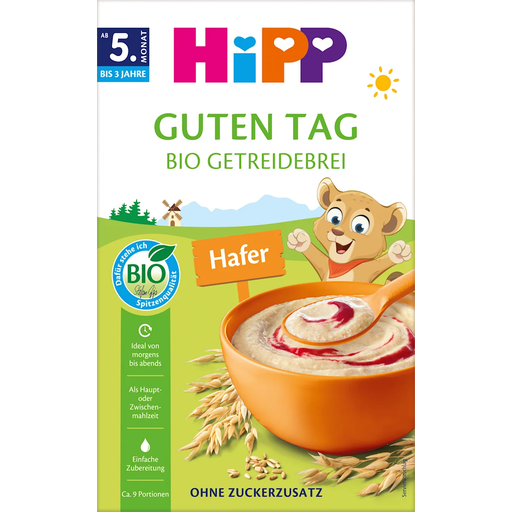
The two Alnatura varieties are fine organic oats for breakfast. The HiPP product, by contrast, is an organic oat cereal for babies, not a standard pack of oats for adults.
 No image available
A finely rolled organic option if you’re looking for a less chewy texture for your own breakfast. If you have specific dietary requirements, check the information on the pack.
 No image available
A fine organic oat option for breakfast, in a 500 g pack. The word “organic” alone does not mean a product is suitable for a strictly gluten-free diet.
 No image available
This organic cereal is intended for weaning, not as a standard oat-based breakfast for parents. The age recommendation of 5 months and over is no substitute for assessing whether your child is ready to start weaning; follow the preparation instructions and information on the pack.
Look for the organic label and the inspection body details on the specific product’s packaging. According to Germany’s Federal Ministry of Food and Agriculture, the German organic seal identifies food produced and inspected in line with EU organic farming regulations.
Melt-in flakes are one fine-textured option for homemade baby food, but the name alone does not determine when to start weaning. Kölln markets its organic melt-in flakes for weaning from the fifth month. The Federal Institute of Public Health advises that the timing depends on the child’s development, within the window from after the fourth month to the start of the seventh month.
No. EDEKA warns that one organic oat variety may contain traces of other cereals containing gluten. If you need to follow a strictly gluten-free diet, check for an explicit gluten-free claim and read the information on the specific pack.
Follow the storage instructions on the pack you’ve bought and check the best-before date. That way, you’ll be following the guidance for the exact variety you have at home.