People shopping with coeliac disease
You want to check the gluten-free label on the specific variety and consider organic status as an additional buying factor only afterwards.


If you have coeliac disease, first choose a snack whose specific variety is clearly labelled gluten-free. If you also want an organic product, check that claim separately. Then consider the ingredients, allergen information and snack format to find a product that suits your day-to-day routine.
You want to check the gluten-free label on the specific variety and consider organic status as an additional buying factor only afterwards.
You’re looking for something to enjoy on a break or on the go, and want to choose between savoury snacks, bars and muesli without assuming that organic means gluten-free.
You’re interested in nut or fruit mixes and need to check ingredients and allergen information that are relevant to you, as well as gluten. For example, Alnatura states that its organic nut mix may contain traces of peanuts, milk and other nuts.
If you have coeliac disease, first check the gluten-free claim on the specific variety. Then compare the organic label, ingredients and format for how you plan to enjoy it.
| Criterion | What to check | Who is it important for? |
|---|---|---|
| Gluten-free labelling | Check that the current pack for the specific variety says “gluten-free”. Under EU Implementing Regulation (EU) No 828/2014, this claim is subject to a maximum gluten content of 20 mg/kg. | If I’m choosing a snack with coeliac disease, I need an explicit gluten-free claim rather than trying to guess from the ingredients. Around 42% of consumers would put this check first. |
| Organic status and ingredients | Check the organic label and gluten-free claim separately, then read the ingredients list for the variety you’ve chosen. | Once I’ve confirmed that it’s gluten-free, I want an organic product with ingredients that suit my preferences. Around 25% of consumers would make this their main consideration. |
| Snack format | Choose between ready-to-eat savoury snacks, bars and muesli; compare portion sizes and nutritional information if needed. | For on-the-go, I want something ready to eat; for breakfast, I’d rather have muesli. Around 17% of consumers would choose mainly according to the format that suits them. |
| Other allergens | Read the ingredients list and allergen information for each variety, especially for nut and fruit mixes. | If I have other allergies, I need to know which nuts or other relevant ingredients a mix contains. This would be the next priority for around 16% of consumers. |
The two labels answer different questions. Germany’s Federal Office for Agriculture and Food describes the organic logo as a mark of compliance with EU organic requirements; gluten-free claims are regulated separately.
If you have coeliac disease, first look for “gluten-free” on the specific pack, then check for organic status as an additional feature.
A gluten-free claim on one product doesn’t automatically apply to other flavours or similar-looking packs. Lorenz itself advises customers to check the ingredients list on the relevant pack.
Check the label again for every variety, especially if the packaging or recipe has changed.
A gluten-free mix may still contain ingredients that matter if you have other allergies. Alnatura lists almonds, hazelnuts, cashews and walnuts among the ingredients in its trail mix.
Read the ingredients list and any may-contain information separately from the gluten-free claim.
A supermarket own-label range with individual products labelled both organic and gluten-free, including corn and quinoa corners, as well as chocolate and fruit muesli in REWE’s German range.
An organic food brand offering snacks labelled gluten-free, including nut corners and an oat bar.
An organic brand with individual savoury snacks labelled gluten-free, including corn corners and a snack made with lentils and chickpeas.
An organic own-label range with individual products labelled gluten-free, including sandwich biscuits and salted chickpea waffles.
A savoury snack brand with individual varieties labelled gluten-free, such as Naturals Rosemary.
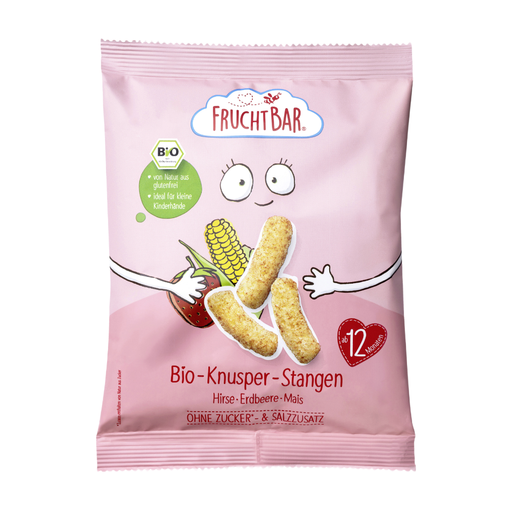
This selection features a fruity organic snack with a stated gluten-free claim. If you have coeliac disease, it’s still important to check the label on the specific pack and any additional allergen information that may apply.
 No image available
For anyone looking for a fruity organic snack labelled gluten-free in a 30 g pack.
The product information states that it’s suitable for children from 12 months. Supervise children while they eat, as there is a risk of choking. If you have other allergies, check the information on the current pack.
No. Organic and gluten-free are separate claims. EU Implementing Regulation (EU) No 828/2014 sets a maximum gluten content of 20 mg/kg for the “gluten-free” claim, so check the specific variety as well as its organic label.
If you have coeliac disease, don’t rely solely on the fact that there’s no wheat in the ingredients list. Check for an explicit gluten-free claim on the specific mix and, if you have other allergies, check the ingredients and may-contain information too.
Check the gluten-free label on the specific variety of oat snack or muesli. EDEKA warns that oats may be contaminated during harvesting, so the fact that a product contains oats doesn’t tell you whether it’s gluten-free.
Keep gluten-free snacks well sealed and separate from foods containing gluten. The German Coeliac Society recommends storing gluten-free ingredients separately and safely, especially when sharing a kitchen.