
Lieferung heute & morgen

Qualitätsgarantie

Willkommens-Angebote freischalten: KOSTENLOSE Lieferung | Bis zu 80 % RABATT | Kostenlose 30-Tage-JoyPlus-Testphase
App herunterladen
A supportive sleeping surface is crucial for a dog's joint health and overall well-being, especially for senior pets, large breeds, or dogs with pre-existing joint conditions. However, the market for orthopedic dog beds can be overwhelming. Many products fail to live up to their marketing claims. As your Joybuy Product Recommendation Officer, I'm here to help you identify the key features and make an informed decision.
Before we dive into the essential features, let's highlight three common problems that often lead to disappointment and unnecessary expense:
To avoid these pitfalls, focus on three verifiable criteria. These determine the durability, comfort, and functionality of the bed.
The filling material is the most critical factor for a joint-friendly dog bed. There are significant differences in quality:
Pay attention to the specified material type and height. A mattress height of at least 7-8 cm is a good guideline for most dogs to avoid contact with the floor.
A high-quality cover is robust, comfortable, and above all, easy to care for. Look for models with a removable and machine-washable cover. A zip, ideally an L-shaped one, makes removing and putting the cover back on much easier.
Common materials include:
A bed is only comfortable if it's the right size. Measure your dog while they are fully stretched out, from the tip of their nose to the base of their tail, and add 15-20 cm to determine the minimum length of the sleeping surface.
Especially for dog pillows for large dogs, a stable, thick mattress is crucial to support the animal's weight without it sagging through.
Here are a few models that are well-suited for different requirements and dog types, based on objective features.
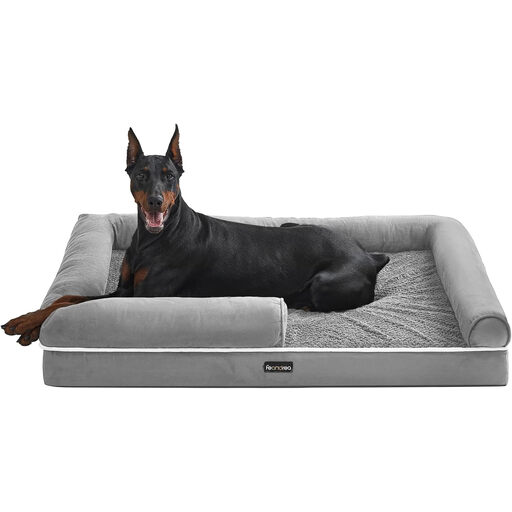
Why It's a Match: With its generous dimensions of 120 x 85 cm and a weight capacity of up to 45 kg, this bed is specifically designed for large breeds. The raised rims provide a sense of security and a comfortable headrest, which caters to the natural sleeping habits of many dogs.
The bed uses a combination of supportive foam and PP cotton, which is a clear declaration of its filling. The cover is removable via a zip and washable, avoiding the hygiene trap. The base is non-slip.
The sofa design with its stable, high rims offers an excellent combination of orthopedic support and a feeling of security.
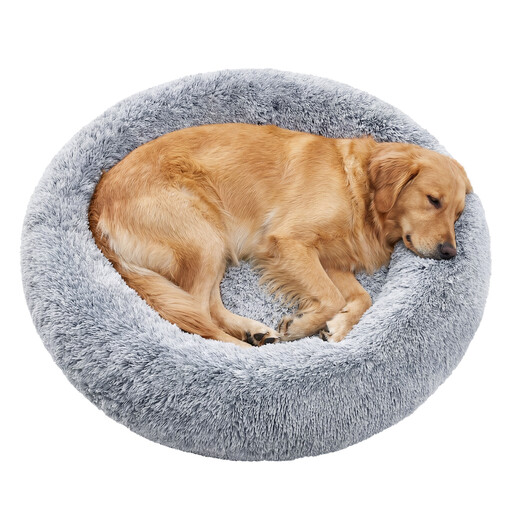
Why It's a Match: The donut shape is ideal for dogs that like to curl up to sleep. The high, soft rim provides a sense of security. With a 100 cm diameter, it's also suitable for medium to large dogs who prefer this nest-like shape.
This bed solves the hygiene problem perfectly: the central cushion can be completely removed via a zip on the bottom and washed separately. The filling of supportive PP cotton is clearly declared.
The combination of cosy long-pile plush and the practical, removable filling for easy cleaning.
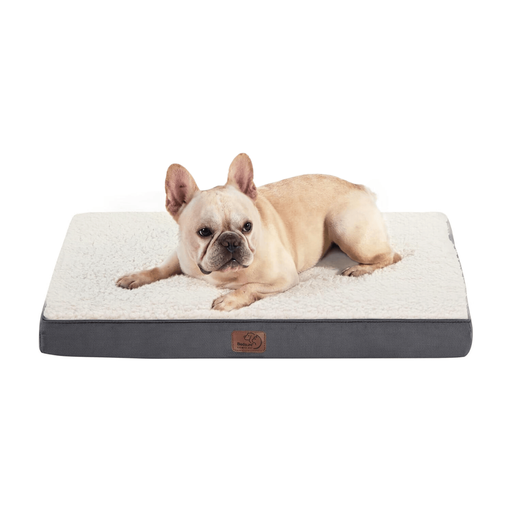
Why It's a Match: This cushion is a versatile all-rounder. It's suitable as an insert for crates or as a standalone dog mat. The convoluted foam provides good pressure relief and shock absorption, which is especially beneficial for older dogs.
Instead of a vague "orthopedic" promise, this product specifies the exact foam type (convoluted foam) and its function (pressure distribution, shock absorption). The cover is easily removable and washable thanks to an L-shaped zip.
The excellent air circulation from the convoluted foam and the non-slip base make it a safe and practical solution for everyday use.
We have compiled a complete, up-to-date list of products that fully meet these strict selection criteria and safety standards.
1. How do I find the right size for an orthopedic dog bed? Measure your dog while they are in their favourite sleeping position. If they like to stretch out, measure them from their nose to the base of their tail. If they curl up, measure the diameter. Add about 15-20 cm to these measurements to ensure your dog has enough space to move and change positions comfortably.
2. How often should you wash a dog bed cover? The frequency of washing depends on usage, your dog's coat, and any allergies. As a general rule, it's recommended to wash the cover every one to two weeks. More frequent cleaning may be necessary for heavy shedders, after walks in the rain, or for dogs with skin conditions.
3. What is the difference between memory foam and regular foam? Regular foam provides basic cushioning but simply compresses under pressure. Memory Foam (viscoelastic foam), on the other hand, reacts to body heat and weight, moulding around the body to distribute pressure evenly. This provides targeted relief for joints and the spine. After the pressure is removed, memory foam slowly returns to its original shape, whereas regular foam often loses its supportive properties quickly and develops dips.