
Lieferung heute & morgen

Qualitätsgarantie

Willkommens-Angebote freischalten: KOSTENLOSE Lieferung | Bis zu 80 % RABATT | Kostenlose 30-Tage-JoyPlus-Testphase
App herunterladen
An outdoor floor lamp can provide flexible lighting for seating areas, paths or entrance areas. However, not every outdoor floor lamp is suitable for every location. Unclear information about ingress protection, battery life or light output often means a lamp is less practical in everyday use than expected.
The term “weatherproof” is not very meaningful on its own. The key factor is the IP rating. A lamp with IP44 is protected against solid foreign objects measuring 1 millimetre or more and against splashing water from various directions. It is suitable, for example, for a partially sheltered balcony or covered patio.
For freestanding garden lighting exposed to more severe weather, a higher rating such as IP65 is more suitable. It provides protection against dust and water jets. Even an IP65 light should not be left standing in water or flooded for long periods.
A decorative garden floor lamp does not automatically provide enough light for reading or illuminating a path. Look at the luminous flux in lumens (lm):
The colour temperature also affects how the lamp can be used. 2,700 to 3,000 Kelvin creates a warm, understated effect. 6,500 Kelvin, on the other hand, produces noticeably cooler, white light. For a cosy patio lamp, warm white light is usually more suitable than cool white functional lighting.
With a solar floor lamp, the operating time depends on sunlight, the season, the orientation of the solar panel and battery capacity. A location beneath a balcony overhang or next to a tall hedge can significantly reduce charging performance.
For a battery-powered outdoor lamp, you should also check:
IP44 may be sufficient for a covered balcony. On an open patio or in the garden, models rated IP54 to IP65 are better prepared for changing weather conditions. However, the IP rating does not replace a stable base. In windy conditions, a tall, lightweight lamp should be secured or temporarily brought indoors.
A mains-powered outdoor LED floor lamp provides light regardless of sunlight, but it requires a suitable outdoor socket and an appropriate cable. Solar lights work without a mains connection and often switch on automatically when it gets dark. Their performance depends on their location.
Battery-powered models offer flexible positioning and can often be charged via USB. A dimmable outdoor lamp is practical when you want to switch between atmospheric lighting, entertaining and brighter illumination.
Measure the available space before buying. A slim lamp fits on many balconies, but may be less stable in windy conditions. Low models or lights with ground spikes are suitable for paths and flower beds. For seating areas, lights measuring 108 to 125 cm provide a more visible light source.
Material specifications should be precise. Steel, aluminium, plastic and glass have different properties in terms of weight, maintenance and weather resistance. Clean solar panels and light covers regularly with a soft, damp cloth. Abrasive cleaners can damage surfaces and protective covers.

Why this product suits this profile: This solar light does not require a mains connection and can be positioned in soft ground using its ground spike. It is therefore suitable for adding initial accents around flower beds, paths or small lawns.
The specifications state a charging time of 4 to 6 hours and an operating time of 8 to 12 hours. Its IP44 rating makes its intended use as a splash-resistant garden light clear.
Polycrystalline solar cell, NiMH battery and stated operating temperature of -10 °C to 50 °C.
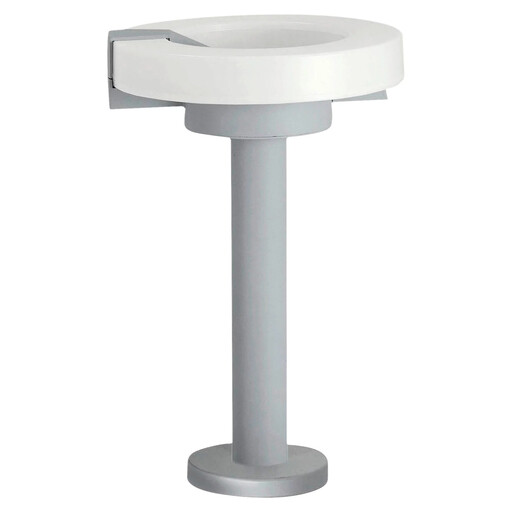
Why this product suits this profile: The classic post design and stated IP65 rating are suitable for freestanding areas such as garden paths, driveways and lawns.
The IP65 rating is clearly specified rather than being described only with a general reference to weather resistance. This makes it easier to assess where the light can be used.
Stated 470 lm, warm white 3000 K light and a robust design with glass diffuser and base.
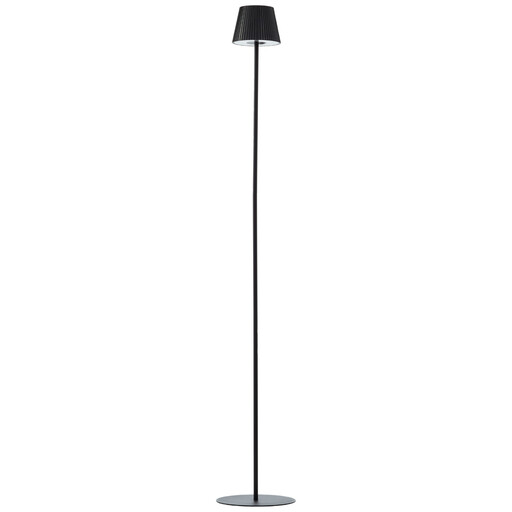
Why this product suits this profile: This 125 cm-high outdoor lamp is ideal for anyone looking to use a cordless light flexibly on a balcony, patio or in an indoor-outdoor transition area.
The brightness is not described only in general terms: the specifications state a maximum of 340 lm, 3000 K and three dimming levels. The IP54 rating indicates protection against dust and splashing water.
Integrated ICR18650 battery, USB charging cable, touch dimming and warm white LED light.
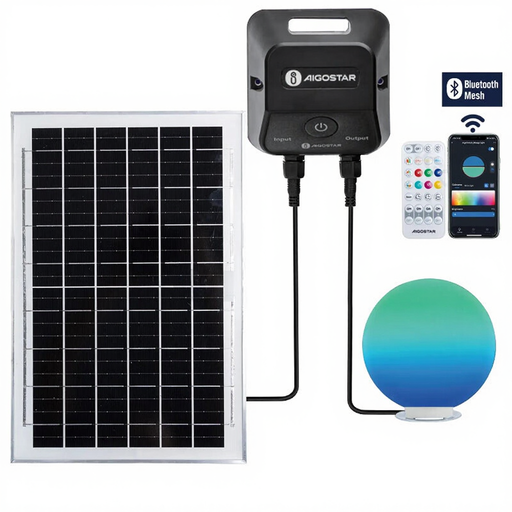
Why this product suits this profile: For larger outdoor areas and users who want to change their lighting, this solar floor lamp offers RGB as well as warm and daylight options. It is controlled via Bluetooth Mesh.
As well as the light colour options, the specifications state an IP65 rating, a charging time of 4 to 6 hours and a battery capacity of 8,000 mAh. This makes the key selection criteria easy to assess.
Monocrystalline solar panel, Bluetooth Mesh connection for multiple devices and a stated maximum battery life of 24 hours.
We have put together a complete, regularly updated list of products that fully meet these strict selection criteria and the safety regulations applicable in the EU.
Position a solar floor lamp so that the panel receives several hours of direct daylight. Avoid areas beneath trees or directly next to tall walls. For battery-powered lights, a dry place for charging is recommended, along with indoor storage during extreme weather.
An outdoor lamp should stand securely and not create a trip hazard. Mains-powered models require a connection suitable for outdoor use. Also check the housing, cable, seals and battery regularly. If there is visible damage, stop using the light.
IP44 may be sufficient for sheltered balconies and covered patios. For open garden or patio areas, IP54 or IP65 is more practical. Suitability also depends on the exact position, wind, direction of rain and risk of flooding.
The operating time varies depending on the model and charging conditions. According to the product specifications, the Aigostar Solar Path Light provides 8 to 12 hours of light. The Smart Solar light states a maximum battery life of up to 24 hours. In winter or after several overcast days, the actual operating time may be shorter.
Power consumption depends on battery capacity, charging frequency and operating time. A USB-rechargeable LED light uses comparatively little energy while charging. Solar models do not require regular mains electricity, although their light output depends more heavily on their location and the weather.