
Lieferung heute & morgen

Qualitätsgarantie

Willkommens-Angebote freischalten: KOSTENLOSE Lieferung | Bis zu 80 % RABATT | Kostenlose 30-Tage-JoyPlus-Testphase
App herunterladen
The right outdoor garden lighting should illuminate paths, light up entrances and make outdoor living areas feel welcoming. In practice, however, poor purchases are often not caused by insufficient brightness, but by unsuitable IP ratings, incorrectly assessed solar conditions or an unsuitable light colour.
Marketing terms such as “weatherproof” or “suitable for all conditions” are no substitute for technical specifications. An IP44 outdoor light, for example, is protected against solid foreign objects and splashing water, but is not designed for permanent immersion. For unprotected façades, garages or areas exposed to heavy rain, IP65 outdoor lights or higher are often more suitable.
Installation is also important. Even an IP66 LED floodlight can cause problems if cable connections are left exposed or water runs along an incorrectly fitted bracket and into the housing.
Wattage primarily describes energy consumption. The lumen value is more important when it comes to perceived brightness. A small LED outdoor floodlight with a highly concentrated beam can illuminate one spot very brightly, while a garden light with a wide beam spreads light more evenly over a larger area.
Moderate light output is usually sufficient for paths and flowerbeds. An LED floodlight for a driveway, courtyard or work area, on the other hand, requires more lumens and suitable positioning to prevent glare.
A solar outdoor light needs direct or sufficiently intense sunlight. Charging performance can drop significantly beneath trees, on a north-facing wall or in the shadow of a building. With a solar floodlight with solar panel, a separately mountable panel provides greater flexibility, as the light and panel can be positioned in different directions.
The stated operating time also depends on daylight, the season, battery condition and operating mode. Product specifications should therefore be understood as guidelines rather than guaranteed results for every location.
The IP rating consists of two digits:
An IP67 solar light is not automatically better suited to every installation. What matters is whether the light, bracket and connection points are suitable for the specific area. For permanently connected lights, installation and protective measures should comply with local electrical requirements.
Colour temperature is measured in Kelvin:
A solar path light with 6500K can highlight contours clearly, but may feel less subtle in a seating area. For an outdoor wall light at the front entrance, 4000K is often a well-balanced compromise between easy orientation and a neutral lighting effect.
Before buying, check the following:
Solar lights should be cleaned regularly with a soft, damp cloth. With mains-powered models, electrical connections must be protected from moisture. Damaged lights should not be used.

Why this product suits this profile: This solar ground light can be pushed into soft soil without fixed wiring, making it suitable for paths, flowerbeds and smaller garden areas.
The charging conditions are clearly specified: direct sunlight, around 4–6 hours of charging time and a stated lighting duration of 8–12 hours. The IP44 rating makes it clear that the light is not designed for immersion in water.
Solar-powered, with a ground spike and 6500K cool white light. The housing combines plastic with a stainless steel element.
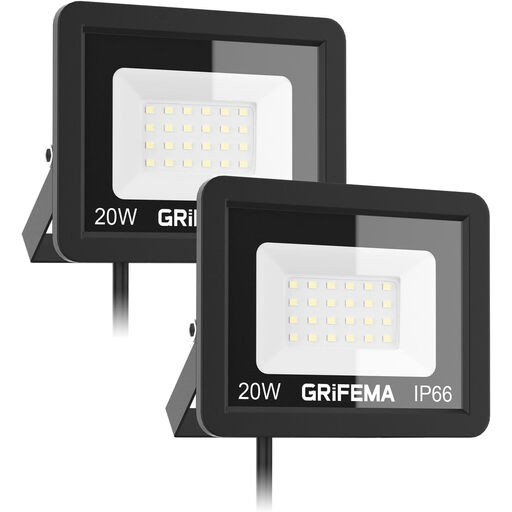
Why this product suits this profile: This set is aimed at buyers who want to illuminate a larger area such as a garden, garage, courtyard or patio with two adjustable floodlights.
The product data specifies 2200 lumens for the set of two, 20 watts per floodlight and IP66 protection. The 180° bracket allows targeted positioning instead of a fixed beam direction.
Two LED outdoor floodlights, 6500K cool white light, IP66 protection and wall, ceiling or ground mounting.
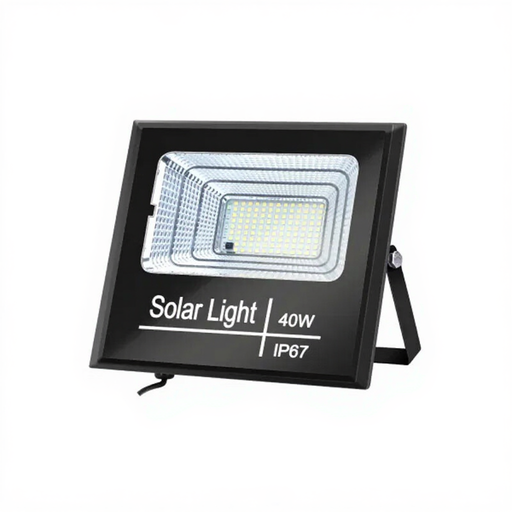
Why this product suits this profile: A separate panel makes installation easier in locations where the floodlight itself does not receive enough sunlight. This makes it suitable for larger gardens, paths or remote outdoor areas without a mains connection.
The separate-panel design reduces dependence on the installation location. The product description also states that it has a 10,000-mAh battery, up to 12 hours of lighting and IP67 protection.
Solar-powered without a mains cable, separate panel, aluminium and glass construction, plus a high stated protection rating.
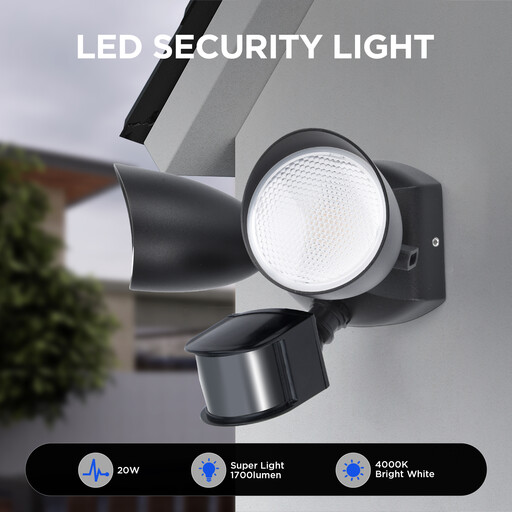
Why this product suits this profile: The integrated twin lights and sensor are designed for front entrances, patios, garages and driveways where lighting is only needed when required.
The light colour is specified as 4000K neutral white, making it different from particularly cool 6500K light. Before installation, check the sensor area, detection direction and any potential causes of false triggering.
1700 lumens, 20 watts, 4000K neutral white light and two light heads with motion sensor.
We have put together a complete, regularly updated list of products that fully meet these strict selection criteria and the safety regulations applicable in the EU.
For sheltered areas, an IP44 light may be sufficient if it is not permanently exposed to heavy rain. For unprotected façades, garages and open garden areas, IP65, IP66 or IP67 are often suitable. The right choice depends on the installation location, exposure to water and type of connection.
Consumption depends on the wattage and how long the light operates each day. A 20-watt model that operates for five hours a day uses 0.1 kilowatt-hours per day in theory. Motion sensors can reduce the actual operating time. Solar lights do not use mains electricity, but they do depend on sunlight and battery capacity.
Service life depends on the LED module, battery, housing, temperature, moisture and operating mode. With solar lights, the battery is often an important wear factor. Stated LED lifespans, such as 15,000 hours for some models, are technical product values and do not guarantee the same service life for the light as a whole.