
Lieferung heute & morgen

Qualitätsgarantie

Willkommens-Angebote freischalten: KOSTENLOSE Lieferung | Bis zu 80 % RABATT | Kostenlose 30-Tage-JoyPlus-Testphase
App herunterladen
The right outdoor garden lighting can illuminate paths, highlight flower beds or create a pleasant atmosphere on your patio or balcony. In practice, however, design and light colour alone do not guarantee a good purchasing decision. Protection rating, power supply and the actual installation location are often overlooked.
The term IP44 garden lighting indicates protection against solid foreign objects from 1 mm in size, as well as splashing water from different directions. This is sufficient for many sheltered outdoor areas, but it does not mean that the light can stand in water or be cleaned with a high-pressure jet.
For exposed locations, such as an open driveway, an IP65 outdoor light may be more suitable. This protection rating indicates complete protection against dust and protection against water jets. The specific installation instructions remain decisive, however: cable connections, power supplies and sockets may have a different protection rating from the light fitting itself.
Solar garden lights require direct daylight. Shade from walls, trees or tall hedges reduces charging capacity. Claims such as 8 to 12 hours of illumination apply under suitable charging conditions and may be reduced in winter, during cloudy weather or when the solar panel is dirty.
Before buying, you should therefore check:
RGB garden lighting, app control and voice commands can make operation more convenient. For a safe driveway or a clearly visible path, however, luminous flux, positioning and beam angle are crucial. A coloured decorative light with low power consumption is not equivalent to a bright path lighting system.
Warm white light between approximately 2700 and 3000 Kelvin has a subtle effect outdoors and is suitable for seating areas, flower beds and decorative garden spike lights. Neutral white light can show contours and steps more clearly. Luminous flux in lumens describes the amount of light emitted. A light with 470 lumens is suitable for a limited area, while several weaker solar lights are more likely to provide points of orientation.
With LED garden lights, you should also check whether the LED module is replaceable. An integrated, non-dimmable module provides a fixed light output. If you want a flexible lighting atmosphere, look specifically for dimmable garden spotlights or lights with CCT and RGB functions.
The IP code consists of two digits. The first describes protection against solid foreign objects and dust, while the second indicates protection against water. For water-resistant outdoor lighting, IP44 is often sufficient in sheltered areas, while IP65 offers greater protection against dust and water jets.
The construction also matters:
Solar lights can be positioned without a permanent power connection, but require a sunny location. Mains-powered lights generally provide a more consistent light output, but require professional installation. An outdoor Wi-Fi socket can switch existing lights on and off according to a schedule or via an app. To control garden lighting with Alexa, the smart plug, app, Wi-Fi frequency and voice assistant must be compatible. According to the product information, the EIGHTREE model requires 2.4 GHz Wi-Fi.
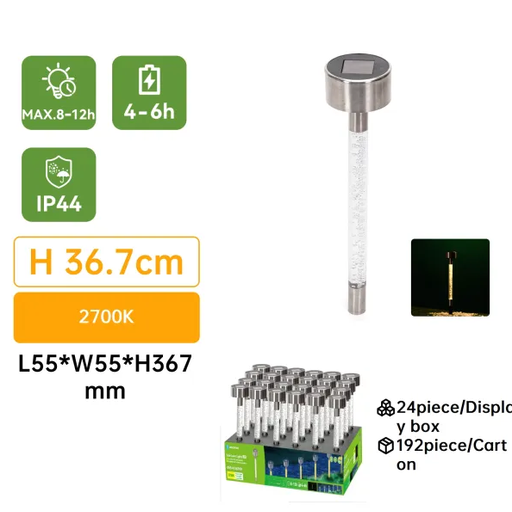
Why this product suits this profile: This solar light can be placed in lawns, flower beds or beside paths without a direct power connection, and provides warm white light at 2700 K.
The product information clearly states the charging and illumination times: approximately 4–6 hours of charging and 8–12 hours of lighting under suitable conditions. IP44 should nevertheless not be confused with complete waterproofing.
Solar-powered with no mains connection, 2700 K warm white light, integrated Ni-MH battery and automatic activation in the dark.
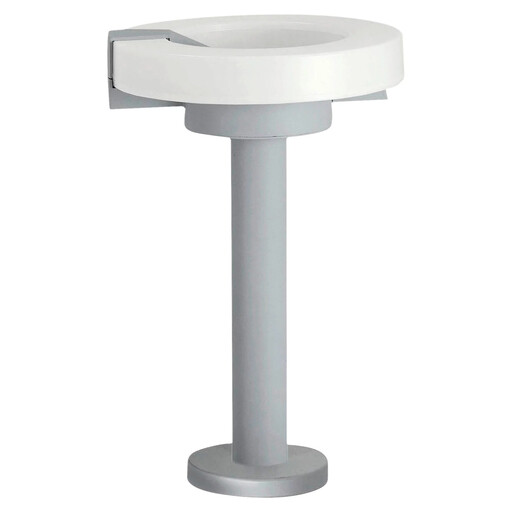
Why this product suits this profile: This classic garden lamp post is designed for paths, lawns and driveways, combining a robust housing with a fixed light output.
The stated IP65 protection rating is designed for dust-protected outdoor areas and water jets. According to the product information, the integrated LED module is not dimmable; this should fit your lighting plan before you buy.
470 lumens, 3000 K warm white light, toughened glass diffuser, stable base plate and an E27 socket for bulbs up to 40 W, according to the product information.
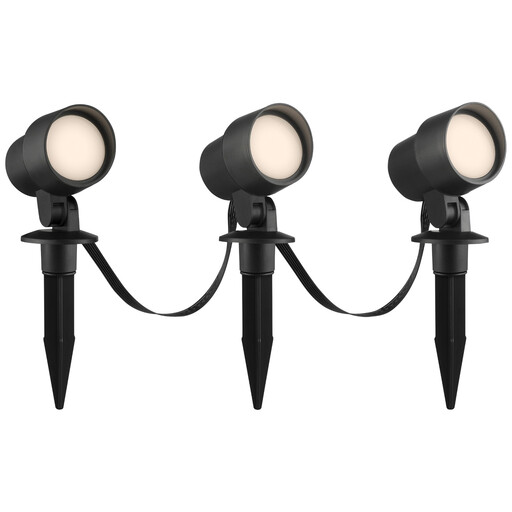
Why this product suits this profile: Three ground spike lights allow flexible positioning in flower beds, beside paths or on the patio. Tuya Smart, CCT, RGB and dimming functions offer several control options.
The functions are clearly specified: app and voice control, adjustable colour temperature, RGB colours and dimming. With IP44, installation in sheltered areas is preferable.
Set of three, RGB and CCT selection, dimmable light and compatibility with Tuya Smart, Alexa and Google Assistant according to the product description.
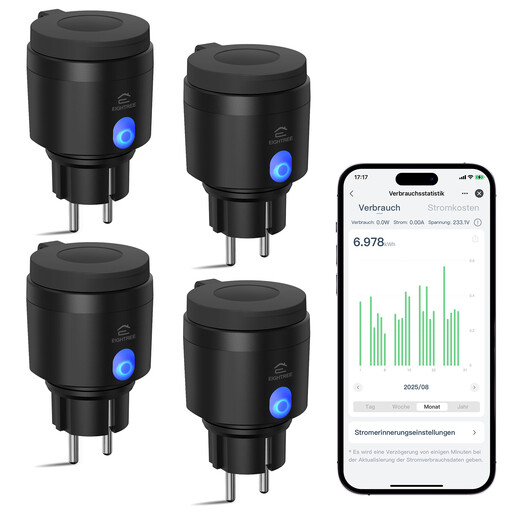
Why this product suits this profile: The four-pack is ideal if you want to control several existing outdoor lights, decorations or devices according to a schedule.
The product information specifies IP44, timer, remote control, energy monitoring and the restriction to 2.4 GHz Wi-Fi. These requirements should be checked before placing your order.
Four outdoor sockets, schedules, remote app control, energy consumption display and voice control with Alexa and Google Home according to the description.
We have put together a complete, regularly updated list of products that fully meet these strict selection criteria and the safety regulations applicable in the EU.
Their lifespan depends on the LED module, battery, charging conditions and exposure to the weather. For the Aigostar models mentioned, a rated lifespan of up to 15,000 hours is specified. The battery may lose performance sooner due to charging cycles and cold temperatures. Regularly cleaning the solar panel and choosing a sunny location will help it perform as intended.
Running costs depend on the power rating, daily operating time and electricity tariff. A simple calculation is: power in kilowatts multiplied by operating hours and the price per kilowatt-hour. Solar garden lights do not require direct mains electricity, but their light output varies depending on the weather and location. With mains-powered lights, a timer can reduce unnecessary operating time.
Outdoor path lights should be positioned so that they mark the route without creating glaring points of light at eye level. With ground spike lights, a firm surface that does not become waterlogged is important. Permanently connected mains lights and outdoor sockets must be installed in accordance with the applicable installation requirements; if you are unsure, consult a qualified electrician. The light, cable, plug and power supply must also be suitable for the intended outdoor area.