
Lieferung heute & morgen

Qualitätsgarantie

Willkommens-Angebote freischalten: KOSTENLOSE Lieferung | Bis zu 80 % RABATT | Kostenlose 30-Tage-JoyPlus-Testphase
App herunterladen
An outdoor key safe with a combination lock can simplify the handover of house, garage or access keys. For landlords, Airbnb hosts, property managers, care services and families, it removes the need for in-person key exchanges. However, not every outdoor key box is suitable for long-term use in the British climate.
As Joybuy’s Product Recommendation Officer, I’ve filtered the relevant product details and highlighted what really matters when choosing one. The key factors aren’t flashy marketing claims, but rather the build quality, internal dimensions, mounting method and practical code management.
A weatherproof key box shouldn’t just rely on a coated casing. Rain, frost, dust and road salt can all affect the combination mechanism. A protective lid or cover for the number dials reduces direct contact with moisture and dirt.
The term “rust-resistant” should also be considered in relation to the material. Zinc alloy, aluminium and steel differ in weight, surface treatment and resistance to mechanical stress. A single material specification doesn’t replace checking the door, shackle, screws and mounting surface.
Many users need more than just space for a single front door key. For key storage used by families, tradespeople or care services, you may need room for several keys, a keyring or an access card. Before buying, you should therefore compare internal dimensions and capacity details.
A 4-digit combination lock theoretically offers up to 10,000 possible combinations. This improves choice over a shorter code, but doesn’t automatically prevent unauthorised access. An easily guessed code, visible wear marks on the number dials, or a poorly mounted box all remain security risks.
A theft-resistant key box always depends on its fixing. Mounting on thin cladding, crumbling brickwork or plasterboard can significantly reduce its protective effect. For a wall-mounted key box, you should use load-bearing surfaces such as concrete, solid brick or suitable timber.
Check before installation:
For outdoor use, casings made from zinc alloy or aluminium are often a sensible choice, provided the doors, hinges and combination lock are also designed for outdoor use. Look for a cover over the number dials and for information about frost and moisture resistance. A specific IP rating isn’t always given for mechanical key boxes; if it’s missing, you shouldn’t assume any particular level of waterproofing.
For a single front door key, a compact compartment is sufficient. A key box for multiple keys, on the other hand, should offer enough width and depth for key heads, rings and possibly a card. Bear in mind that the external dimensions don’t reflect the usable internal space.
For an Airbnb key safe, it’s also important that the code can be changed between stays. For property managers or businesses, documented code allocation can be useful. Only share the code with people who genuinely need access.
A key safe with a combination lock requires no battery and can be used by multiple authorised people. The combination shouldn’t be based on dates of birth, house numbers or simple repeated digits. Store the code in a secure place and, after setting it, check that the box actually locks when the shackle is closed.
On some models, the code is changed using an internal lever. Read the included instructions before changing the code. Lost combinations on mechanical models often can’t be reset without causing damage.

Why this product fits the profile: The removable shackle allows flexible use, while the 4-digit combination lock requires no battery. According to the product details, the compartment has space for up to five keys and a card.
The combination of a combination lock and removable shackle avoids reliance on batteries or a spare key. Before buying, check the dimensions stated in the listing, as different measurements are given.
Zinc alloy, resettable 4-digit code and stated storage for up to five keys and a card.
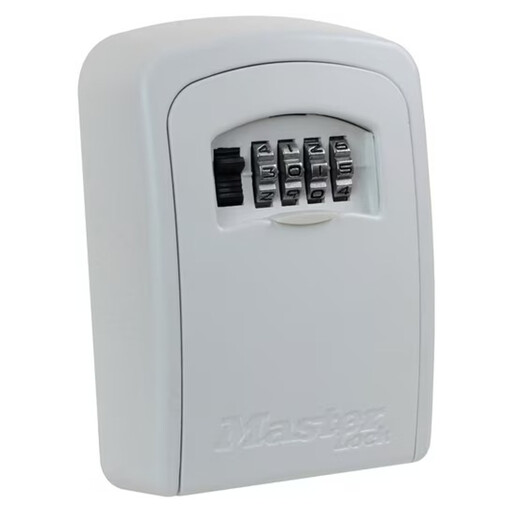
Why this product fits the profile: This model is designed for permanent wall mounting and features a weather-protected flap over the combination dials. The internal dimensions are stated as 9.2 × 6.4 × 3 cm.
The protective flap addresses the common weakness of unprotected number dials. The compact internal dimensions also help you realistically assess the actual capacity before ordering.
Aluminium casing, individually settable 4-digit combination and included mounting hardware.

Why this product fits the profile: The wall-mounted design is intended for controlled access at holiday lets, care services or shared buildings. According to the product details, the compartment holds approximately five keys and a card.
A cover protects the number dials from rain, dust and snow. The product details also mention pre-drilled fixing holes; however, mounting should still be carried out on a load-bearing surface.
Zinc alloy, resettable 4-digit code and stated external dimensions of 11.5 × 9.5 × 9.5 cm.
We’ve put together a complete, regularly updated list of products that fully meet these strict selection criteria and the safety regulations in force across the EU.
Once you’ve chosen your key safe, it should be mounted in a location that’s as sheltered as possible, yet still accessible to authorised people. A covered area can reduce exposure to rain and snow. The screws should sit flush within the casing and not be easily reachable from the outside after installation.
For ongoing use, we recommend:
Installation is usually done through pre-drilled holes on the back. Use wall plugs and screws suitable for the surface. Different fixings are needed for concrete or solid brick compared to wood. Mounting on thin cladding or plasterboard is generally not suitable for storing security-relevant keys.
It’s not possible to give a general lifespan. It depends on the material, installation location, frost, moisture, dust and frequency of use. A protective flap, regular visual checks and a suitable, partially sheltered position can help maintain mechanical function. If you see visible corrosion or damaged number parts, the box should be replaced.
A mechanical combination code normally incurs no battery costs. Ongoing expense mainly comes from installation, occasional cleaning and, if necessary, replacement due to wear or damage. If users change frequently, you should also allow time for secure code management.