
Lieferung heute & morgen

Qualitätsgarantie

Willkommens-Angebote freischalten: KOSTENLOSE Lieferung | Bis zu 80 % RABATT | Kostenlose 30-Tage-JoyPlus-Testphase
App herunterladen
An outdoor lamp has to meet very different requirements depending on where you use it. When camping, low weight matters; in the garden, you want pleasant all-round lighting; and during a power cut, the simplest possible power supply is key. Many purchasing decisions fall through not because of the light source itself, but because of unclear product specifications and unsuitable features.
A high lumen figure describes the luminous flux, but it doesn't tell you on its own how useful the lamp will be. A focused torch can beam light a long way, whereas a camping lamp with side lighting illuminates a larger area evenly. So for reading in a tent, the table on the patio, or finding your way around the garden, the brightest figure isn't automatically the best one.
Also pay attention to the light distribution, several brightness levels and a possible red-light mode. A torch with side lighting can combine two tasks: directional light for paths and broader light for your immediate work area.
The protection rating needs to be read carefully. IP44 protects against solid foreign objects larger than 1 millimetre and against splashing water from any direction. That's fine for light rain or damp outdoor areas, but it doesn't mean the lamp can be submerged. A so-called waterproof outdoor lamp may technically only be splash-proof.
With IP67, the housing is dust-tight and protected against temporary immersion under the conditions specified by the manufacturer. Even so, you should check the charging ports, seals and battery compartment before every use.
The stated operating time of a rechargeable lantern or portable lamp often refers to the lowest brightness level. At full power, the run time drops. So check whether the manufacturer gives separate figures for torch mode, side light and reduced brightness.
For longer trips, a rechargeable outdoor lamp with USB-C can be a good idea. A solar camping lamp offers additional charging options, but needs direct, unobstructed sunlight. In the British winter or when it's cloudy, solar power should therefore be seen as a supplement rather than a sole power source.
At least three values are relevant for your buying decision:
An LED outdoor lamp with a front light is good for orientation and paths. A lamp with a side panel or 360-degree coverage is more practical for a table, tent or living area. A red light can be less dazzling when moving around at night, but it doesn't replace safe path lighting.
ABS plastic is lightweight and sufficient for many camping uses. Aluminium can offer a sturdy housing option, but it adds weight depending on the design. For backpacking trips, compact dimensions and a low net weight are important. For a garden lamp or patio lamp, what matters more is stability, a handle, a hanging hook and a shape that suits your décor.
Also note the cleaning instructions. After contact with dust or moisture, the lamp should be dried and the charging port closed. Gas-powered models must only be used outdoors and in well-ventilated areas.
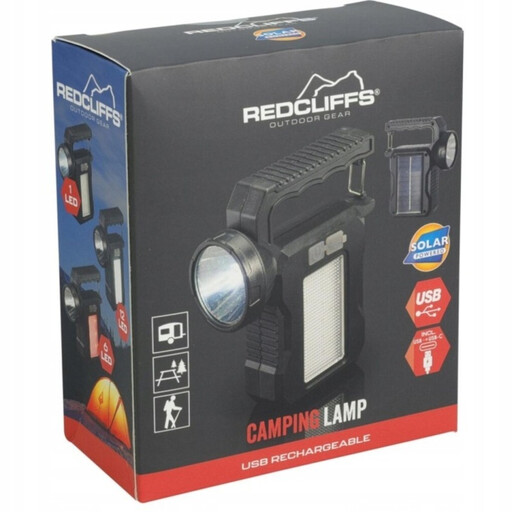
Why this product fits the profile: This compact camping lamp combines USB-C charging with an integrated solar panel and can be hung from a hook. It's suitable for a tent, balcony, garden and as an emergency lamp.
The run time is listed separately: around 4 hours in torch mode and around 5 hours with side light. The IP44 rating is classed as splash-proof, not as submersible.
150 lumens front light, 80 lumens side light, red-light mode, 1200 mAh battery and USB-C charging time of approximately 3 hours.
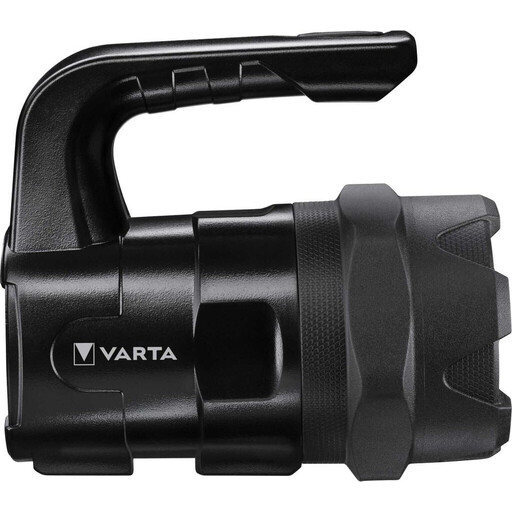
Why this product fits the profile: For demanding outdoor and work environments, this battery-powered lantern offers an aluminium housing, a stated IP67 rating and two light modes.
The specifications list not only brightness, but also the protection rating, impact resistance and battery type. The battery compartment must be correctly closed before use.
400 lumens, stated beam distance up to 400 metres, up to 85 hours run time and 6 AA batteries included.
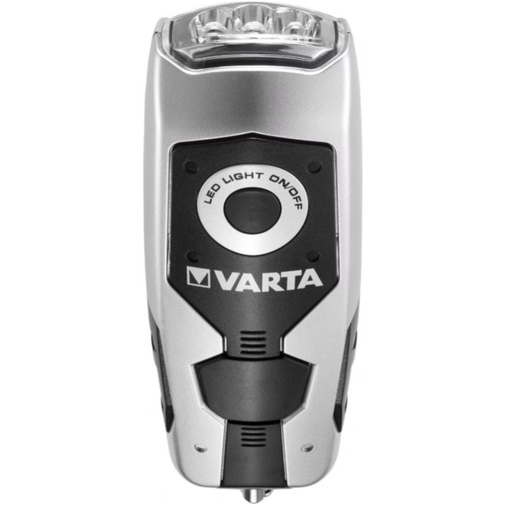
Why this product fits the profile: This dynamo torch is designed for the car, garage, camping and power cuts when no charged batteries or spares are available.
The power supply is via a hand crank. This removes the reliance on mains electricity and disposable batteries; for longer use, regular cranking needs to be factored in.
No batteries required, built-in dynamo, impact-resistant ABS housing and splash-proof protection according to product specifications.
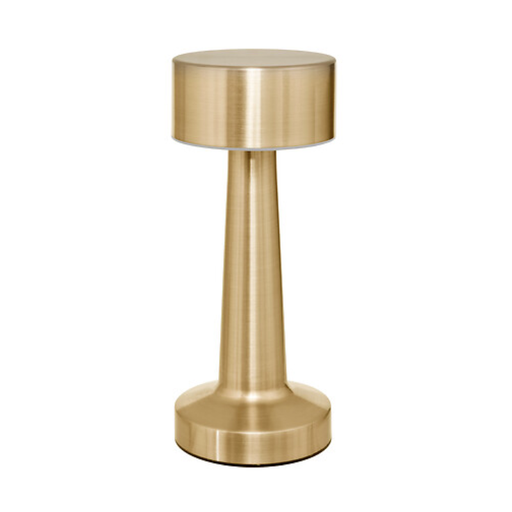
Why this product fits the profile: This compact light is designed as a decorative, cordless garden lamp for the patio, balcony, garden paths and outdoor areas.
The power supply is via a built-in 18650 lithium-ion battery. Before buying, you should check whether a USB cable and charging adapter are needed, as this is not clearly stated.
21.5 cm height, 9 cm diameter, steel housing with gold finish and cordless operation thanks to the built-in battery.
We've put together a full, regularly updated list of products that fully meet these strict selection criteria and the safety regulations in force in the EU.
For a power cut, an emergency lamp with a charged battery, a battery-powered model or a dynamo torch are all suitable. The key thing is that the power source is available independently of the mains. A solar camping lamp can supplement this, but can only be recharged to a limited extent when there's no daylight.
The battery life depends on the capacity, light mode and temperature. A figure of up to several hours often refers to a reduced brightness. So compare the run time for front light and side light separately, and recharge a lithium-ion battery regularly if it's being stored for a long time.
IP44 protects against splashing water, not against heavy, persistent rain or submersion. An IP44 outdoor lamp should only be used temporarily in light damp conditions and then dried off. For permanent outdoor installation, you also need to follow the manufacturer's instructions for installation, power supply and storage.