
Lieferung heute & morgen

Qualitätsgarantie

Willkommens-Angebote freischalten: KOSTENLOSE Lieferung | Bis zu 80 % RABATT | Kostenlose 30-Tage-JoyPlus-Testphase
App herunterladen
Outdoor LED fairy lights should look attractive, work reliably and suit your existing power supply. In practice, unnecessary costs often come not from the purchase price, but from choosing the wrong IP rating, misjudging the length or picking an unsuitable light colour. This buying guide from the Joybuy Product Recommendation Officer will help you compare technical details and avoid common buying mistakes.
Many listings describe their fairy lights as waterproof in general terms. What matters, though, is the specific IP rating. IP44, for example, protects against splashing water from different directions, but not immersion. IP65 offers greater protection against water jets, but it still doesn’t mean that power supplies, battery compartments or solar panels can be used underwater.
For long-term outdoor use, cable connections should also be kept out of puddles. If you choose mains-powered fairy lights, place the power supply in a sheltered area wherever possible.
The stated overall length doesn’t always match the section that will actually be lit. With meteor shower lights, for example, you may also need to allow for the lead cable and hanging elements. With G40 string lights, the spacing between bulbs and the route along railings, pergolas or façades also matter.
Before you buy, it’s worth making a simple sketch:
Warm white LED fairy lights, at around 2,700 to 3,000 Kelvin, create a softer, more decorative glow. At 6,500 Kelvin, the light looks much cooler and more like daylight. Warm white is usually the choice for a cosy patio or a wedding, while cool white can work well for certain decorations or crisp lighting accents.
The power supply should also suit the location. Solar fairy lights need plenty of direct sunlight. Battery-powered lights are flexible, but you’ll need to replace the batteries regularly. Mains-powered models are suitable for longer periods of use, but require a sheltered power source.
The first digit indicates protection against solid objects, while the second indicates protection against water. IP44 may be suitable for decorative fairy lights in a sheltered outdoor area. For a more exposed installation, such as on a pergola or in the garden, IP65 offers greater protection against water jets.
Important: the IP rating doesn’t necessarily apply to every component. With solar products, the solar panel, battery casing and light string may each have different limitations. For battery-powered models, the battery compartment must remain fully closed.
A higher number of LEDs doesn’t automatically mean brighter lighting. Other factors also matter:
Icicle lights and meteor shower lights create a vertical effect with drops of different lengths. G40 string lights, on the other hand, use larger individual bulbs as visible decorative features.
Dimmable fairy lights can be more practical than a model with just one brightness setting, especially if your needs change. Timer and memory functions make them easier to use. With colour-changing fairy lights, check whether you can control the modes using the switch or a remote control.
For outdoor Christmas lights, memory functions and a suitable cable length are also important. For events, the option to connect multiple strings can make installation easier. Be sure to check the maximum number of connectable sets in the product details.

Why this product suits your needs: Two 8-metre strings, each with 80 multi-coloured LEDs, are ideal for balconies, smaller gardens, plants or railings where there’s no socket nearby.
The solar power supply means you don’t need an outdoor socket. However, the stated run time of 8–14 hours depends on the weather and, according to the product details, requires 6–8 hours of direct sunlight.
An IP65 rating, eight lighting modes and a memory function. The copper-wire design can be easily wrapped around branches and decorations.

Why this product suits your needs: With 23 shatterproof LED bulbs, the G40 design is suitable for patios, pergolas, gardens and events such as weddings.
The product details specify an IP65 rating, dimming and replaceable bulbs. This makes it easier to assess the level of protection, adjust the brightness and maintain the lights.
20-metre length, warm white light, dimming and the option to connect sets for up to 500 bulbs in total, according to the product description.

Why this product suits your needs: With 15 hanging points and a coverage area of 10 × 0.5 metres, these lights are designed for larger façades, trees, shop windows or seasonal outdoor Christmas displays.
The product details clearly state the LED count, colour temperature, hanging spacing, power rating and IP44 rating. This makes it easier to plan your installation in advance.
720 warm white LEDs at 3,000 Kelvin, a memory function, a 5-metre extension cable and a 9-watt adapter for 220–240 volts.
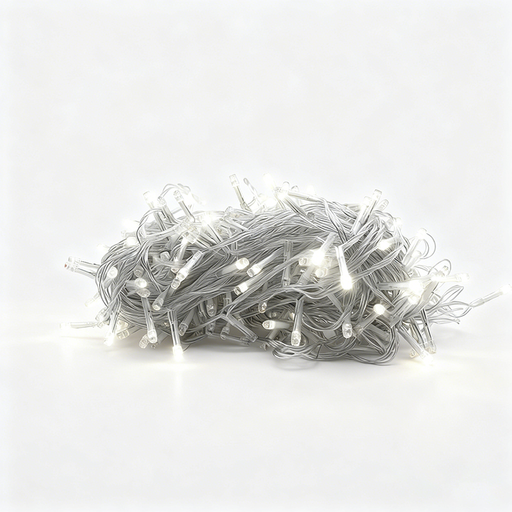
Why this product suits your needs: These compact, battery-powered fairy lights are ideal for camping, balconies, small decorations and areas without a power socket.
The power supply requirement of three AA batteries is clearly stated; batteries are not included. The IP44 battery compartment must be protected from moisture and kept fully closed.
4-metre length, 50 LEDs, eight lighting modes and a memory function, with a stated colour temperature of 6,500 Kelvin.
We’ve put together a complete, regularly updated list of products that meet these strict selection criteria and fully comply with the safety regulations in force in the EU.
Their lifespan depends on the LED components, cable quality, usage time, temperature and moisture. It isn’t possible to give a general estimate without knowing the specific conditions of use. For longer-lasting performance, check regularly for damaged cables, loose bulb holders and leaking casings. If you use the lights seasonally, switch them off completely and store them somewhere dry.
Running costs depend on the wattage, how long the lights are on and your electricity tariff. The calculation is: power in kilowatts × operating hours × electricity price. For example, a 9-watt string of lights uses 0.09 kilowatt-hours over ten hours. With solar and battery-powered models, you may instead need to factor in the cost of replacement batteries or battery wear.
This depends on the IP rating and the manufacturer’s instructions. IP44 models should be protected from prolonged driving rain, snow build-up and standing water. The same applies to IP65: plug connections, power supplies and solar panels must not be submerged. Before installation, also consider frost, wind load and secure fixing.