
Lieferung heute & morgen

Qualitätsgarantie

Willkommens-Angebote freischalten: KOSTENLOSE Lieferung | Bis zu 80 % RABATT | Kostenlose 30-Tage-JoyPlus-Testphase
App herunterladen
An outdoor LED floodlight with a motion sensor and twin spotlights can provide targeted lighting for paths, driveways, patios or the area outside your garage. However, some marketing claims can easily lead to the wrong purchase. It’s not just lumens and wattage that matter: you should also consider the mains voltage, IP rating, mounting method and how the sensor actually works.
A high lumen rating describes the total light output, but it doesn’t automatically mean the light will be evenly distributed. Two adjustable heads can spread the light more effectively than a single fixed head. A wide beam is useful for a driveway, while a narrower beam can highlight a doorway or gate.
Check whether the two heads can be adjusted independently. With an outdoor twin floodlight, you should also choose a mounting position where walls, roof edges or plants won’t unnecessarily block the beam.
Terms such as “waterproof” or “weatherproof” are of limited value without a clear IP rating. Before you buy, check whether an IP rating is provided and whether it’s suitable for the intended mounting position. An outdoor light beneath a porch roof faces different conditions from a floodlight mounted on an exposed garage wall.
The available product information doesn’t list a specific IP rating for every model featured here. Follow the installation instructions, and don’t make unauthorised changes to cable entries, seals or the light’s position.
Many lights sold in Germany run on a 230-volt mains supply. However, according to the product information, the second model in our selection is designed for AC 120 V, 60 Hz. These specifications aren’t directly compatible with the German mains supply. Before ordering, you must check that the product is suitable for your intended connection.
For hardwired lights, installation and maintenance should only be carried out with the power switched off and by a suitably qualified electrician. A built-in motion sensor is no substitute for safe electrical installation.
An outdoor 20 W floodlight with integrated LEDs often offers a good balance between light output and energy use. When choosing a model, consider the wattage alongside the lumen rating:
The two 20-watt models in this selection are rated at 1,800 and 1,700 lumens respectively. These figures come from the product information and shouldn’t be taken as a guarantee of illuminance at a particular point.
4000 K LED light appears neutral white and is well suited to entrances, patios, paths and garage areas. 5000 K daylight white has a cooler appearance and can work well in work areas or where you want clear illumination around sheds and driveways.
Colour temperature doesn’t indicate the quality or safety of a light. What matters is whether it suits its surroundings and won’t cause unnecessary glare for neighbours, passing pedestrians or people inside your home.
A metal housing may be a good choice if you’re looking for a black outdoor light for permanent installation. According to the product information, the second model features die-cast aluminium, a black powder-coated finish and toughened glass covers. It also has two light heads that can be adjusted through 180 degrees.
For any outdoor LED light, check for:
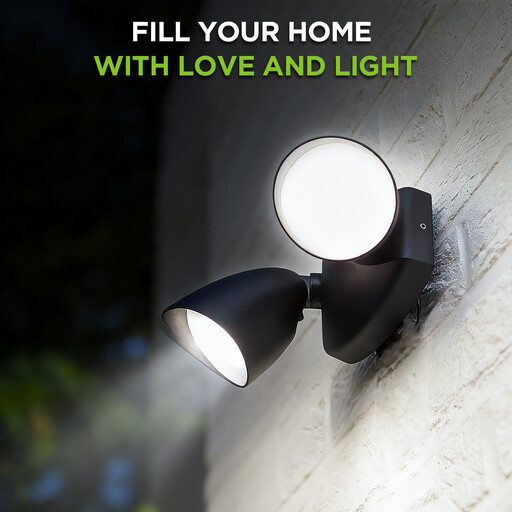
Why it suits this profile: With 20 watts, 1,800 lumens and 4000 K, this model is a good option if you’re looking for neutral white lighting for a house wall, patio, courtyard or garden.
The product information gives specific figures for power, light output and colour temperature, making it easier to compare this model with other 20-watt floodlights.
1,800 lumens, 20 watts, 4000 K and two light heads, according to the product information.
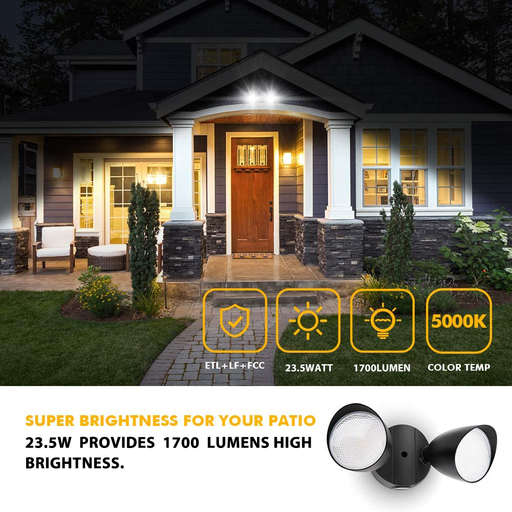
Why it suits this profile: The adjustable heads, die-cast aluminium, toughened glass and 5000 K daylight white will appeal if you prioritise material specifications and directional lighting for a garage, shed or driveway.
The product information specifies the materials, glass type and 180-degree adjustment. Important: check electrical compatibility for use in Germany before buying, as this model is rated at AC 120 V and 60 Hz.
Die-cast aluminium, toughened glass covers and two heads adjustable through 180 degrees, according to the product information.
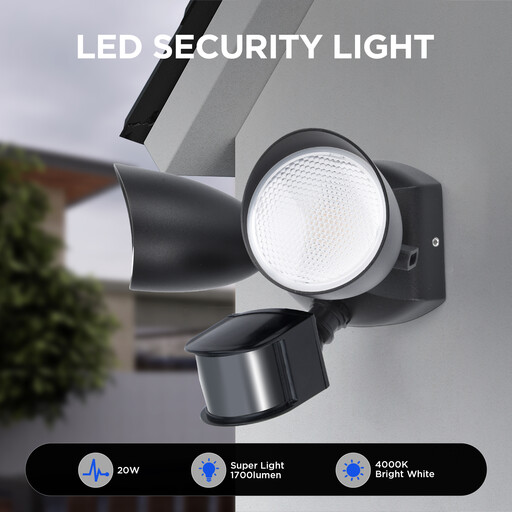
Why it suits this profile: This outdoor floodlight has a sensor and two light heads, making it suitable for entrances, courtyards, garden paths or a garage where you want the light to switch on automatically.
The product name specifically mentions the sensor. Before installation, check its detection area and position, and consider whether animals or passing vehicles could trigger it accidentally.
1,700 lumens, 20 watts, 4000 K and an integrated sensor, according to the product information.
We’ve put together a complete, regularly updated list of products that meet these strict selection criteria and fully comply with the safety regulations in force in the EU.
A 20-watt LED floodlight uses 0.02 kWh for every hour it’s switched on. Actual consumption depends on how long the light stays on. A motion sensor can reduce running time when correctly adjusted. However, if the timer is set too briefly, the light may switch off while you’re still passing through.
For safe installation, you should:
There’s no single ideal height for every mounting position. On a house wall, garage or shed, position the floodlight so the sensor covers the area you want and the light heads remain accessible. The mounting height should also suit the sensor’s range and stated detection angle.
Lifespan depends on the LED module, electronics, heat dissipation, switching cycles and exposure to the elements. Unless the manufacturer provides specific information, you shouldn’t assume a set operating life. A sheltered mounting position, good heat dissipation and cleaning in accordance with the instructions can help maintain the intended operating conditions.
A light with a power consumption of 20 watts uses 0.02 kWh per hour of operation. To work out the cost, multiply this consumption by your electricity tariff. With sensor-controlled operation, total consumption also depends on how often the motion sensor is triggered and how long the timer is set for.