
Lieferung heute & morgen

Qualitätsgarantie

Willkommens-Angebote freischalten: KOSTENLOSE Lieferung | Bis zu 80 % RABATT | Kostenlose 30-Tage-JoyPlus-Testphase
App herunterladen
An outdoor LED light with motion sensor can automatically illuminate entrances, garages, patios and paths. However, not every outdoor motion-sensor light is suitable for every location. Unclear product specifications, an unsuitable installation position or an inadequate battery often mean that the light is less reliable in everyday use than expected.
This buying guide helps homeowners, tenants and garden owners assess technical specifications correctly and choose a suitable outdoor security light.
The lumen rating describes the total luminous flux. However, how the light is distributed is also important. A light with a narrow beam angle may only cover a limited area despite its high brightness. For courtyards, garage driveways or larger gardens, adjustable light heads, multiple LED panels or a wide beam angle are therefore useful.
A waterproof outdoor light should have a clearly stated IP rating. The first digit indicates protection against solid foreign objects and dust, while the second indicates protection against water. IP65 includes dust protection and protection against water jets from various directions. This makes the light suitable for many outdoor areas, but it should not be left standing in water or exposed to a pressure washer for extended periods.
IP44, on the other hand, protects against splashing water. This may be sufficient for a partially sheltered patio or covered entrance area. For unprotected façades, open courtyards or areas exposed to harsher weather, the exact installation position is particularly important.
A solar outdoor light needs sufficient direct sunlight during the day. Beneath a roof overhang, in the shade of a house wall or under trees, the battery may store significantly less energy. In winter and after several cloudy days, the available lighting time is reduced further. If you need consistently reliable illumination, consider a mains-powered outdoor LED wall light or a model with a rechargeable battery.
For a small entrance, 300 lumens may be sufficient if only a limited area needs to be illuminated. An LED floodlight with around 1,700 to 3,000 lumens is more suitable for larger areas such as driveways, courtyards or garage areas. The actual effect depends on the installation height, distance and alignment.
Colour temperature is measured in Kelvin:
Pay attention to the stated detection distance and detection angle. A 180° sensor detects movement across a wide lateral area, while a longer range is important for long driveways or paths. The sensor should be positioned so that people cross its detection area rather than walking directly towards it. Depending on the technology used, detection may take longer when someone approaches the sensor head-on.
Adjustable lighting duration, sensitivity and different lighting modes are also useful. With a garden light with sensor, position the unit so that not every passing car or moving branch activates it.
Solar floodlights do not require a mains cable and can often be attached with just a few screws. Before installation, check:
For battery-powered models with a USB connection, planning when to recharge the unit is important. A portable light can be used flexibly, but it needs to be recharged at regular intervals.

Why this product suits this profile: This solar light is suitable for courtyards, garages, patios and larger garden areas where running a power cable is not desirable.
The product specifications state a 180° detection angle, a range of 60 feet, three lighting modes and an IP65 rating. Before buying, you should nevertheless check that the planned installation location receives sufficient sunlight.
302 LEDs, 3,000 lumens according to the product specifications, three adjustable heads and a 1,800-mAh lithium-ion battery.
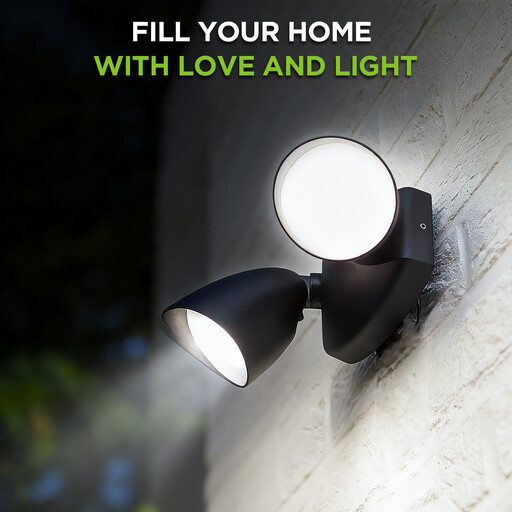
Why this product suits this profile: This wall-mounted dual-head light is designed for permanent outdoor installation on patios, in gardens or courtyards, and provides neutral white light.
Two light heads can make it easier to illuminate different areas. The product name specifies 20 watts, 1,800 lumens, 4,000 K and a housing made entirely of metal.
Dual-head design, 1,800 lumens and metal construction according to the product name. Check the specific IP rating and sensor range on the product page before buying.

Why this product suits this profile: This portable model with an integrated battery and magnet is suitable for flexible use on metal surfaces, patios or sheltered entrance areas.
With 300 lumens, 3,000 K, a USB charging cable and IP44 protection, this model is clearly intended for smaller, partially sheltered areas. It is not a substitute for an IP65 outdoor light in highly exposed locations.
Integrated battery, USB connection, magnetic mount, toggle switch and motion sensor in a compact design.
We have put together a complete, regularly updated list of products that fully meet these strict selection criteria and the safety regulations applicable in the EU.
An outdoor LED wall light should be securely mounted and positioned so that it does not unnecessarily dazzle neighbours or road users. For mains connections, electrical work must only be carried out by a suitably qualified professional. Solar and USB models are easier to install, but they also require a secure, weather-protected mounting point.
For solar lights, clean the panel and sensor window regularly with a soft, slightly damp cloth. Remove leaves, dust and cobwebs, as these can affect energy absorption or motion detection. For battery-powered lights, charge the battery according to the manufacturer’s instructions and later dispose of it properly at the designated collection points.
As a general guide, install it at a height of around two to two and a half metres. The exact height depends on the detection angle, range and area you want to illuminate. Test the sensor from several directions after installation.
IP44 is suitable for areas exposed to splashing water, such as beneath a sheltered roof. IP65 provides greater protection against dust and water jets and is often more suitable for outdoor areas that are more exposed to the elements. However, the IP rating alone is no substitute for correct installation.
A solar light does not use mains electricity when it receives sufficient sunlight. With mains-powered models, consumption mainly depends on the wattage and daily operating time. A motion sensor can limit how long the light remains on when the settings are configured appropriately.