
Lieferung heute & morgen

Qualitätsgarantie

Willkommens-Angebote freischalten: KOSTENLOSE Lieferung | Bis zu 80 % RABATT | Kostenlose 30-Tage-JoyPlus-Testphase
App herunterladen
An outdoor LED string light should decorate and illuminate your balcony, garden, terrace or house façade while coping with changeable weather. In practice, poor purchases are often caused not by the LED technology itself, but by unclear information on IP rating, length and power supply.
The term waterproof string light is used rather loosely in some listings. What really matters is the stated IP rating. An IP44 string light is protected against solid objects of 1 millimetre and larger, and against splashing water from various directions. It is not designed for immersion, standing water or unprotected plug connections.
For outdoor setups, you should also shield power adapters, battery boxes and cable joints from direct rain. A higher rating such as IP65 offers stronger protection against jets of water, but still doesn’t replace safe installation.
Before buying, check whether the total length refers to the illuminated section or the entire run including the supply lead. For a balcony with 4 metres of railing, a short battery-powered string light may suffice. For a house wall or a larger tree, however, length, LED spacing and number of light points all matter together.
A close LED spacing of, for example, 8 centimetres creates a more even spread of light than LEDs set far apart. Actual coverage also depends on how you install it.
A string light with 8 modes can offer effects such as flashing, waves, chasing or steady on. That’s handy for parties and seasonal decorations, but near a front door or in a bedroom it can be distracting. A memory function is useful if you want the last setting to be retained the next time you switch it on.
For a partially sheltered balcony or a covered terrace, an IP44 string light can be suitable. For more exposed areas, a higher rating such as IP65 is worth considering. The rating always applies to the components marked accordingly. The battery box or the mains plug may have different protection requirements.
Also note:
A mains-powered LED string light is suitable for longer operating times and semi-permanent installations near a socket. The products listed here use, depending on version, a 6 W or 9 W adapter.
A battery-powered string light offers more flexibility for balconies, camping, party areas or spots without a socket. The models below each require three AA batteries, which are not included. For regular use, check battery condition and the battery box regularly.
A solar garden string light uses daylight to charge and, on suitable models, switches on automatically. Actual run time depends on sunlight, season and the location of the solar panel. A shaded balcony may therefore be less suitable than an open area in the garden.
Cool white at around 6500 K looks similar to daylight and brings out contours. Warm white at around 3000 K is often chosen for softer outdoor Christmas lighting or decorative terrace lighting. A multicoloured string light is more suitable for parties, children’s areas and changeable festive décor.
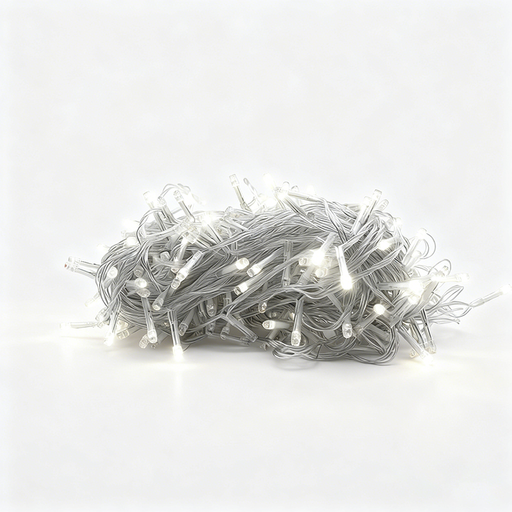
Why this product suits the profile: The 4‑metre, battery-powered string light is designed for small balconies, rooms, party tables or individual decorative areas. Three AA batteries power 50 cool-white LEDs; batteries must be purchased separately.
Clearly stated length, LED count, battery type and IP44 rating make planning easier. The battery box still needs protecting from moisture.
4 metres in length, 50 LEDs, 8 operating modes plus memory function, and flexible placement without a socket.

Why this product suits the profile: The meteor string light with 15 tubes is intended for larger trees, façades, shop windows or event spaces. 720 warm-white LEDs at 3000 K and coverage of 10 × 0.5 metres provide clearly defined technical parameters.
The 15 hanging points are spaced 70 centimetres apart. This makes installation easier to plan than with a string light that provides no information on layout.
720 LEDs, warm white colour temperature, 9 W adapter, memory mode, IP44 and a 5‑metre extension cable.
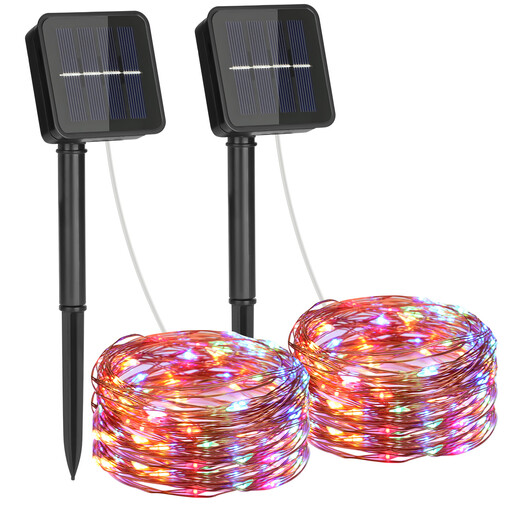
Why this product suits the profile: Two solar string lights, each 12 metres long with 120 LEDs, are suitable for gardens, terraces, balconies, weddings or seasonal decorations. The multicoloured version offers eight modes and automatic on/off.
Charging and run times are given as guide values: 6–8 hours’ charging and 8–14 hours of light, depending on the weather. That lets you assess the solar performance more realistically.
Two strings at 12 metres each, 240 LEDs in total, IP65, solar powered, 8 modes and a memory function.
We’ve compiled a complete, continuously updated list of products that fully meet these strict selection criteria and the safety regulations in force in the EU.
For an LED Christmas string light or an icicle string along the roof edge, you should define fixing points and cable routing in advance. With meteor string lights, the spacing of the hanging tubes is crucial. An 8‑tube version with 192 LEDs may make more sense for smaller areas than a model with 15 tubes and 720 LEDs.
Do not hang lighting near easily flammable materials. Mains-powered products should be disconnected from the power supply when not in use. With battery-powered versions, don’t mix old and new batteries or different battery types. Dispose of batteries after use at designated collection points.
For sheltered outdoor areas, IP44 is commonly used. This rating protects against splashing water, not immersion or permanently standing water. For more exposed mounting locations, IP65 can offer additional properties. What’s crucial is that all components are appropriately protected and correctly installed.
Run time depends on the number of LEDs, light mode, battery capacity and how often you use it. Flashing or dimming programmes can change consumption. As the batteries are not included with the models mentioned, use suitable AA batteries and keep the battery box dry.
Solar doesn’t require a socket during use, but it depends on sufficient sunlight. Mains power is more predictable for regular or long periods of lighting, but needs a suitable socket and safe cable routing. When deciding on cost, consider purchase price, duration of use, battery costs and local electricity prices together.