
Lieferung heute & morgen

Qualitätsgarantie

Willkommens-Angebote freischalten: KOSTENLOSE Lieferung | Bis zu 80 % RABATT | Kostenlose 30-Tage-JoyPlus-Testphase
App herunterladen
The right outdoor light with a motion sensor not only enhances your property's security but also adds convenience by automatically illuminating paths and entryways. However, the market is flooded with products whose marketing claims often leave you in the dark. Many buyers invest in lights that fail after just one winter or whose sensors are unreliable. Before you make a decision, it's important to know the most common pitfalls.
The 3 most common mistakes when buying outdoor lights with motion sensors:
solar light with motion sensor on a shady, north-facing wall will never work reliably. Buying a mains-powered light without an existing electrical connection leads to unexpected installation costs.To find a durable and functional outdoor light, you should focus on verifiable technical data rather than marketing buzzwords.
The IP (Ingress Protection) rating is one of the most important specifications for any waterproof outdoor wall light. It consists of two digits. The second digit is crucial for protection against water:
garden light with motion sensor. They are dust-tight and can also withstand a jet of water from any direction.Always look for an IP rating of at least IP44; for unprotected areas, IP65 is the recommended choice.
A light's output is measured not in watts, but in lumens (lm). Watts only indicate energy consumption.
LED outdoor floodlight with motion sensor or an LED floodlight for the garage typically falls into this category.The motion sensor should also be carefully examined:
The choice of power source depends entirely on your installation location and needs.
Here are some models that represent a considered choice for specific user profiles based on their objective specifications.
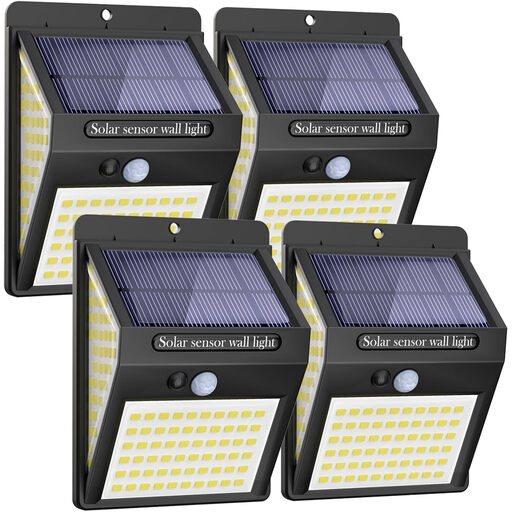
Why This Fits Their Persona: Ideal for users who want to illuminate multiple areas like garden paths, sheds, or back entrances affordably and without wiring. The 4-pack offers excellent value for money to get started.
With an IP65 rating, this light is protected against heavy rain, avoiding the trap of insufficient weather resistance. The solar power source eliminates installation costs.
No running costs thanks to solar power; three adjustable light modes for different needs; 270° wide illumination angle.

Why This Fits Their Persona: Perfect for homeowners who need to brightly illuminate large areas like driveways, garages, or the entire yard for deterrence and security. The high brightness and wide detection range are crucial here.
This model addresses the pitfall of an inadequate sensor. According to the manufacturer, it offers a detection range of up to 18 metres (60 feet) and a 180° angle, ensuring reliable coverage of large areas.
Very high brightness of 3000 lumens; three adjustable light heads for flexible illumination (270° coverage); IP65 rating for high weather resistance.

Why This Fits Their Persona: For anyone looking for simple, portable, and stylish lighting for a balcony, patio, or campsite. The freedom to install it without cables or drilling is the biggest advantage here.
This model solves the problem of an unsuitable power source. Thanks to the integrated battery (rechargeable via USB), you are completely independent of power outlets or sunlight and can place the light flexibly.
Integrated magnet for easy attachment to metal surfaces; IP44 rating for use in sheltered outdoor areas; warm white light (3000 K) for a pleasant atmosphere.
We have compiled a complete, up-to-date list of products that fully meet these strict selection criteria and local safety regulations.
A mounting height of about 2 to 3 metres is ideal in most cases. At this height, the sensor can cover a wide area without being constantly triggered by small animals on the ground. At the same time, the light is protected from easy tampering. Always follow the manufacturer's recommendations.
It depends on the mounting location. For a covered entryway or balcony, IP44 (protection against splashing water) is sufficient. However, if the light is mounted on an unprotected wall or in the garden and is exposed to heavy rain, snow, and wind, you should choose a light with at least IP65 (protection against jetting water) to ensure a long lifespan.
Modern LED outdoor wall lights with motion sensors are very energy-efficient. Since the light is only switched on for a short, preset time when motion is detected, the overall consumption is extremely low. A solar light with a motion sensor incurs no electricity costs after the initial purchase, as it draws its energy exclusively from the sun.