
Lieferung heute & morgen

Qualitätsgarantie

Willkommens-Angebote freischalten: KOSTENLOSE Lieferung | Bis zu 80 % RABATT | Kostenlose 30-Tage-JoyPlus-Testphase
App herunterladen
An outdoor light with a motion sensor can automatically illuminate entrances, garages, patios and driveways. However, when making your choice, it’s not just about high lumen counts or a striking design. What really counts is the installation location, weather protection, power supply and the actual range of the sensor.
Many buyers first look at the advertised brightness and overlook the technical details. The following points will help homeowners, tenants and business owners avoid common buying mistakes.
A 3000 lumen outdoor floodlight can brightly illuminate a large area. However, the brightness does not automatically tell you how far the motion sensor can detect people. For everyday usability, you also need to consider the detection angle, detection distance and the orientation of the sensor.
A light with a narrow beam angle may only cover a limited area, even with high light output. For a yard, garage or driveway, adjustable light heads and a wide beam angle are often more practical.
Terms like “waterproof” or “weatherproof” should not be taken at face value without checking the IP rating. An IP65 outdoor light is protected against dust and can withstand water jets from various directions. However, this does not mean it can be submerged in water or permanently installed in a pool of water.
For a sheltered entrance, an IP44 outdoor light may be sufficient. For exposed facades, carports or freestanding areas, a higher protection rating is usually more appropriate. The manufacturer’s installation instructions and intended mounting situation remain the deciding factors.
A solar outdoor light with a motion sensor needs enough direct sunlight to charge the battery regularly. Under a deep balcony, in the shade of a wall or on the north side, the available energy may be lower. Dirt on the solar panel also reduces light intake.
A battery-powered outdoor light, on the other hand, offers flexible placement but must be recharged regularly via USB or a charger. So before you buy, you need to know whether your installation spot has a mains connection, enough sunlight or easy access for charging.
Check the IP rating to match the installation location. A covered patio has different requirements from an exposed driveway. Plastic housings can be lightweight and corrosion-resistant; aluminium is often used for permanently installed lights. What matters are the manufacturer’s specific details on material, installation and temperature range.
Light output is given in lumens. For a small entrance area, 300 lumens may be enough, while a yard or a wide garage needs higher light output. The colour temperature affects the ambience: 3000 Kelvin produces warm white light, while 4000 Kelvin appears more neutral. The model with 7000 Kelvin from the selection below is noticeably cooler and should be assessed based on your intended use.
Also pay attention to adjustable heads, the beam angle and the mounting height. An outdoor floodlight with a sensor should cover the desired area without being constantly triggered by passing cars or moving branches.
A motion sensor reacts to heat movement and needs a clear line of sight. Walls, large plants or unfavourable mounting angles can restrict detection. Look for details on range and angle, such as 180° detection at a specific distance.
With a hardwired LED outdoor wall light, the light is always ready to operate, independent of a battery. Solar and USB models offer more flexibility but require a realistic assessment of charging conditions and usage time.
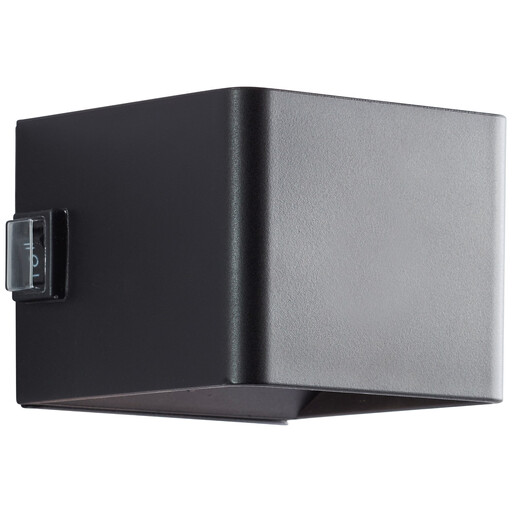
Why this product fits the profile: This compact, portable light works with an integrated battery, USB connection and magnetic mount. With 300 lumens and 3000 Kelvin, it is suitable for smaller entrance, patio or garden areas without a fixed mains connection.
The technical specifications clearly state light output, colour temperature, battery, sensor and IP44. This makes it easier to assess suitability for a sheltered outdoor area than with a purely marketing claim.
Integrated battery, USB charging, magnetic mount, motion sensor and 300 lumens at 3000 Kelvin.
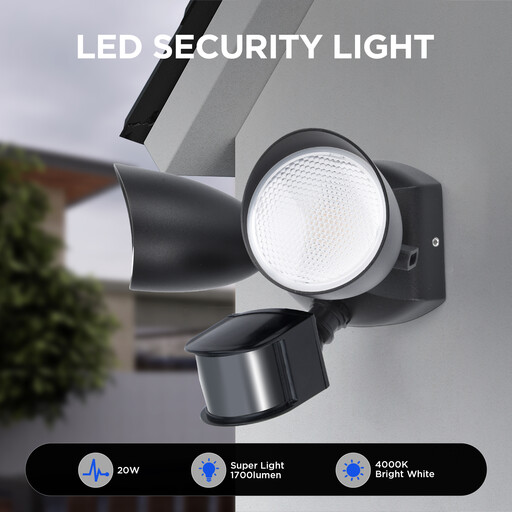
Why this product fits the profile: This hardwired outdoor floodlight is designed with 20 watts, 1700 lumens, 4000 Kelvin and two light heads for a more brightly lit outdoor area. It suits yards, driveways or larger wall spaces.
The selection is based on concrete performance data rather than just the term “security light”. Two heads can make alignment easier; the final coverage depends on mounting height and wall position.
1700 lumens, 4000 Kelvin, 20 watts, integrated LED and two adjustable light heads according to the product description.
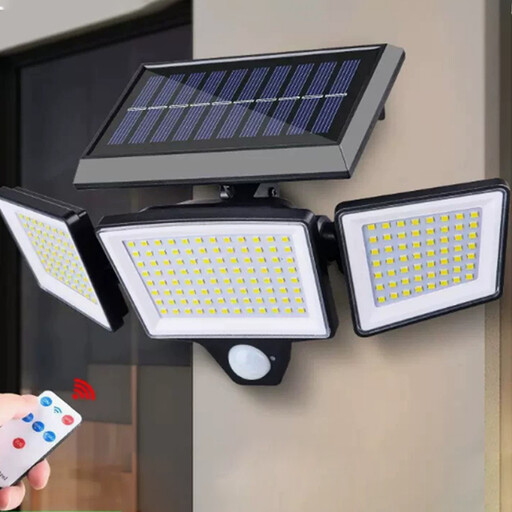
Why this product fits the profile: For larger gardens, yards, garages or driveways, this model combines solar operation, three light heads and three operating modes. It is specified with 3000 lumens, a 180° sensor angle, 60 feet detection distance and a 270° coverage area for the heads.
The specifications separate light output, sensor range, angle, battery and IP65 protection rating. Before installation, you should still check whether the solar panel receives several hours of direct sunlight.
302 LEDs, 3000 lumens, 1800 mAh lithium-ion battery, three operating modes and IP65 protection rating according to the product specifications.
We have put together a complete, regularly updated list of products that fully meet these strict selection criteria and the safety regulations in force in the EU.
The right height depends on the model, detection angle and local conditions. A mounting height above direct eye level is often chosen so that the sensor covers the walking path and the light cannot be easily knocked out of position. The manufacturer’s installation instructions for your specific model remain the deciding factor.
The lifespan depends on factors including operating time, heat dissipation, electronics, battery and weather conditions. For solar and battery lights, the energy storage unit is an additional wear factor. A specific lifespan should only be relied upon if it is stated in the technical product data.
A light with a motion sensor is only switched on when activated, unless a constant light mode is used. Running costs depend on the wattage, daily activation time and your electricity tariff. With solar lights, there is no mains power consumption during operation, but sunlight, battery capacity and weather conditions affect the available lighting duration.